
SafetyWing, World Nomads, Genki, Heymondo, IMG, Seven Corners, Trawick, Tokio Marine, and Blue Cross Blue Shield compared

In the life of a nomad, freely wandering abroad from place to place can be both exciting and intimidating. Living without the normal safety net of home, without friends or family to call on when you’re sick, or not knowing a familiar hospital to visit for check-ups, accidents, or illness adds a potentially uncomfortable wrinkle in an otherwise dream lifestyle.
To bridge that gap in support, help when injuries or mishaps happen, and to ensure that when accidents do happen they can be handled smoothly enough as not to derail your adventure, travel health insurance and nomad health insurance are essential. Not only does the relatively small monthly premium ensure that an unexpected accident potentially costing thousands of dollars doesn’t break the bank and send you home early, but with the best travel insurance options, you know that you will always have someone to contact for health assistance who knows their way around your situation as a solo wanderer abroad, ready to provide several options for places to visit for treatment.
So, we can agree that if you’re traveling abroad, you absolutely need a health insurance option suitable for travelers and nomads, but which provider specifically?
In this guide, we’ll cover the top ten health insurance providers for nomads that offer tailored insurance covering health, accidents, and the calamities that happen when we wander, to help you decide which best fits you and your long-term solo trip.
(Information current as of October 2026)
This article contains affiliate links, but prioritizes sharing objective information and helping you find the right coverage for you.
For expats and flexpats living abroad in a single location long term, also read our Guide to the Best Expat Health Insurance Providers.

Table of Contents
My Experience: Health insurance tailored to long travel and a nomadic life is absolutely necessary
In the decade I’ve lived and traveled abroad, I’ve witnessed and experienced so many amazing things, exciting things, and bucket list worth things, but not everything that I’ve witnessed has been all roses.
While I have been lucky enough to never suffer anything more than scrapes and bruises, friends of mine haven’t been so lucky. From the guy that trekked to Everest Base Camp too quickly and needed to be evacuated by helicopter due to altitude sickness (and his lungs filling with fluid), to the freediver in Bali who blacked out underwater and, unfortunately, died because he didn’t have proper travel insurance to pay for medical evacuation, to the Australian friend that suffered a brain bleed after crashing his motorbike in and was then forced to max out his credit card or be kicked out of the hospital (despite his brain still bleeding) because he, as well, didn’t have travel insurance, I’ve seen more times I can count why health and accident insurance tailored to a life abroad is so pivotal – for your health, your life, and your bank account. It is better to pay $100 a month to adventure without worries than get hit with a $25,000 bill for a life flight because your current hospital and country aren’t equipped for how critical your situation is.
While I personally manage risk enough that I have rarely had to use travel insurance, and never for any large situations, and I keep my ongoing health tip-top via medical tourism, as a savvy financial planner, I always maintain travel insurance whenever and wherever I wander – for life, limb, and avoiding a massive hit to the bank account in the case that a life-threatening situation ever does befall me.
You, as a carefree wanderer that wants to stay healthy, happy, and financially responsible, should maintain proper and adequate health insurance friendly to how nomadic types live and travel.
Now that we can agree that you do need travel insurance, let’s review the best options available.
Comparison Table: A quick review of the best nomad health insurance providers and plans
Provider | Longest trip or term | Medical limit | Deductible | Pre-existing conditions | Buy while abroad | Published price | Trustpilot |
1. SafetyWing | Essential 364 days; Complete renews indefinitely | US$250,000 (Essential) | None | Excluded on Essential | Yes | US$62.72 per 4 weeks (Essential), US$177.50 a month (Complete), ages 18 to 39 | 4.3 (4,220) |
2. World Nomads | 180 days single trip; 45 days per trip annually (US) | US$125,000 Standard, US$150,000 Explorer | Not stated | Excluded | Yes | ** | 4.2 (6,662) |
3. Genki Traveler | Up to 12 months | EUR 1,000,000 | EUR 50 | Excluded | Yes | ** | 4.2 (991) |
4. Heymondo Long Stay | Starts at 90 days, renews in terms up to 275 days | US$2,500,000 | US$250 | Excluded | Not stated | US$162 for the first 90 days (worldwide except USA) | 4.3 (3,930) |
5. IMG Patriot | Not stated | US$50,000 to US$1M (Lite, Plus); US$2M to US$8M (Platinum) | ** | Exclusion in IMG disclaimers | Not stated | ** | 4.6 (25,375) |
6. Seven Corners | 30, 45, or 60 days per trip (annual plan) | US$1M up to age 69; US$100,000 at 70 to 79 | US$0, US$250, or US$500 | Acute onset up to US$20,000 (age 69 and under) | Not stated | ** | 4.5 (6,364) |
7. Trawick | Outbound 180 days; International 364 days | US$50,000 to US$500,000 (Outbound); to US$1M (International) | US$0 to US$5,000 (International) | Unexpected recurrence on International; stable pre-existing on Complete | Not stated | US$20 minimum premium per person | 4.4 (1,726) |
8. BCBS Global Solutions | Single trip 182 days; multi-trip 70 days per trip | Not stated | Not stated | Options on Single Trip; included on Multi-Trip | Not stated | Quote required | 2.3 (52) |
9. Allianz Partners | AllTrips 45 days (Prime) or 90 days (Premier); OneTrip 180 days | US$20,000 (Prime); US$50,000 (Premier) | Not stated | Not stated | No | Plans from US$27 (trip entry price) | 4.1 (200,893) |
10. Tokio Marine HCC Atlas | Not stated | Atlas Premium up to US$2M | Not stated | Not stated | Not stated | Quote required | 1.7 (57) |
Trustpilot notes: Scores reflect self-selected reviewers of the whole company, not only the plan in this article. IMG’s score covers all IMG products, Allianz’s covers its US travel insurance site, and the BCBS Global Solutions and Tokio Marine HCC pages hold few reviews (52 and 57, on an older or corporate domain).
What Travel Insurance Covers and Why Nomads Need It
Travel insurance is short-term health and mishap insurance coverage for trips outside your country of residence, meant to cover emergency and unexpected health incidents, not routine care. Additionally, it usually has coverage for evacuation and response for issues like medical emergencies, natural disasters, and political unrest.
Trave insurance typically pays emergency medical bills and medical evacuation, and some plans add trip cancellation, lost baggage, and delay benefits, but the coverage design assumes you have a home, and home country medical covereage, and will return to it.
Cigna describes the split this way: travel insurance suits a holiday and usually runs six months or less, while international health insurance suits expats who work and live abroad, usually on 12-month terms (Cigna Global’s comparison). While your home country health insurance likely covers routine and emergency medical, but likely only within a specific geographic area or your home country.
For nomads, the exposure to health risks grows with time and movement. You may spend four months in Portugal, three in Thailand, and two in Mexico, then repeat the circuit. Every extra day abroad adds exposure to road accidents, tropical illness, and injuries from the activities you chose the lifestyle for, especially when you’re changing environments constantly. Most domestic health plans pay little to nothing abroad, and credit card protection rarely covers beyond lost baggage and delayed travel and rarely covers major medical events, so check your own policies before you rely on them. For a primer on cost and coverage, see our guide to whether you need travel insurance and what it costs.
Travel insurance bridges the period between leaving your home country’s coverage and qualifying for coverage in a host country. The problem is that most plans were not built for people who stay on that bridge indefinitely.
When Expat Health Insurance Is the Better Choice
If you stay in one country for more than six months, or you have established tax residency there, price an expat health plan first. Expat plans renew annually, include routine and preventive care, and do not run on trip-length limits. Travel plans assume you are a visitor, and some will not sell to you once you are not.
Two examples from the providers below show how this plays out. Trawick’s Safe Travels International is not available to anyone who has lived outside their home country for more than 365 days before the start date. Allianz tells buyers they cannot purchase a new plan while they are already traveling, and recommends returning home before a 180-day trip runs out.
Where it gets complicated for flexpats: If you split time among two or three countries without residency anywhere, you sit between product categories. Some nomads keep an expat plan as their base and use a travel plan only for gaps. Others rotate travel plans and renew before each limit. Check each plan’s maximum trip length and eligibility wording before you buy, because the rules differ from provider to provider.
Rule of thumb: Rotating through 90-day stays in different countries keeps travel insurance workable. A base of a year or more in one country points to expat cover. See the long-term visa and residency directory for the insurance rules attached to your visa.
Read our full list of the Best Expat Health Insurance Options for Living Abroad.
Exclusions That Void Nomad Claims
Travel policies often carry exclusions that conflict with how nomads live and that you should be aware of. Read and understand these dealbreakers before signing up for a plan.
Motor and scooter rules: Policies tie medical coverage while on a motorbike to your licensing and the safety equipment you use and wear. Simply put, always wear a helmet, and drive a motorbike (or expect to be covered) if you don’t have a motorbike endorsement for your license in that country, or have the same in your home country and an International Driving Permit, and that setup meets the demands of local law. And never drink alcohol and drive.
SafetyWing covers motor accidents only if you are properly licensed, wear all safety equipment, and are not intoxicated. Confirm that the license on your policy matches the engine size you ride.
Activity and depth limits: Coverage varies and tops out with specific activities, adventure sports, and their thresholds. SCUBA diving, skydiving, high altitude trekking, and bungee jumping are a few of the several. Additionally, hiking above a certain altitude or SCUBA diving below a certain depth, or without the additional coverage, means you are not covered during that activity. Full activity lists decide what you can claim for. World Nomads lists more than 150 adventure activities, SafetyWing sells an adventure sports add-on at US$10 per 28 days, and SafetyWing covers scuba to the depth you or your instructor is licensed for. Check trekking altitude and dive depth against the policy’s activity list before you book.
Pre-existing conditions: Most plans below exclude them, cover only an acute flare-up, or sell cover for them at extra cost, and if you try to claim disregarding this fine print, your claim will likely be denied. Trawick’s definition of a pre-existing condition looks back for injuries and issues three years from the policy effective date. A condition that appears abroad can become pre-existing the next time you buy a new policy, which is why automatically renewing policies within the same policy on a trip are crucial.
Trip length and residency: Each plan fixes a maximum trip length, and coverage ends when you pass it. Plans below range from 30, 45, or 60 days per trip (Seven Corners annual) to 364 days (SafetyWing Essential, Trawick). Policies may also restrict abroad long-term buyers.
Read the terms and limits of the policy and think about your pattern of travel, then compare plans. The gap between what you assume is covered and what the policy pays shows up when you are in a hospital bed asking for pre-authorization.
Pricing: Premiums depend on age, destination, trip length, deductible, and whether you include the United States. This guide gives each premium line with its source, date, and profile. Prices from an insurer’s own site come first. Where an insurer publishes no price, the line says so, and you will need a quote to get any price estimate. When you shop around, be sure to request a quote for the same personal profile across three providers, at least, and compare.
Now, on to the best nomad health insurance options, for every need and type of nomad.
Insurance Options Designed for Nomads and Extended Travels
These plans are sold online, renew by month or by term, and do not require you to live in the country you purchase from.

1. SafetyWing Nomad Insurance
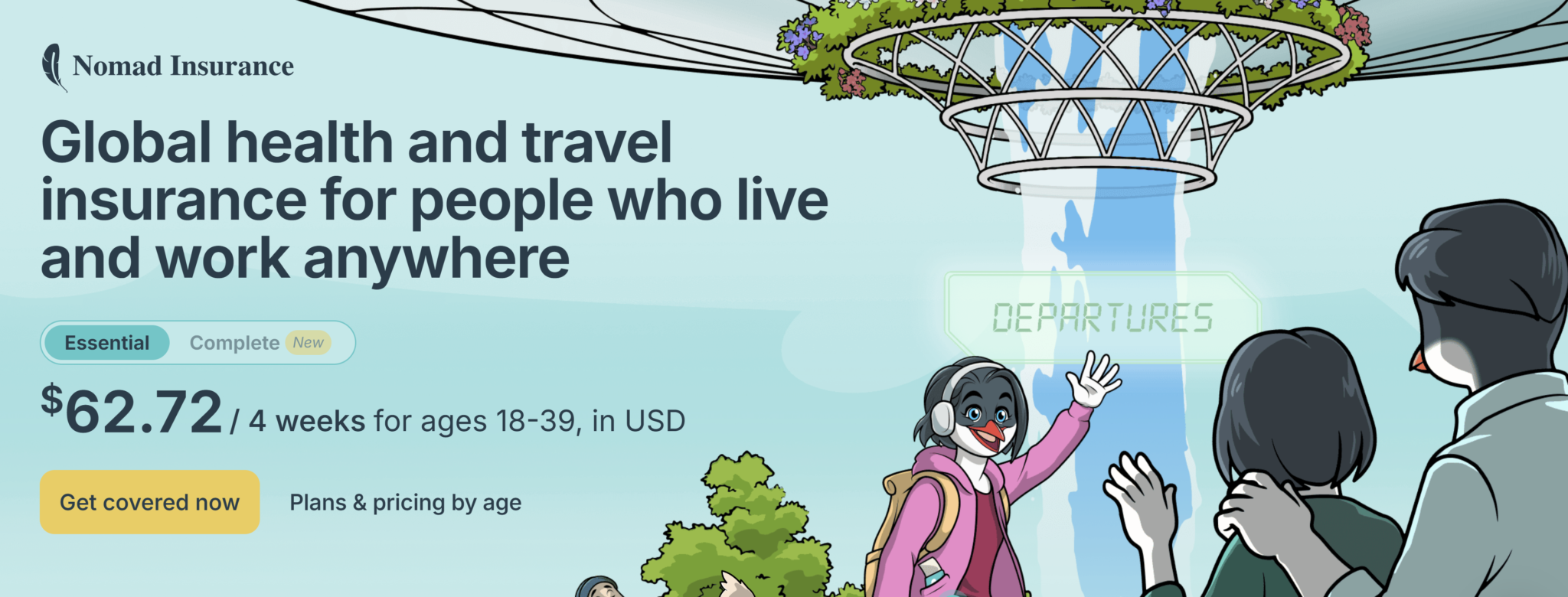
SafetyWing sells two plans to people who live and work anywhere: Essential, a travel insurance plan, and Complete, a full health plan. SafetyWing Insurance I.I., a Puerto Rico-domiciled international insurer, underwrites the plans, and certain health benefits are underwritten by VUMI, also in Puerto Rico. You can buy SafetyWing coverage before you leave or while you are already abroad.
SafetyWing is Best for: Healthy nomads who move often and want to buy coverage online while already abroad.
Plans and limits:
Safetywing Essential Coverage
- Covers new, unexpected illness and injury while traveling, with a US$250,000 overall limit and no deductible. Each policy covers up to 364 days at a time, extended in monthly increments. At the end of one year, you have to start a new policy.
HERE HERE - Covers evacuation to a better-equipped hospital, when necessary, with a US$100,000 lifetime maximum. This would happen if the hospital or country isn’t equipped or prepared to provide the treatment, and covers costly medical evacuation flights.
- Home country medical coverage is partially provided, up to 30 days per 90-day period, or 15 days if your home country is the US.
SafetyWing Complete Coverage
- Renewable indefinitely, adds routine care, mental health support, cancer treatment, and has no home country restrictions.
- Offers maternity coverage: Covers up to $2,500 for pregnancy and childbirth costs after a 10-month waiting period, and up to US$50,000 for newborn care and complications.
- Has an optional adventure sports add-on: US$10 per 28 days on subscription plans. Paying in full for specific dates saves 10%.
Claims: SafetyWing reimburses by bank transfer, typically within 10 business days after the claims team confirms the payment. Support runs 24/7 by live chat. SafetyWing cites coverage in 180+ countries, and US coverage is extra.
Premiums: Essential costs US$62.72 per four weeks for ages 18 to 39, about US$816 a year over 13 four-week periods. Complete costs US$177.50 a month for ages 18 to 39, or US$2,130 a year. Both are SafetyWing’s published rates, read on its site on 26 October 2026, and they rise with age.
Customer ratings: Trustpilot shows 4.3 out of 5 from 4,220 reviews (74% five-star, 16% one-star), read on 26 October 2026. (Source: Trustpilot)
Pros: Online purchase from anywhere, no deductible, and a Complete plan with maternity care, routine care, and cancer treatment.
Cons: Essential excludes pre-existing conditions, maternity, and cancer treatment, and it caps total benefits at US$250,000.
Gotchas: Essential covers pregnancy emergencies only, such as ectopic pregnancy or miscarriage in the first 26 weeks. Read the Complete plan’s pre-approval list and its pre-existing condition FAQ before considering this coverage.
For a full walkthrough, read Our SafetyWing review.
Official site: SafetyWing Nomad Insurance | ABA review: SafetyWing travel insurance review
2. World Nomads
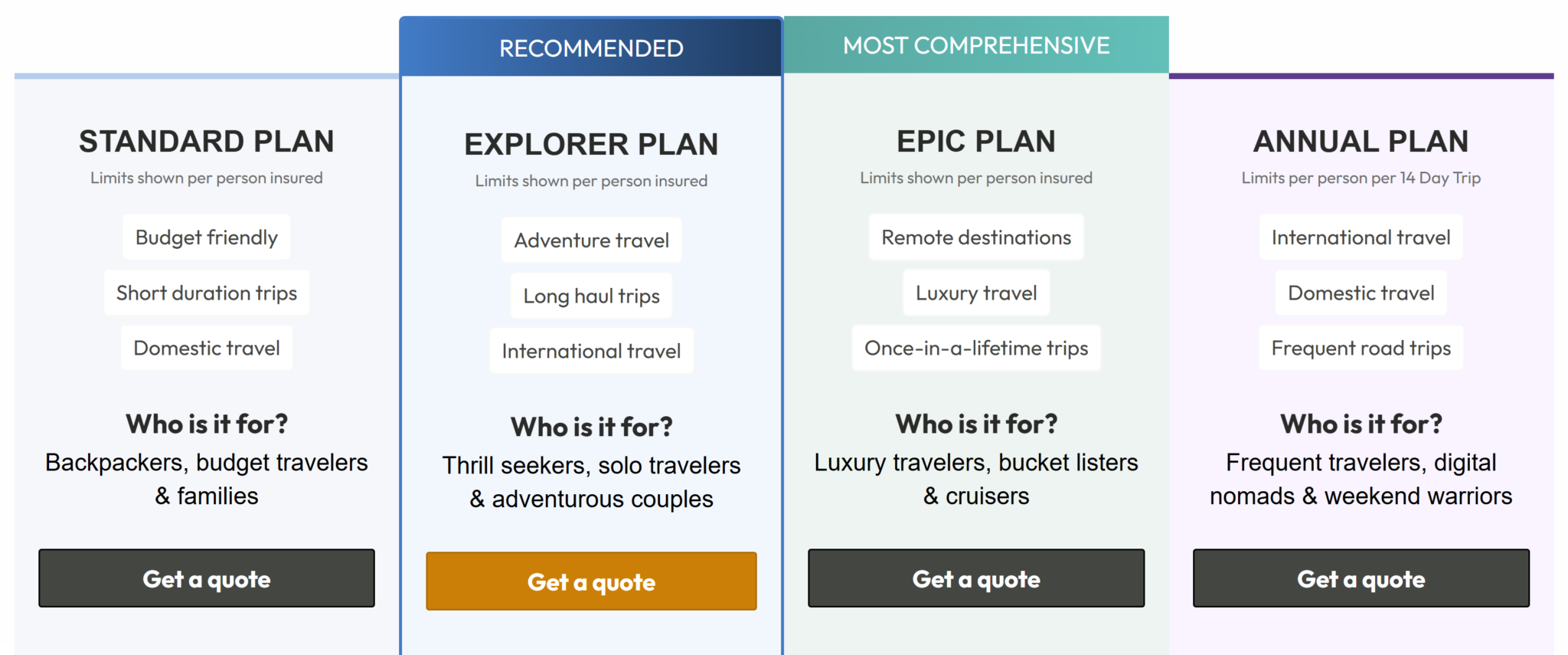
World Nomads sells single-trip plans called Standard and Explorer, plus Epic (for US residents) and Annual Multi-Trip plans (US, Canada, and UK), and you can buy at home or while traveling. In the US, United States Fire Insurance Company underwrites the plans, marketed through Trip Mate, a Generali Global Assistance and Insurance Services brand. Underwriters differ by country of residence.
Best for: Nomads who do adventure activities and want cover they can buy and extend while already abroad.
Plans and limits (US single-trip plans):
- Standard: Emergency medical limit US$125,000, trips of one to 180 days.
- Explorer: Emergency medical limit US$150,000, trips of one to 180 days, with more activities covered than Standard.
- Annual Multi-Trip: up to 45 days per trip.
- Activities: The main page cites 150+ adventure activities. Other World Nomads pages say 200 and 250, so count against the activity list for your plan.
- Buying: You can purchase before or during your trip and extend while you are away.
Claims: You can claim online from anywhere.
Premiums: World Nomads shows prices only after you enter your country, trip dates, and ages in its quote tool.
Customer ratings: Trustpilot shows 4.2 out of 5 from 6,662 reviews (63% five-star, 18% one-star), read on 26 October 2026. Source: Trustpilot.
Pros: Wide activity coverage, allows purchasing while traveling, and plans for single trips and annual multi-trip use.
Cons: US single-trip plans max out at 180 days, and medical coverage limits are in the low six figures (USD).
Gotchas: World Nomads excludes pre-existing medical conditions. Coverage and plan availability depend on your country of residence (where you live, have long-term coverage, have unlimited rights of entry, and would be repatriated to), so quote from the right country page. Your policy wording governs electronics and baggage limits.
Official site: World Nomads travel insurance | Get a quote: World Nomads instant quote
3. Genki Traveler
Genki Traveler is a monthly travel medical subscription that is designed for and targets digital nomads. Squarelife is the insurer, and Genki acts as the agent and group policyholder. Genki pays for treatment at any licensed doctor or hospital worldwide. Genki offers two separate types of coverage: Genki Traveler and Genki Native, with a Basic and Premium level under Native.
Genki Traveler is a travel policy that lasts up to one year and excludes pre-existing conditions. Genki Native is long-term expat health insurance with no end date, a medical questionnaire, and more robust benefits.
Differences between Genki Traveler and Genki Native
What Native adds over Traveler
- No end date. Traveler lasts up to one year and cannot be extended. Native has no fixed term, runs from one month to life, and can be cancelled monthly after the first month.
- Pre-existing conditions can be covered. Traveler excludes them. Native uses a medical questionnaire, and a condition may be covered, accepted with exclusions, priced higher, or rejected. Genki also says that if you re-sign for Traveler after a subscription ends, earlier conditions are excluded.
- Better home country cover. Traveler covers only emergencies at home, for the first six weeks of each stay. Native Basic gives full cover for up to 182 days per visit after at least 91 days abroad. Native Premium covers your country of nationality in full, except the USA.
- Broader sports cover. Native covers all sports except professional ones. Traveler excludes professional sports and high-risk activities such as BASE jumping and wingsuit flying.
- A higher limit on Premium. Traveler and Native Basic both cap at €1,000,000 per insurance year. Native Premium raises it to €3,500,000 and adds preventive care, dental, vision, maternity, mental health, and alternative care.
- No fixed deductible on Native. Traveler charges €50 per case for outside hospital stays. Native has none by default, and you can choose a €500 or €1,000 annual deductible to cut the price.
What Native costs you
- Price. Genki’s example for a 24-year-old is €52.50 a month for Traveler, €189 for Native Basic and €285 for Native Premium. Prices vary with age, region, deductible, and health answers.
- Age at sign-up. You must be 55 or younger to start Native, against 69 for Traveler. Once covered, there is no upper age limit.
- US coverage is limited. Native covers the US only for emergencies that begin within 91 days of arrival, after at least 91 days outside the US, with a 3-month waiting period. The annual US limit is €250,000 on Basic and €500,000 on Premium.
When to pick Native
- You live abroad or travel indefinitely and have no long-term health cover at home.
- You have a condition you want assessed and possibly covered.
- You want cover for routine care, and Premium adds dental and preventive care.
- You return to your home country often and need real cover there.
When Traveler is enough
- You plan to travel up to a year and then go home to existing long-term cover.
- You are over 55 and cannot start Native.
- You want the lowest monthly price and have no pre-existing conditions.
Best for: Nomads who want a monthly plan with a low deductible and cover for up to 12 months.
Simplified Plan terms:
- Medical cover up to EUR 1,000,000.
- Deductible: EUR 50.
- Duration: up to 12 months of cover.
- Worldwide, with a list of countries that have limited cover.
- Waiting period of up to 14 days, and cover ends after medical repatriation.
Premiums: €52.50 per month for a 24-year-old and €63.90 per month for a 30-year-old on the Genki Traveler plan.
/ month. Customer ratings: Trustpilot shows 4.2 out of 5 from 991 reviews (77% five-star, 14% one-star), read on 26 October 2026. Source: Trustpilot.
Pros: Low deductible, a 12-month maximum, and an online sign-up that works while abroad.
Cons: Genki Traveler excludes prior health conditions and shows its price only inside the sign-up flow.
Gotchas: Check the countries with limited coverage, the age limits, and the 14-day waiting period before you pay. Genki’s long-term plan, Genki Native, covers more but is an expat health plan, not travel insurance.
Official site: Genki Traveler | Check price and sign up: Genki Traveler sign-up
4. Heymondo Long Stay
Heymondo sells a Long Stay plan for trips of 90 days and longer.
Best for: Nomads who want a priced 90-day start and renewals in 30 to 275 day terms.
Plan terms:
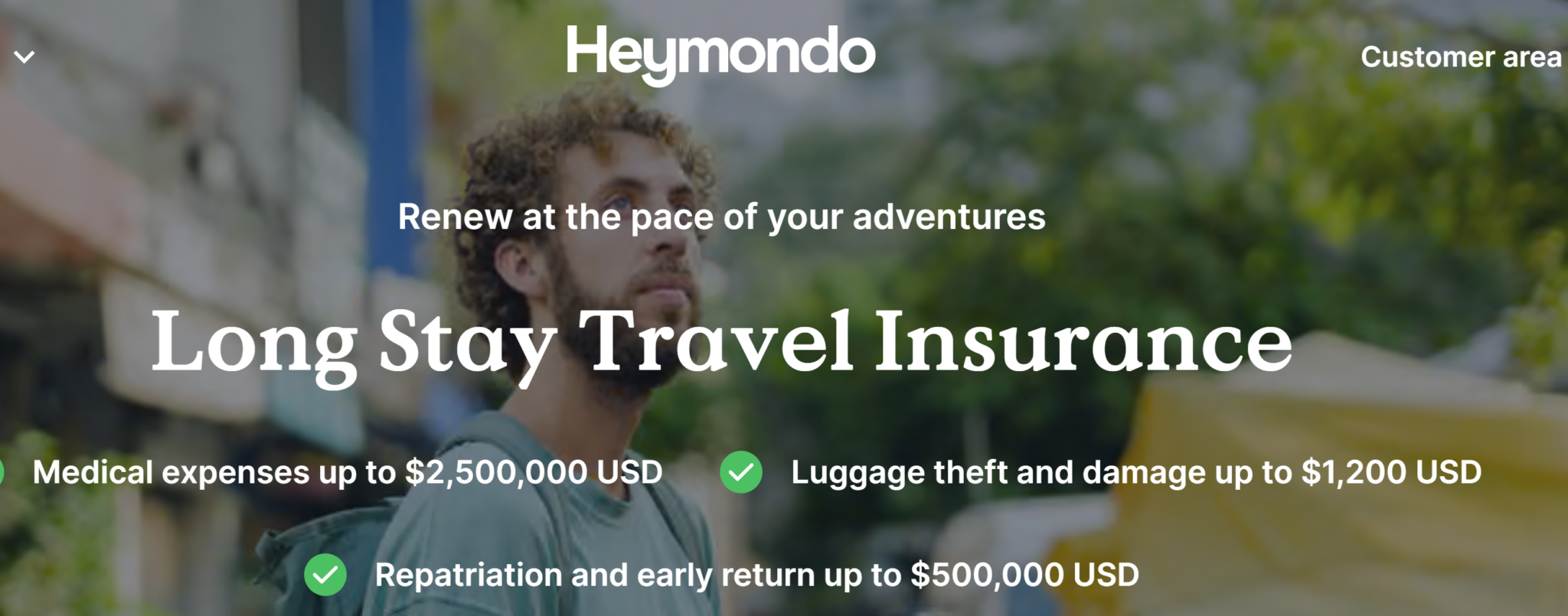
- Medical cover up to US$2,500,000 for emergency medical and dental expenses overseas.
- Excess: US$250, applied to medical expenses only.
- Purchases start at 90 days. Renewals run in 30, 120, 180, and 275 day terms.
- Worldwide coverage, with armed conflict zones excluded. The USA is covered only in the higher-priced option.
Premiums: Heymondo’s published Long Stay prices, as of publication, are: the first 90 days cost $162 (USD) worldwide except the USA, or $296 including the USA. Renewals for worldwide except USA and worldwide including USA are: 30 days US$54 and US$87, 120 days $215 and $350, 180 days $323 and $525, and 275 days $491 and $841.
Customer ratings: Trustpilot shows 4.3 out of 5 from 3,930 reviews (75% five-star, 12% one-star), read on 26 October 2026. Source: Trustpilot.
Pros: Published prices by term, a US$2.5 million medical limit, and flexible renewal terms.
Cons: Heymondo cites an age limit of 49, and its pages do not make clear whether that applies to Long Stay.
Gotchas: Heymondo says its policies do not cover routine medical checkups or pre-existing medical conditions.
Official site: Heymondo Long Stay
Travel Medical Specialists
These providers sell travel medical plans with selectable limits and deductibles. Most are built for people who live in one country and travel out of it.
5. IMG Patriot Travel Series
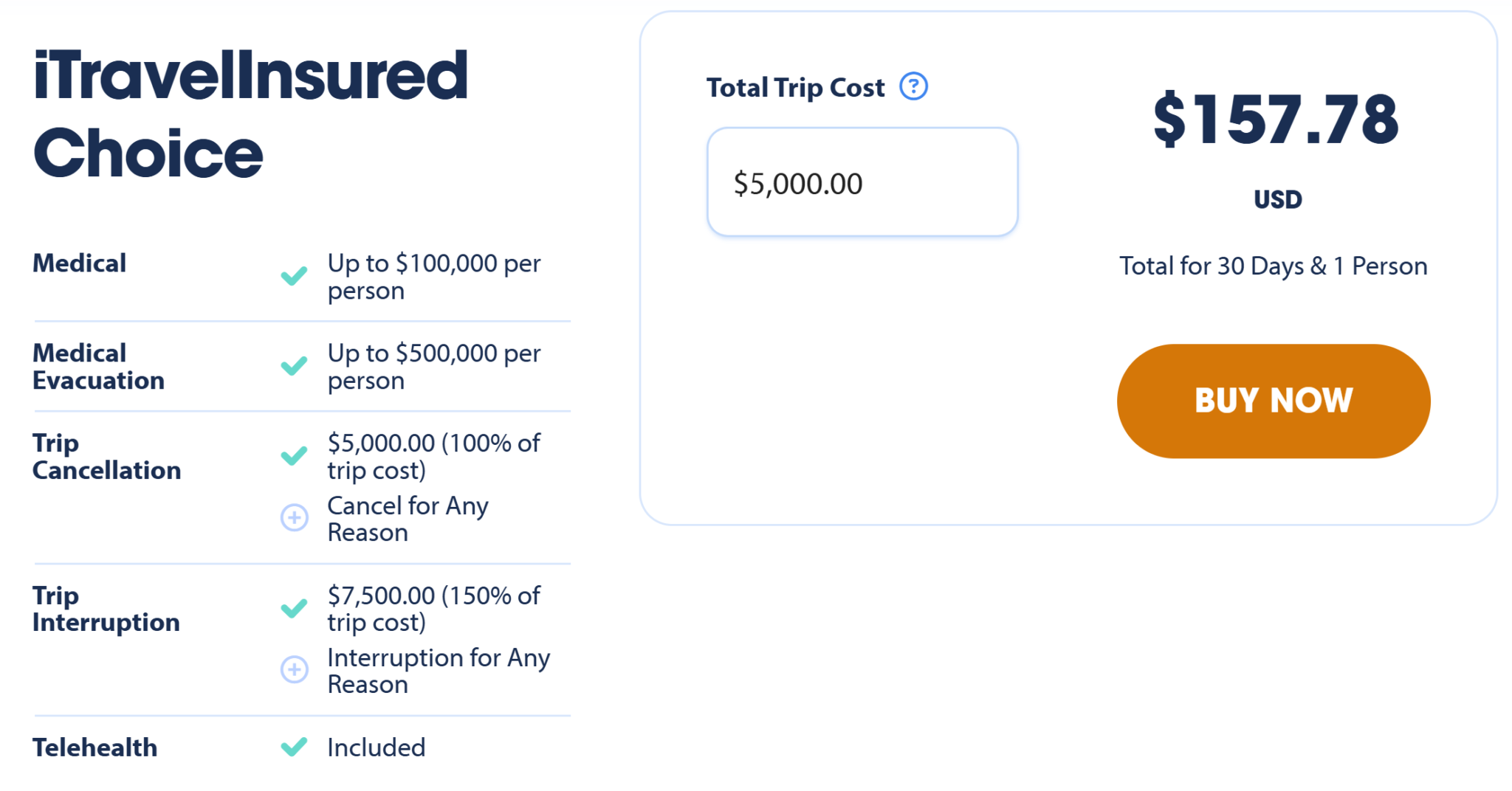
International Medical Group (IMG) is based in Indiana, and its Patriot Travel series covers people traveling outside their home country for business or pleasure. IMG’s iTravelInsured plans are separate trip protection products that cover cancellation and delay.
Best for: Travelers who want a selectable medical limit and a plan that offers an upgrade to US$8 million.
Plans and limits:
- Patriot Lite and Patriot Plus: Medical limits from US$50,000 to US$1,000,000, evacuation up to US$1,000,000, telehealth as an optional add-on.
- Patriot Platinum: Medical limits from US$2,000,000 to US$8,000,000, evacuation up to US$8,000,000, telehealth included, and optional trip cancellation and interruption.
- Other travel medical plans on the site: Patriot Multi-Trip, Patriot Exchange Program, Visitors Care, and student plans.
Premiums: $81.38 USD for a 30 year old on Patriot Platinum, with a $0 deductible and $2,000,000 of coverage.
Customer ratings: Trustpilot shows 4.6 out of 5 from 25,375 reviews (80% five-star, 5% one-star), as of 26 October 2026. The score covers all IMG products, not only Patriot. Source: Trustpilot.
Pros: A wide range of medical limits and a high-limit Platinum plan.
Cons: IMG’s plan pages do not show deductibles, maximum trip length, or mental health limits, so you need the plan documents and you’ll have to toggle around when selecting quotes to find where your needs and needed value meet.
Gotchas: IMG’s travel pages carry an exclusion for pre-existing medical conditions. Download the plan documents for deductible options, maximum coverage length, and rules on buying after you have left home, because the site does not state them.
Official site: IMG travel medical insurance | Get a quote: Patriot Platinum plan and price
6. Seven Corners
Seven Corners is based in Carmel, Indiana, and sells travel medical, trip protection, and an Expat and Nomad Health Insurance plan. HDI Global Specialty SE underwrites its Travel Medical Annual Multi-Trip plan and carries an A+ (Superior) rating from AM Best (2024).
Best for: Travelers who take several short trips a year, and US residents who live abroad and want one plan.
Plans and limits:
- Travel Medical Annual Multi-Trip: medical maximum US$1,000,000 up to age 69 and US$100,000 for ages 70 to 79.
- Deductible: US$0, US$250, or US$500.
- Trip length: 30, 45, or 60 days per trip. A trip ends when you return home or stay abroad longer than the length you bought.
- Acute onset of pre-existing conditions: up to US$20,000 for travelers 69 and under and US$5,000 for ages 70 to 79.
- Expat and Nomad Health Insurance: for US residents living and traveling abroad long term, with no time limit stated.
Premiums: Travel Medical Annual Multi-trip is quoted as $243 per month for a 30 year old. Expat & Nomad insurance requires contacting a licensed agent for a custom quote.
Customer ratings: Trustpilot shows 4.5 out of 5 from 6,364 reviews (71% five-star, 13% one-star), read on 26 October 2026. Source: Trustpilot.
Pros: A US$1 million medical limit, low deductible options, a pre-existing acute onset benefit, and a separate long-term plan.
Cons: The annual plan applies only to travel outside the United States and ends each trip at 30, 45, or 60 days.
Gotchas: The annual plan excludes the United States and several countries, including Cuba, Iran, Russia, and Ukraine. The Expat and Nomad plan page lists no limits, deductibles, or underwriter, so call Seven Corners at 800-335-0611 for the schedule.
Official site: Travel Medical Annual Multi-Trip | Long-term option: Expat and0020Nomad Health Insurance
7. Trawick International
Trawick sells separate travel medical plans depending on who you are and where you live. Safe Travels Outbound is for US citizens and residents who live in the USA. Safe Travels International is for non-US citizens and residents traveling outside their home country, excluding the USA. Trawick says it was named International Travel and Health Insurer of the Year at the ITIJ Awards.
Best for: US residents on trips of up to 180 days, and non-US nomads who have lived abroad for less than a year.
Plans and limits:
- Safe Travels Outbound: for people who live in the USA, trips up to 180 days, medical maximums of US$50,000, US$100,000, US$250,000, or US$500,000, emergency medical evacuation US$500,000.
- Safe Travels International: ages 14 days to 89 years, medical maximums from US$50,000 to US$1,000,000, deductibles from US$0 to US$5,000, trips of 5 to 364 days.
- Safe Travels International Cost Saver: same maximums, with 80% co-insurance on the first US$5,000, and COVID-19 excluded.
- Safe Travels Complete: for non-US citizens visiting the USA, with a stable pre-existing condition benefit.
Premiums: Trawick Safe Travel International (for non-US residents) quotes $64.79 per month. Safe Travels Outbound (for US residents) quotes $45.57 per month.
Customer ratings: Trustpilot shows 4.4 out of 5 from 1,726 reviews (72% five-star, 17% one-star), read on 26 October 2026. Source: Trustpilot.
Pros: Plans split by resident type, a range of medical maximums, and a stable pre-existing benefit for US visitors.
Cons: Safe Travels International is not sold to anyone who has lived outside their home country for more than 365 days.
Gotchas: Trawick excludes travel to or within restricted countries. For Safe Travels International, the list includes Indonesia, Lebanon, Cuba, Iran, Russia, and Belarus, which matters if you base in Bali. Outbound requires you to live in the USA and is not available to anyone over 85.
Official site: Trawick travel medical for people outside their home country | US residents: Trawick Safe Travels Outbound |
Large Insurer Brands
These providers sit inside large insurance groups. Their travel products differ from their expat health plans, so match the product to your trip.
8. Blue Cross Blue Shield Global Solutions (formerly GeoBlue)
GeoBlue became Blue Cross Blue Shield Global Solutions in February 2026. The provider offers short-term plans for trips and long-term plans for living abroad. Blue Cross Blue Shield Global Solutions Travel Insurance is designed for U.S. residents and US citizens and must be purchased before traveling abroad.
Best for: Travelers who want a plan from a larger insurer, like Blue Cross Blue Shield brand, with options for pre-existing conditions.
Short-term plans:
- Single Trip: trips up to 182 days, with options for pre-existing condition coverage.
- Single Trip for groups of five or more: trips up to 182 days.
- Multi-Trip Annual: unlimited trips during the year, up to 70 days each, with pre-existing condition coverage included.
- Buyers must be 18 or older, and no one under 6 can be enrolled alone.
Premiums: BCBS Global Solutions quotes $87.42 monthly for a 30 year old traveler.
Customer ratings: Trustpilot shows 2.3 out of 5 from 52 reviews (17% five-star, 75% one-star), read on 26 October 2026. Only 52 reviews, posted under the former GeoBlue domain, so treat the score as weak evidence. Source: Trustpilot.
Pros: Pre-existing condition options, a 182-day single-trip maximum, and a Blue Cross Blue Shield brand.
Cons: The short-term page does not state medical limits, nor does it say who is eligible by citizenship.
Gotchas: BCBS Global Solutions’ long-term plans, Worldwide Premier and Outside the U.S., require US status and a stay outside your home country of at least three months a year. Ask the sales team for the medical limit and eligibility on any short-term plan before you pay: 610-263-0308 or [email protected].
Official site for quotes: Blue Cross Blue Shield Global Solutions
9. Allianz Partners (formerly Allianz Global Assistance)
Allianz sells travel insurance for US residents and US citizens under the Allianz Partners name. Its annual plans are AllTrips Prime and AllTrips Premier, and its single-trip plans are OneTrip Basic, Prime, Premier, and Emergency Medical. Allianz warns that annual plans are built for multiple trips in a year, not one trip lasting a year.
Best for: Frequent travelers on trips under 90 days who want trip protection bundled with medical cover.
Plans and limits:
- AllTrips Prime: Trips up to 45 days, emergency medical and dental coverage up to $20,000 USD and emergency transportation up to $100,000 USD.
- AllTrips Premier: trips up to 90 days, emergency medical and dental coverage up to $50,000, emergency transportation up to $500,000.
- OneTrip plans: Trips up to 180 days.
- Rental car damage and theft: $45,000 per rental on AllTrips plans, not available to residents of Kansas, Texas, and New York.
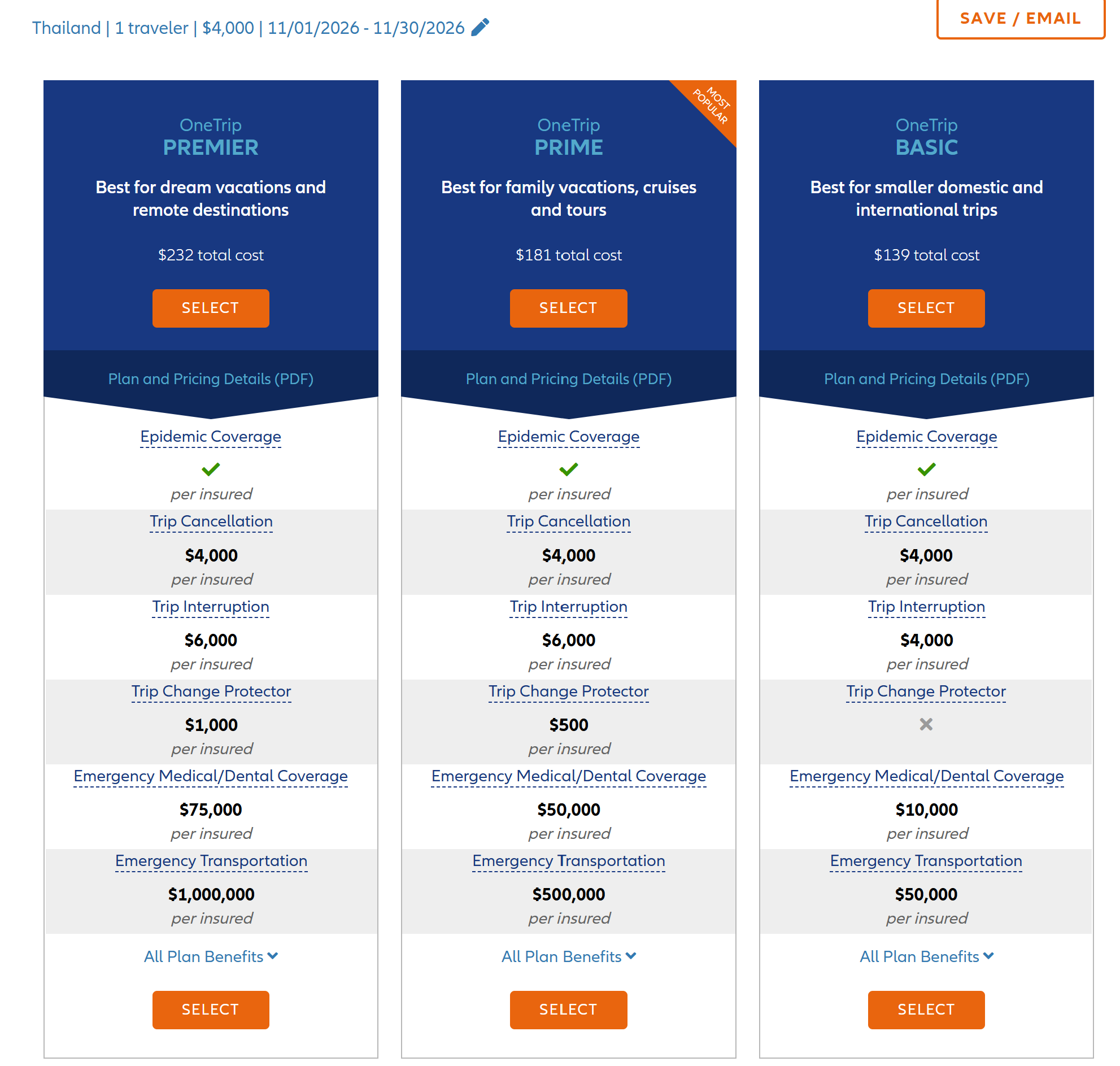
Premiums: Allianz advertises plans starting at $27, but that is a trip-specific entry price. However, a one-month trip for a 30 year old American traveling to Thailand on a $4,000 trip has a monthly premium of $139 to $232.
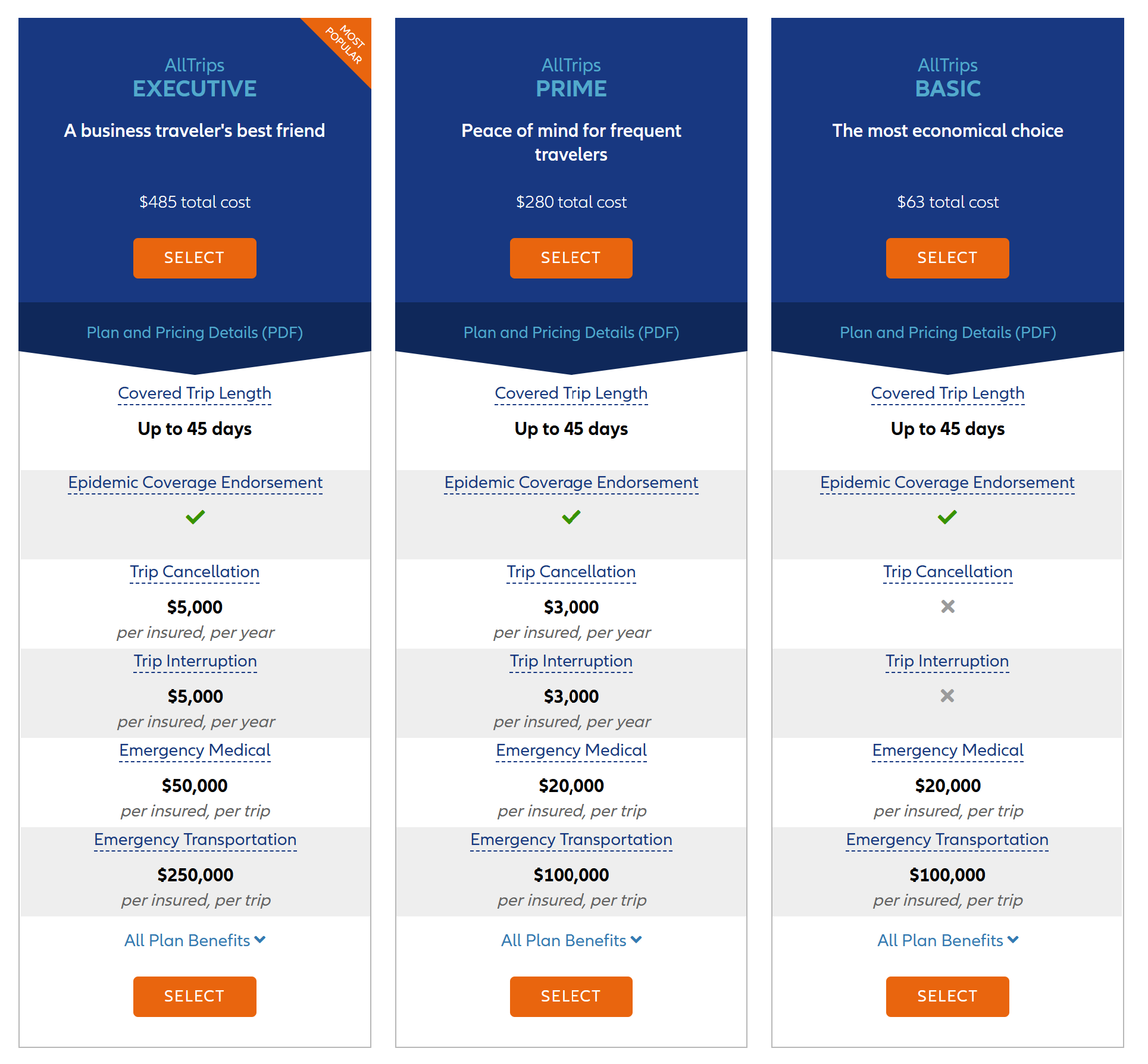
The annual trips option, for the same 30 year old American, ranges from $63 to $485 per month, depending on the coverage level you select (Basic, Prime, or Executive), and limits each trip to 45 days maximum.
Customer ratings: Trustpilot shows 4.1 out of 5 from 200,893 reviews (72% five-star, 17% one-star), read on 26 October 2026. The score covers Allianz’s US travel insurance site, mostly for trip protection buyers. Source: Trustpilot.
Pros: Trip protection bundled with medical cover, annual pricing that does not rise with age, and an international assistance line.
Cons: Medical limits of US$20,000 and US$50,000 are low for a serious injury abroad.
Gotchas: Allianz states that you cannot buy a new travel plan while you are traveling, and it advises returning home before a 180-day trip ends. Annual plan pricing does not change with the traveler’s age. For long-term coverage, Allianz Care sells expat plans: see ABA’s expat health insurance guide.
Official site: Allianz Partners travel insurance | Compare plans: AllTrips Prime vs Premier
10. Atlas Travel Medical Insurance (via Tokio Marine HCC)
Tokio Marine HCC lists its Atlas travel medical products, provided by WorldTrips. The range of coverage offerings includes Atlas Travel Medical Insurance, Atlas Premium, Atlas MultiTrip, and Atlas Group. Atlas Journey is a trip protection plan for US residents.
Tokio Marine, the underwriter, is the same underwriter for Safetywing.
Best for: Travelers who want to set their own maximum, deductible, and coverage length.
Plans and limits:
- Atlas Travel Medical Insurance: You choose the length of coverage, maximum amount, and deductible. Covers emergency medical evacuation of US$1 million and names digital nomads among its best-for groups.
- Atlas Premium: Overall maximum up to US$2 million per certificate period.
- Atlas MultiTrip: Annual travel medical for multiple trips.
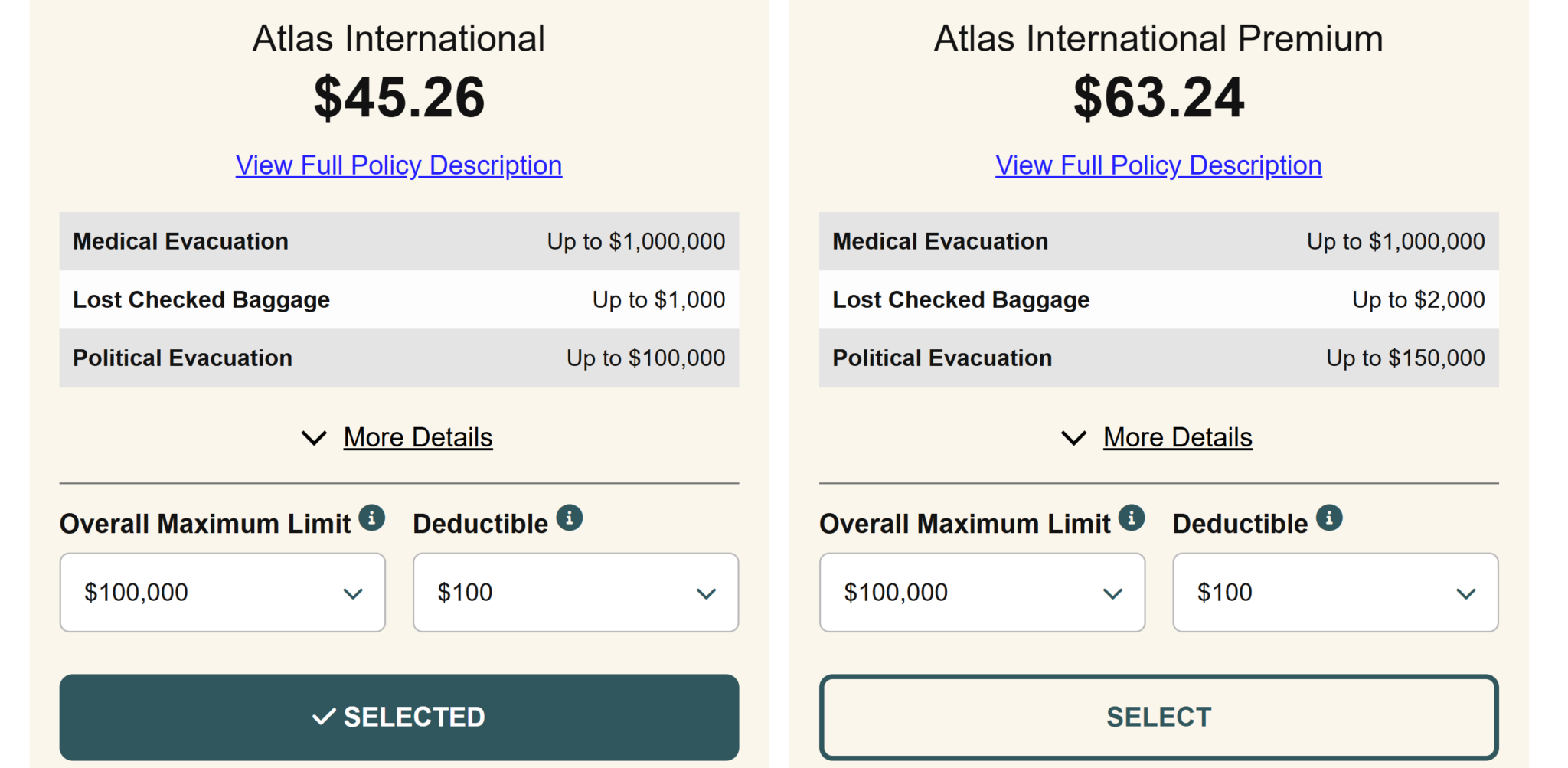
Premiums: Atlas International quotes at $45.26 monthly for a 30 year old American traveling to Thailand, while Atlas International Premium quotes at $63.24 monthly for the same traveler.
Customer ratings: Trustpilot shows 1.7 out of 5 from 57 reviews (9% five-star, 85% one-star), read on 26 October 2026. Only 57 reviews, posted on the corporate domain, so treat the score as weak evidence. Source: Trustpilot.
Pros: Customizable limits, a US$1 million evacuation benefit, and a plan that lists nomads as a target.
Cons: Tokio Marine HCC’s pages do not state maximum coverage length, medical maximums by plan, deductibles, or pre-existing terms.
Gotchas: Because Tokio Marine HCC’s pages do not state a maximum coverage length, be sure to get it in writing before you plan a multi-year stay around it. The site names WorldTrips as the provider and does not name the underwriter.
Official site: Atlas Travel Medical Insurance
Popular Providers for Medical Coverage Abroad That Aren’t Fit for “Travelers
Cigna Global and Integra Global have great reputations, sell annual expat health plans, not travel insurance, and Cigna’s own page describes travel insurance as a separate product.
For a full review of these two and other long-stay options, review our Guide to Expat Health Insurance.
Additionally, consider reading our full Guide to Medical Tourism and our List of the Best Destinations for Medical Tourism.
The right choice of Travel Insurance providers for you depends on where you live, how long you stay in each place, your nationality, and how much risk you can carry yourself.
To decide which is best for you, start by analyzing your pattern of movement and travel around the world, focusing on which countries you visit, how long you stay, and how risky (or accident prone) your activities are.
Then, match the trip length limits and eligibility rules to it first, and compare medical limits and price. A plan that excludes your country, your activity, or your length of stay will not pay when you need it at the worst time of your trip and when you need it most.
If you stay in one country for more than six months, price expat health insurance before you buy a travel plan. If you rotate through shorter stays, a nomad plan with a published price and a long maximum trip length keeps coverage continuous without a repurchase every few weeks.
Sources:
- SafetyWing: Nomad Insurance
- SafetyWing: FAQ
- World Nomads: travel insurance (USA)
- World Nomads: single trip plans (USA)
- Genki: Genki Traveler
- Heymondo: Long Stay travel insurance
- IMG: travel medical insurance
- Seven Corners: Travel Medical Annual Multi-Trip
- Seven Corners: Expat and Nomad Health Insurance
- Trawick: Safe Travels International
- Trawick: Safe Travels Outbound
- Trawick: Safe Travels Complete
- Blue Cross Blue Shield Global Solutions: plans
- Blue Cross and Blue Shield of Oklahoma: GeoBlue rebrand notice, 18 February 2026
- Allianz Partners: AllTrips Prime vs Premier
- Allianz Partners: travel insurance for long trips
- Tokio Marine HCC: global travel insurance
- Cigna Global: travel insurance vs international health insurance
- Trustpilot: SafetyWing
- Trustpilot: World Nomads
- Trustpilot: Genki
- Trustpilot: Heymondo
- Trustpilot: IMG
- Trustpilot: Seven Corners
- Trustpilot: Trawick
- Trustpilot: GeoBlue (BCBS Global Solutions)
- Trustpilot: Allianz Travel Insurance
- Trustpilot: Tokio Marine HCC
.

.
ABOUT THE AUTHOR
Carlos Grider launched A Brother Abroad in 2017 after a “one-year abroad” experiment turned into a long-term life strategy. After 65+ countries and a decade abroad, he now writes about FIRE, personal finance, geo-arbitrage, and the real-world logistics of living abroad—visas, costs, and tradeoffs—so readers can make smarter global moves with fewer surprises. Carlos is a former Big 4 management consultant and DoD cultural advisor with an MBA (UT Austin) and Boston University’s Certificate in Financial Planning. He’s the author of Digital Nomad Nation: Rise of the Borderless Generation and is currently writing The Sovereign Expat.