
& The Beautiful Sting of Being a Permanent Foreigner
In the crisp morning air, I watched from the rooftop as the mass walked by in procession, all clad in white, on the street below. Cadenced by gongs, drums, and flutes, they proceeded in ritual toward the beach, flanked by the waving green grass of rice fields along the way. Every aspect of it was foreign, and beautiful.
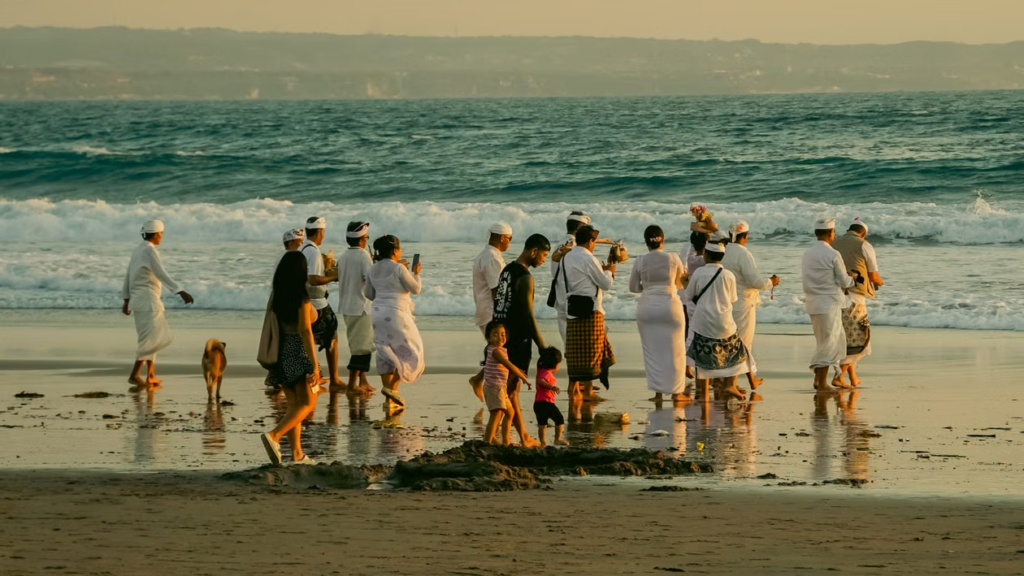
I’d been in several other ceremonies before, for births, deaths, weddings, naming, and even the purification of my own house. But in this ceremony, hundreds of Balinese walked for miles through this beachside village, a village in which hundreds of foreigners lived long term; however, at this moment, there wasn’t a single other foreigner in sight. As with all experiences living in a foreign culture, there is a ceiling beyond which the visitor can no longer pass. For the Balinese, this holy purification ceremony of Melasti was theirs and no one else. And my only privilege was to enjoy that moment that exists nowhere else in the world, from the sideline of a rooftop, as an observant guest.
Even past that day, the pleasure of living in that village was as you would expect. Lovely locals. A language that is learnable with effort and rewards with increasing welcome and warmth. And immersion in a culture that is rightfully regarded as fun and endearing.
However, my own veil of island pleasantness was pierced when an Indonesian neighbor (not Balinese) became upset one day and expressed that dissatisfaction by calling me a racial slur. “Nigger!” he yelled in anger punctuated with finality, and entitlement. Such a thing would be unacceptable in most other places in the world. I was livid, nearly to the point of violence. In the place I am from, words that small have led to neighborhoods being burned as vengeance. But this wasn’t my place, nor was it my village. As a guest, I had no choice but to consult with those who weren’t guests.
“He’s a local,” they told me, with a nearly audible shoulder shrug, as if that mere fact excused the event. The statement punctuated an understanding that, to them, it was indeed a regrettable something, but it was a something I had to accept if I were to continue living there, as a welcome guest.
I later realized that these boundaries to outsiders extended not just to foreigners like myself, but in concentric circles before and past us, even dividing their own Indonesian culture. When some boys that, I assumed, were from Timor got into trouble near my house, the first thing the local police asked on arrival was, “Where are they from?” Not as a doctrinal step in an investigation, but to determine if they were locals (Balinese) or close to it, and subsequently whether this was likely something that could, or should, be swept under the rug and “handled at home,” out of understood respect for such status.
Despite the still buzzing emotional charge that came with my own experience being called the slur, an attempt aimed to demean as much as possible and qualified solely by dark skin, I reluctantly understood their reaction to my own encounter. Sticking with what and who they know is an approach that has protected these villages for centuries before modern policing, radios, and social media revealed and confirmed a stranger’s history. They learned long ago, and continue to apply their belief that the devil you know is better than the devil you don’t.
In modern cities, hives of connectivity, we’re forced to rely on strangers throughout our daily lives. The person who makes your favorite coffee daily. The person who makes your favorite pizza. Even the policeman responding to your 911 call. You likely don’t know anything about them. Much less their names. Because of this, the social contract most of us have in the West doesn’t extend beyond the payment agreed upon and the role prescribed.
Contrast this with the situation I was lucky to live in with those local policemen in my village. We all knew each other by name. They checked up on me once a month as I did with them. We exchanged fruits and vegetables from our gardens weekly, and I was always eager for the updates on their kids and new grandkids. While I felt more welcome, more accepted, and more brought in than anywhere during my travels, possibly even more than the neighborhood I grew up in, the harsh reality was I would always still be a foreigner. That beautiful sting was a powerful realization.
It wasn’t about the passport. It wasn’t about skin color. It wasn’t about language fluency. It was about history, culture, and systems that have served semi-self-sustained societies more than we individualistic Westerners are ever likely to truly understand.
And whether or not these systems that have kept such age-old communities functioning, healthy, and safe are still necessary, they are unquestionably still embedded in cultures around the world. They are bones holding up the social fabric, even if just for the pleasantness of the shape maintained. From rural Indonesia to long refined and cultured corners of Japan.
Having sushi in an empty restaurant with a Japanese chef in Bangkok gave way to a candid conversation about the food, cold vegetable ramen traditions of summer, and the unspoken subtleties between friends unique to his home culture. A meal meant to be a short lesson became a reminder of a depth, often unrecognizable from the outside.
During my own trip through the land of the rising sun, I explored by rail from the southernmost train station in Beppu to the northernmost station in Wakkanai, aiming to end in eyeshot of Russia. I took on this adventure partly to experience world-class cuisine set in a place that epitomizes futurism while still very much living in the past, and partly to consider its countryside as a part-time home via an Akiya, cheap and sometimes abandoned Japanese houses ripe for anyone, even foreigners, to homestead. However, the depth of culture I experienced not only impressed me, but it deterred me.
Experiencing Japan was akin to swimming in a beautiful ocean with the sun glimmering off its shimmering surface in irreplicable beauty, all the while with no idea what lies beneath the mirage-like facade.
However, if you immerse a single foot below the surface, you become newly aware of 10 feet of depth in eyeshot that you still don’t understand. If you have the courage to swim down those 10 feet, you again see and realize that the depth goes further than your eye can see, into a dark, nearly incomprehensible depth; this depth is the basis holding up the thin layer of beauty above, and that blindly shimmering surface beauty is almost all most Westerners can comprehend.
Just like the ocean, in Japan, the more experience and understanding I chased, the more I realized I didn’t understand. But one realization stuck. I could never live in that ocean forever, despite how much I admire its beauty, as I am truly a creature of the land. In the same way, I realized I would always be in awe of Japan and appreciate what it is, but I could never truly be of Japan, because there I am a foreigner and will always be.
Contrast this hard finiteness of existence with something I’ve been jealous of time and again – my friends from my home country, but of Asian descent, experiencing Asia.
Whether of Chinese, Japanese, or Filipino descent, as Americans, there is little possibility they’ll ever fully “pass” as locals. Still, I’ve heard them say countless times, in Indonesia, in Thailand, in Japan, “I feel safer and more comfortable here.” Some of them are more American than I’ll ever be – loud, boisterous, and just forcing their love on you. Others do seem to have subtle characteristics and mannerisms of 2nd or 3rd generation Chinese or Japanese immigrants. From the perspective of a black man who has lived the last 20 years in corporate America and the military, around people that don’t look like me, and dealing with the assumptions and misunderstandings that come with being the odd one out, I understand my friends’ desire for the relief that comes with achieving the appearance of belonging. How far this relief goes, and whether it extends them into becoming “more local,” or just into a superficial bubble of comfort, I have no idea. However, I can relate to the comfortable bubble of familiarity in the all too common “expat bubble,” that is, the soothing source of familiarity that all too many long-staying foreigners lean on during stays away from “home.”
Throughout Southeast Asia and Latin America, the “expat bubble” is commonly the expats’ easy entry into cheap living or comfortable and permissive social structures that Western Europe and North America rarely offer. Alternatively, for the adventurer that may have ventured one town too far for comfort, the expat bubbles can be their retreat to respite when “really living locally” overwhelms. Though they wouldn’t admit it, expat bubbles are a trip back to cultural familiarity while staying immersed in the region, allowing the foreigner to enjoy the best of all worlds. In the international finance hubs of Tokyo, Dubai, and Hong Kong, the expat hubs are endemic to the culture. In other places, like Bali, Lisbon, and Chiang Mai, the situation is far messier, as acceptable norms haven’t totally been established. All the while, the line between “inspiring improvement” and “forcing gentrification” blurs as Western immigrants continue spilling over the borders.
Despite messy appearances, there is value in these foreigner hives. They can be shortcuts to setting up quickly in a country when staying long enough to taste the culture extensively but not long enough to establish real local logistics and, more critically, local social connections. Just don’t try to convince yourself such an experience, thriving in the expat hive, is “living as a local.” But don’t sell the experience short either, as it’s the gateway to a wonderfully valuable experience in living abroad that is likely achievable no other way.
What does this all boil down to?
Years after the ceremonies and processions, at a Las Vegas blackjack table as part of my own reacquaintance tour of the US, I enjoyed a full dose of Americana sitting next to a social couple from the Midwest. “We would love to move there!” They said of my former island home. They shared a plan that sounded like the best of a dream board, and a lot of Post-it notes, yet still much more thought out than what landed me in Bali. And they aren’t alone in that dream.
We’ve all watched the headlines of net outflows of immigration from the US and the pull of 1€ houses, cheap Japanese Akiya, and dying blue zone villages, as millions of North Americans and Western Europeans respond to the call, with increasing interest. They dream that the economic benefits of cheap homes, compounded with the fantasies of exotic places, will be the silver bullet to all that ails their lives. Little do they know, as they stare at this proposition, they are merely planning flight from the devil they know.
Life in these communities persists partly because it is about more than money, and rarely about the force-fed fantasies of elsewhere. The rich, enviable elements of these communities are specifically so because of how the people live in these communities with each other, sustaining them, keeping them alive. They are part of it. That is their wealth. And though many Westerners will be allowed to enjoy experiencing some of that existence, those communities will never share all, and rightly so.
Before you bank on the intangible wealth steeped in the traditions of these communities’ ancestors and rituals, account for the reality that they will gatekeep it – their community, their culture, and their home as the treasures that they are. While you may become a guest, perhaps even a welcome one, you will always be a variation of a guest. Accepting that truth puts the ceiling of the life you desire, sharing their world, in perspective.
Being honest about your path, whether as a tourist, a passer-by, or a committed immigrant, along with what you want and what’s achievable, helps you remove the rose colored glassed and better carve out the life abroad that is best for you. That clear perspective resists the inklings and detours of “you should do everything and go everywhere” that modern social media algorithms trigger.
Maybe that idea of moving to Japan, learning Japanese, and buying an Akiya might happen quickly. But the depth of understanding it takes to truly live in Japan as the Japanese do, and I secretly desired to, will likely take years, possibly decades, but absolutely longer than you have in mind.
Maybe a summer with a Japan Rail Pass as a very engaged tourist is all you truly want, as I realized, ending my journey looking out over the sea to the Russian coast, reaching the end of a country, and the end of a fantasy as well. But, on the contrary, maybe a farmhouse in the frosted countryside of Hokkaido, living out the footprints of the Ainu, as a guest, is what your soul really needs. Either would be a beautiful path. Only one would be more perfect for you, and in the honesty between the two possibilities lies the true, first step.
In just the same way of honesty, I sat atop that rooftop, enviously witnessing a one-of-a-kind community event – part religious, part spiritual – when a child I knew waved at me. He almost punctuated a palpable acceptance that, in a life abroad, sometimes a welcome guest is all you may ever be. Finding satisfaction and beauty in that may not be the treasure we seek, but it is a treasure nonetheless.

.

.
ABOUT THE AUTHOR
Carlos Grider launched A Brother Abroad in 2017 after a “one-year abroad” experiment turned into a long-term life strategy. After 65+ countries and a decade abroad, he now writes about FIRE, personal finance, geo-arbitrage, and the real-world logistics of living abroad—visas, costs, and tradeoffs—so readers can make smarter global moves with fewer surprises. Carlos is a former Big 4 management consultant and DoD cultural advisor with an MBA (UT Austin) and Boston University’s Certificate in Financial Planning. He’s the author of Digital Nomad Nation: Rise of the Borderless Generation and is currently writing The Sovereign Expat.