
For digital nomads visiting Japan that would love to spend more time working in and exploring the “Land of the Rising Sun” than a normal tourist visa allows, the Japan digital nomad visa is an excellent new option for you to visit Japan and experience the archipelago more deeply.
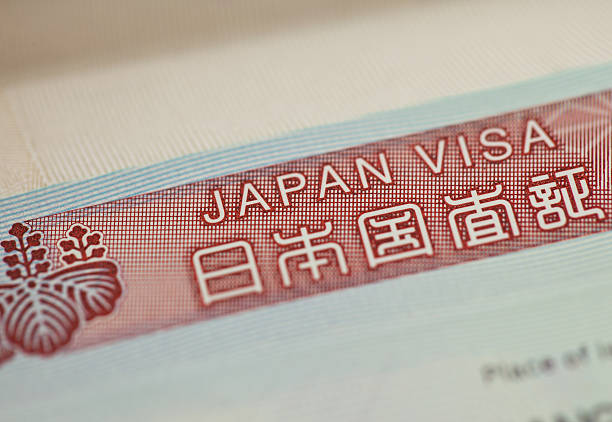
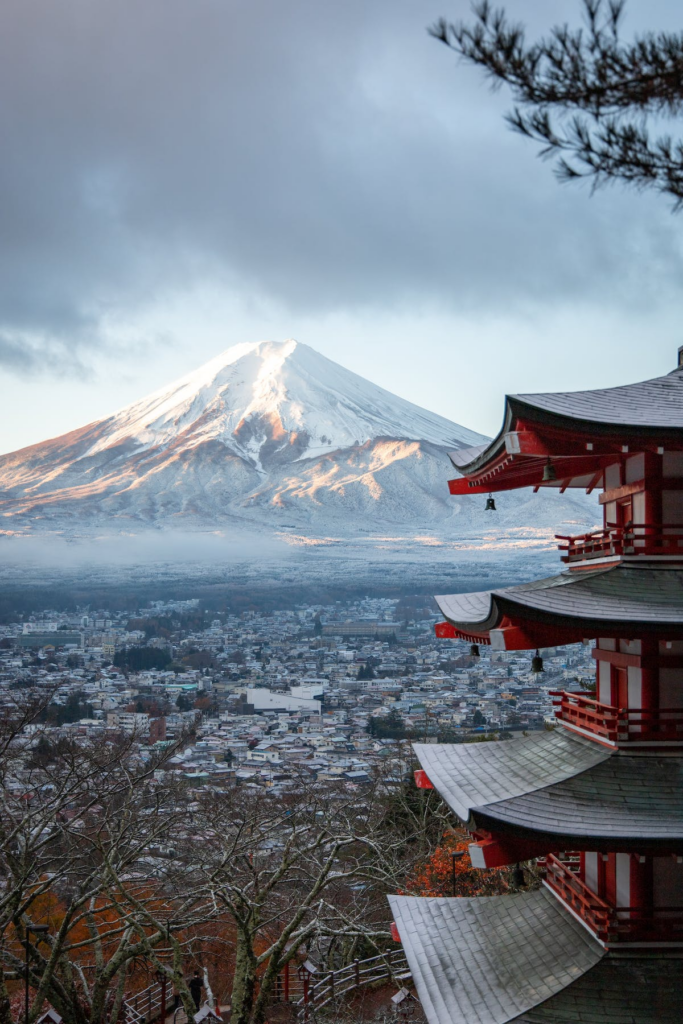
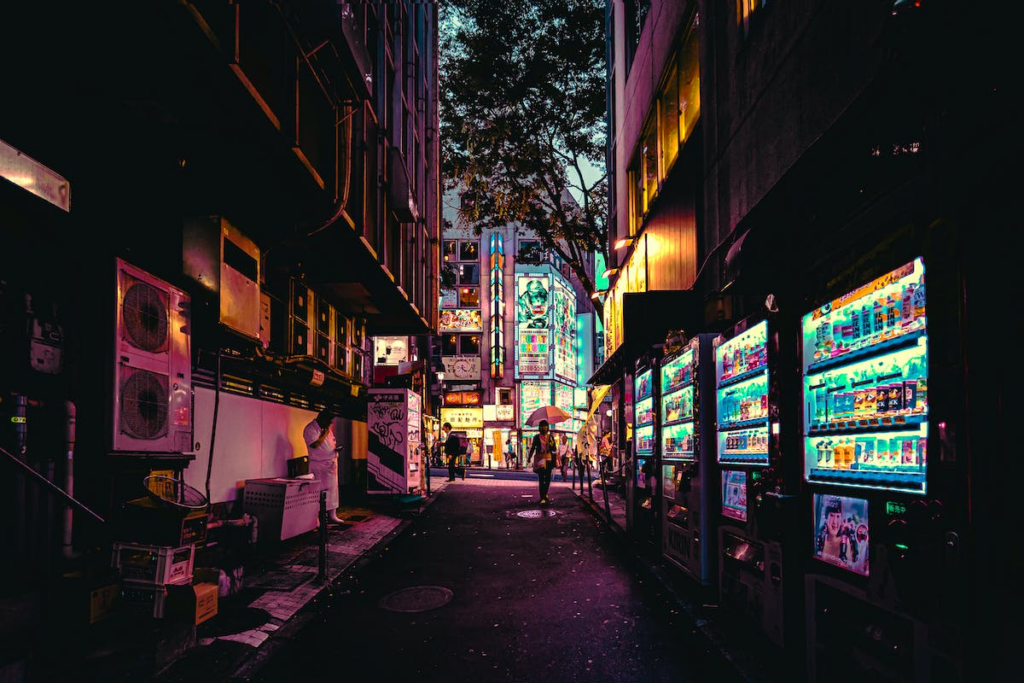
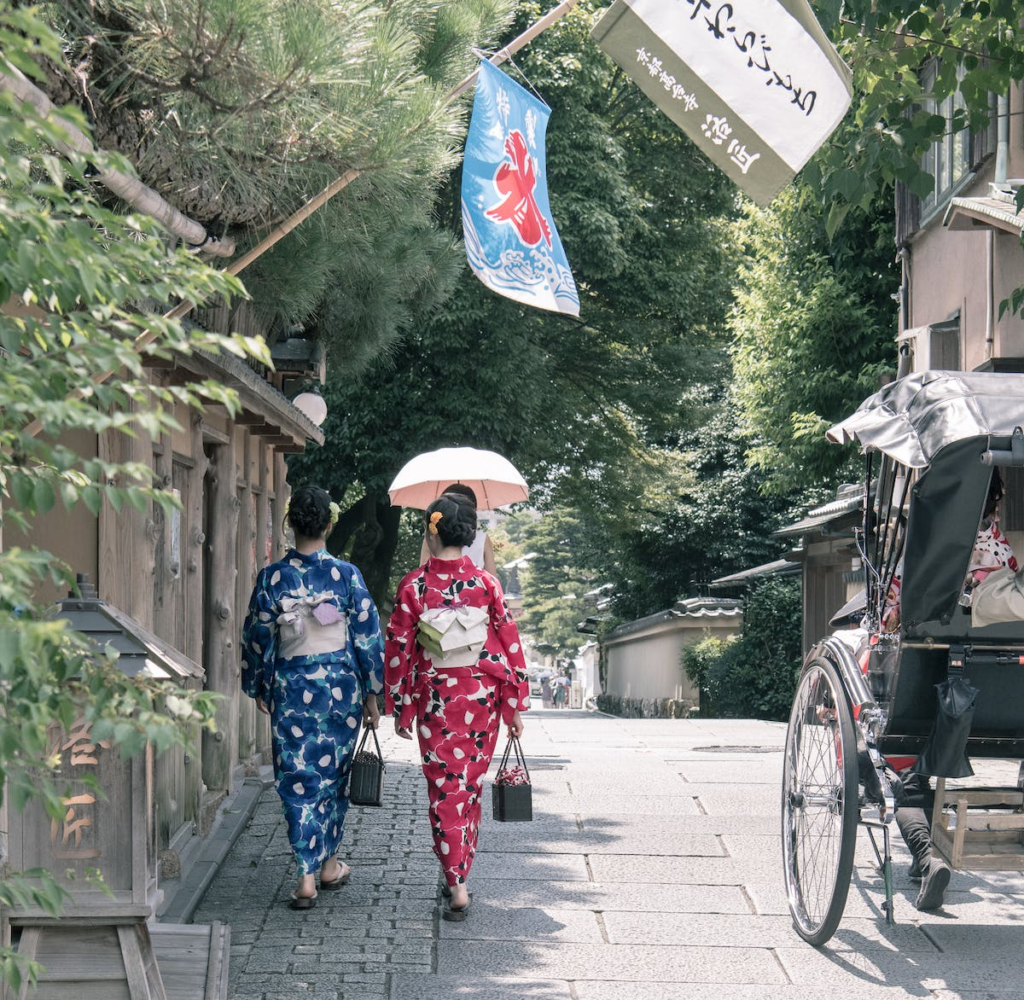
Everyone who has had the pleasure to visit Japan will tell you the experience is otherworldly. This extraordinary country somehow perfectly blends the past and beautiful ancient history with the future via innovative, entertaining, and always satisfying ways to accomplish even the smallest of tasks. The result is a place that satisfies your senses with efficient pleasures in a way nowhere will. For the digital nomad lucky enough to work from this futuristic place, I guarantee you will have one of the most efficient, enjoyable, and satisfying work and nomad experiences of your life.
The only unsatisfying thing about a trip to Japan has always been, the 90 day trip, limited by the tourist. But, but not anymore.
Beginning March 2024, Japan now offers a 6 month digital nomad visa, so you can work and travel from Bepu, to Tokyo, to Hokkaido and your heart’s contentment.
In this complete guide to the new Japan Digital Nomad Visa we’ll share the visa requirements, qualifying countries, and how to apply. Read on to discover everything you need to know to start remote working in Japan.
CONTENTS
- Full Japanese Digital Nomad Visa Details and Requirements
- Visa Limitations
- Who qualifies for the Japan Digital Nomad Visa?
- How to Apply for the Japan Digital Nomad Visa
Excellent info on why Japan should be your next destination for remote work on a DN visa
- How does the 6 month Japan digital nomad visa compare to the normal 90 day Japanese Tourist Visa?
- Background of the Japanese Digital Nomad Visa
- My experience traveling Japan as a nomad
- Official Sources and Resource
- FAQs

Don’t forget to check out our Guide to Japan for Digital Nomads and Long Term Travelers
Japanese Digital Nomad Visa Details and Requirements
- Visa Length: 6 Months
- Renewable: No
- Minimum Income Requirement: ¥10 million income annual income ($67,000 USD), demonstrated
- Cost: TBD
- Family members eligibility: Spouses and dependents are eligible for the on the same initial application
- Application Process: Online via the Japanese Immigration Services Agency Online Portal. The option for “Designated Activities” will be activated as a selection option in the online visa application as Japan plans to activate the visa as option in the portal in late March via the MOJ Online Residence Application System.
- Eligible Countries: All citizens of countries that have both a 1) signed tax treaty with Japan (verifiable at the Ministry of Finance site) and 2) do not require a short term visa (verifiable at the Ministry of Foreign Affairs site).
Visa Limitations:
- Nomads must wait 6 month before applying for a follow on Digital Nomad Visa for Japan
- Recipients are allowed remote work (freelance or employed) for companies or clients located outside of Japan only. No work for customers or clients within Japan is allowed
- Recipients are not permitted to rent long term accommodation
- Time spent on Japan’s Digital Nomad Visa does not count for permanent residency
Who qualifies for the Japan Digital Nomad Visa?
Foreign remote workers and digital nomads that meet the annual income requirement of ($67,000 USD) and are from one of the 49 countries that have a tax treaty with Japan and whose passport holders qualify for a visa exemption, and 21 additional countries are allowed as spouses or dependents on the same visa.
Of course, applicants will need a valid passport with 6 months validity from the day their potential visa will expire.
Last, applicants will need to show proof of health insurance to cover the entire trip.
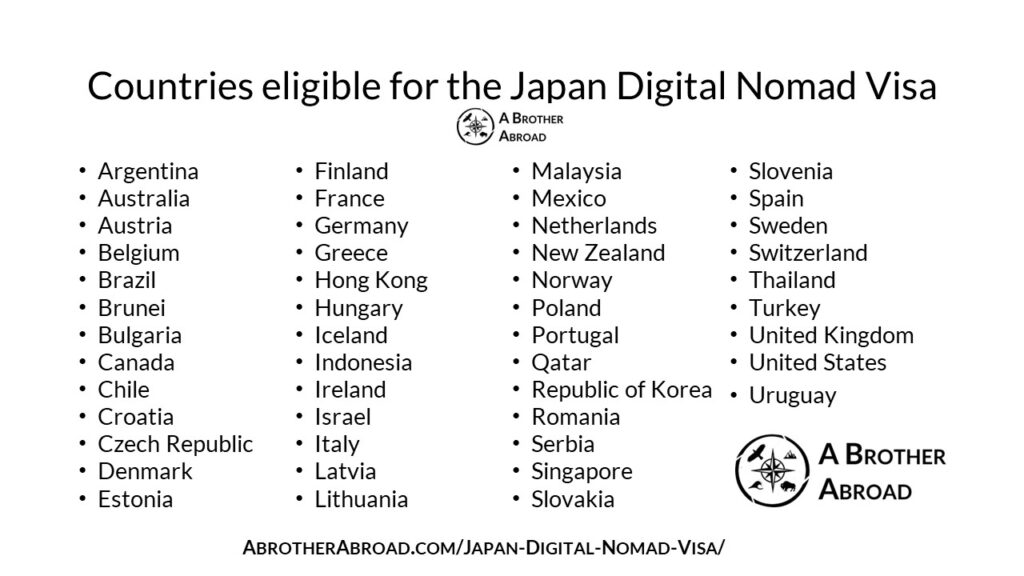
Japan Digital Nomad Visa Eligible Countries List
Must be nationals or citizens of countries/regions as shown in the chart below.
| Countries Eligible for Digital Nomad Visa | Countries eligible for visa as spouse or child of Digital Nomad |
| Australia | Andorra |
| Austria | Argentina |
| Belgium | Australia |
| Brazil | Austria |
| Brunei | Bahamas |
| Bulgaria | Barbados |
| Canada | Belgium |
| Chile | Brazil |
| Croatia | Brunei |
| Czech Republic | Bulgaria |
| Denmark | Canada |
| Estonia | Chile |
| Finland | Costa Rica |
| France | Croatia |
| Germany | Cyprus |
| Hong Kong | Czech Republic |
| Hungary | Denmark |
| Iceland | Dominican Republic |
| Indonesia | El Salvador |
| Ireland | Estonia |
| Israel | Finland |
| Italy | France |
| Latvia | Germany |
| Lithuania | Greece |
| Luxembourg | Guatemala |
| Malaysia | Honduras |
| Mexico | Hong Kong |
| Netherlands | Hungary |
| New Zealand | Iceland |
| Norway | Indonesia |
| Poland | Ireland |
| Portugal | Israel |
| Qatar | Italy |
| Republic of Korea | Latvia |
| Romania | Lesotho |
| Serbia | Liechtenstein |
| Singapore | Lithuania |
| Slovakia | Luxembourg |
| Slovenia | Macao |
Must be nationals or citizens of countries/regions as shown in the chart below.
| Designated Activitie(for Digital Nomad) | Designated Activities (for spouse or child of Digital Nomad) |
| Spain | Malaysia |
| Sweden | Malta |
| Switzerland | Mauritius |
| Taiwan | Mexico |
| Thailand | Monaco |
| Turkey | Netherlands |
| United Arab Emirates | New Zealand |
| United Kingdom | North Macedonia |
| United States | Norway |
| Uruguay | Poland Portugal Qatar Republic of Korea Romania San Marino Serbia Singapore Slovakia Slovenia Spain Surinam Sweden Switzerland Taiwan Thailand Tunisia Türkiye United Arab Emirates United Kingdom United States Uruguay |
Sources
- Japan Ministry of Foreign Affairs – List of Eligible Countries: https://www.moj.go.jp/isa/content/001416932.pdf
- Japan Ministry of Foreign Affairs: https://www.mofa.go.jp/j_info/visit/visa/short/novisa.html?
- Japan Ministry of Finance: https://www.mof.go.jp/english/policy/tax_policy/tax_conventions/tax_convetion_list_en.html?
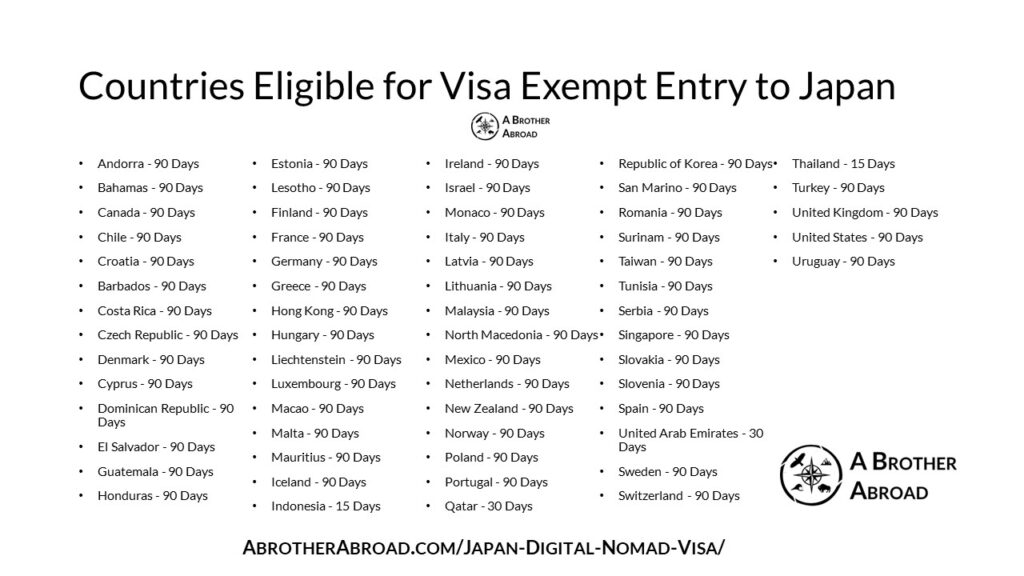
List of countries that qualify for a Japan visa exemption but do not qualify for the Japan Digital Nomad Visa, because no tax treaty exists between Japan and the country
- Andorra – 90 Days Visa exempt stay [No Tax Convention Exists with Japan]
- Bahamas – 90 Days Visa exempt stay [No Tax Convention Exists – Only Tax Information Exchange Agreement Exists]
- Barbados – 90 Days Visa exempt stay [No Tax Convention Exists with Japan]
- Costa Rica – 90 Days Visa exempt stay [No Tax Convention Exists with Japan]
- Cyprus – 90 Days Visa exempt stay [No Tax Convention Exists with Japan]
- Dominican Republic – 90 Days Visa exempt stay [No Tax Convention Exists with Japan]
- El Salvador – 90 Days Visa exempt stay [No Tax Convention Exists with Japan]
- Guatemala – 90 Days Visa exempt stay [No Tax Convention Exists with Japan]
- Honduras – 90 Days Visa exempt stay [No Tax Convention Exists with Japan]
- Lesotho – 90 Days Visa exempt stay [No Tax Convention Exists with Japan]
- Liechtenstein – 90 Days Visa exempt stay [No Tax Convention Exists – Only Tax Information Exchange Agreement Exists]
- Luxembourg – 90 Days Visa exempt stay [No Tax Convention Exists with Japan]
- Macao – 90 Days Visa exempt stay [No Tax Convention Exists – Only Tax Information Exchange Agreement Exists]
- Malta – 90 Days Visa exempt stay [No Tax Convention Exists with Japan]
- Mauritius – 90 Days Visa exempt stay [No Tax Convention Exists with Japan]
- Monaco – 90 Days Visa exempt stay [No Tax Convention Exists with Japan]
- North Macedonia – 90 Days Visa exempt stay [No Tax Convention Exists with Japan]
- San Marino – 90 Days Visa exempt stay [No Tax Convention Exists with Japan]
- Surinam – 90 Days Visa exempt stay [No Tax Convention Exists with Japan]
- Taiwan – 90 Days Visa exempt stay [No Tax Convention Exists with Japan]
- Tunisia – 90 Days Visa exempt stay [No Tax Convention Exists with Japan]
- United Arab Emirates – 30 Days Visa exempt stay [No Tax Convention Exists with Japan]
Sources
- Japan Ministry of Foreign Affairs: https://www.mofa.go.jp/j_info/visit/visa/short/novisa.html?
- Japan Ministry of Finance: https://www.mof.go.jp/english/policy/tax_policy/tax_conventions/tax_convetion_list_en.html?
How to Apply for the Japan Digital Nomad Visa
Interested nomads that meet the criteria for the Japan Digital Nomad Visa will need to gather the required documents (listed below) and submit these documents at a consulate or embassy in their country of residence.
For full information on the application process, visit the Japanese Immigration services agency Online Resident Application System website to create an account, select and apply for the appropriate visa category, and submit the required documents. Specifically visit the Japanese Ministry of Foreign Affairs Specified Visa for Digital Nomads page to apply. For instructions on how to navigate the application portal, visit the MOJ Online Shinsei Guide.
Documents Required for the Japan Digital Nomad Visa Application
(The following is documented from the Japanese Ministry of Foreign Affairs visa application system)
- Visa application form (with a photo)
- Valid Passport
- Documents explaining the applicant’s planned activities and period of stay during their stay in Japan (form template available here)
- Bank documents, financial documents, work agreement, or otherwise proving that the applicant’s annual income is JPY 10 million (~$69,500)or more.
- Tax payment certificate, income certificate, employment contract, contract with a business partner clearly stating the contracted work period and the contract amount.
- Documents proving that the applicant has insurance against death, injury or illness during their stay in Japan with compensation for medical treatment for injury or illness that is JPY 10 million or more.
- Copy of the certificate of insurance coverage and policy summary and copy of the credit card and documents proving supplementary compensation.
It is worth noting that many of the document requirements may be waived if the applying nomad attains a Certificate of Eligibility from the Japanese Ministry of Foreign Affairs before applying.
How does the 6 month Japan digital nomad visa compare to the normal 90 day Japanese Tourist Visa?
Though the visa exemption for most countries is 90 days, easy, and simple, I highly recommend the Japan digital nomad visa for a full 6 month stay, for the perfect balance of working, relaxing, and exploring.
In my experience, three weeks to month is the perfect amount of time to purely travel from Tokyo to either the southern tip of Japan (Bepu in Kyushu) or the northern tip of Japan (Hokkaido) not including the islands (Ryuku islands including Okinawa and around) at a brisk pace. If you wanted to travel only, 2 months would be a good amount of travel time. So, you could possibly travel north to south or vice versa over a 2 month period with 1 month of interspersed work in there.
However, if you’re a nomad that actually needs to work and stay productive, I’d advise against this. The ideal period to work, experience, and travel Japan is 6 months, easily.
For work and just living the culture, spend one month in the city of your choosing in the south. I recommend Fukuoka and exploring Kyushu.
Then spend one month in central Japan. If you like it busy, aim for Tokyo proper. If not, aim Kyoto, Osaka, or one of the many small towns outside of Tokyo.
Finally, spend one month in the north around Hokkaido, ideally in Sapporo or around.
With the remaining three months, plan on spending two months hopping on and off the Japan Rail train as you explore the amazing, charming, and surprisingly pleasant smaller cities and sites between Kyushu, Kyoto/Tokyo, and Hokkaido. Then, save one more for odd adventures you won’t expect.
The bottom line: If you get the opportunity to slow travel and work in Japan for 6 months, absolutely take it!
If you decide that six months isn’t enough and you would like to explore, and live in, Japan for longer, visit the Japanese governments list of long term visas and see if one fits your skills and interest.
Background of the Japanese Digital Nomad Visa
Thanks to an entire year of lobbying by groups within the Japanese government and private advocates for digital nomads in Japan, the Japanese Immigration Services Agency has approved and enacted a digital nomad visa for Japan.
This lobbying of the local community and government in support of digital nomads, and the quick and efficient action to make this visa a reality is a great sign of what you’ll experience in Japanese not only in the efficiency of daily life and exploration, but the budding community of nomads in places like Fukuoka Kyushu
The Japanese Digital Nomad Visa will be valid for six months and is non-renewable, and nomads will only be able to use the visa once every 12 months.
The choice for a 6 month visa was made by the Immigration Services agency after reviewing nomad surveys and studies stating that nomads prefer travel periods within a single country for more than 90 days but less than 9 months with 6 months being the optimal stay

About the Japan Digital Nomad Scene: Opening, booming, welcoming, and fun to discover
This new digital nomad visa is only possible because awareness and support for digital nomads from within Japan, which means there is absolutely community.
Keep an eye out at billboards in hostels and business hotels listed on backpacker centric sights, and you’re bound to bump into other nomads.
While Tokyo boasts the highest number of digital nomads strung out across the metropolis, the more manageable Fukuoka has a more active, connected, and easy to reach nomad scene.
Global Nomad ambassador did a great video of Fukuoka and the digital nomad scene in Japan that absolutely represents the nomad scene in Fukuoka and what you can expect.
My experience traveling Japan as a nomad
Japan is easily one of my favorite destinations in the world to work and explore. The cultural experience is always rich, the food is amazing, and day to day life is so oddly satisfying it will leave you feeling you’re on another planet.
My biggest recommendation, for digital nomads that are balancing work and travel, is to take it slow in Japan, and don’t be afraid to stay in one place longer than you plan.
First, the efficiency of just living in Japan – going downstairs to an onsen, getting an amazing meal at a 7 Eleven next door, enjoy a pristinely clean and perfectly on time train – will put you in a mental place of maximum efficiency for work. If you recognize this and go with it, you’ll not only work better but enjoy more.
Second, every single destination you will visit in Japan has far more than you expect. More food. More temples. More events. More art. More beautiful surprises. Staying in a place longer than you originally planned, its digging deeper into the experience. Japan is one of the few destinations that you can dig as deep as you want and you will still find more. Remember, you can always come back, so enjoy whatever is in front of you as long as you want, and don’t be a slave to your itinerary. Again, you can always come back.
Bottom line on the Japan Digital Nomad Visa
The opportunity to travel and work in Japan at an enjoyable place is an amazing possibility that I highly recommend anyone with the resources take advantage of as soon as possible, and this new visa has easily made that possible. Visit the Japanese Immigration Services Agency website to start your application today!
More Great Articles on Japan for Nomads and Travelers
Other Great Resources
Official Sources and Resource
- Embassy of Japan (Washington, DC)
- Online Residence Application System: https://www.ras-immi.moj.go.jp/WC01/WCAAS010/
- Application Instructions: https://www.moj.go.jp/isa/applications/guide/onlineshinsei.html
- https://www.moj.go.jp/isa/applications/procedures/shikakugai_00001.html
- https://www.mofa.go.jp/j_info/visit/visa/index.html
- https://www.mofa.go.jp/j_info/visit/visa/visaonline.html
- https://www.evisa.mofa.go.jp/index
- https://www.mofa.go.jp/j_info/visit/visa/short/novisa.html
- https://www.mofa.go.jp/ca/fna/pagewe_000001_00046.html
Japan Digital Nomad Visa FAQ
Can you work remotely in Japan as a foreigner?
- According to Japan’s labour ministry, foreigners in Japan on tourists visas or visa exemptions technically cannot work remotely or otherwise according to Japanese law. However the prudent remote worker that does not casually discuss his work likely will not attract sufficient attention to cause any trouble. Personally, I have worked remotely in Japan for months with no issues at all
Is Tokyo good for digital nomads
- Tokyo is an excellent place for nomads as it is affordable, livable, and easier to navigate. However, as Tokyo is a normal mega city and can be chaotic at times, most digital nomads will have a far more satisfying experience living in the alternatives of Kyoto, Osaka, Sapporo, and Fukuoka.
Can you move to Japan as a digital nomad?
- Yes, with the new digital nomad visa you can legally and effectively move to Japan for up to 6 months. On a visa exemption you can easily live and remotely work in Japan for up to 90. Being visa issues, Japan’s livability, internet strength, public transportation network, and general infrastructure make it one of the best places in the world a digital nomad could live.
Can I work remotely in Japan as a tourist?
- Though remote work in Japan on a tourist visa or visa exemption is technically not legal according to the Japanese government, if you are performing remote work for non-Japanese clients that are not based in Japan it is unlikely you will attract the kind of attention that will cause you problems.
Other options to consider
- South Korea digital nomad visa for up to 2 years
- Taiwan visa up to 3 years
- Visa run to Vietnam at the end of a 90 exemption stay in Japan
- Thailand 90 day tourist visa
.

.
ABOUT THE AUTHOR
Carlos Grider launched A Brother Abroad in 2017 after a “one-year abroad” experiment turned into a long-term life strategy. After 65+ countries and a decade abroad, he now writes about FIRE, personal finance, geo-arbitrage, and the real-world logistics of living abroad—visas, costs, and tradeoffs—so readers can make smarter global moves with fewer surprises. Carlos is a former Big 4 management consultant and DoD cultural advisor with an MBA (UT Austin) and Boston University’s Certificate in Financial Planning. He’s the author of Digital Nomad Nation: Rise of the Borderless Generation and is currently writing The Sovereign Expat.