

Investing can seem intimidating. However, to build true wealth, it is something you need to jump into, and the earlier the better.
The word “investing” likely conjures up ideas of the Wolf of Wall Street, Bobby Axelrod, or Warren Buffett, slinging billions of dollars around, which makes the idea sound and feel even more complex and intimidating than it is.
Despite the off-putting complexity that most people associate with the skill of making your money make more money, at its core, investing is simply purchasing an asset that will pay you a profit reliably and grow in value (appreciate) over time. In the end, this “asset” that you’ve purchased as an investment, along with the profits it pays, will ideally have a value large enough to finance the goals you planned – the house, the car, the financial independence, or the life abroad.
Rest assured, the best way for you to invest is via the simplest and easiest approach, which is what we’ll focus on here, regarded as the recommended approach in the “Financial Independence and Retire Early” (FIRE) community.
Luckily for you, personal finance industry advances have made consumer investing impressively fee-free via online brokerage accounts that are easily attainable and easily learned via a plethora of personal finance and investing information and education freely available online. Taking the simple approach to investing has never been easier.
So, how do you do it?
To get started investing…
Understand your financial situation.
Figure out your financial goals.
Figure out your appetite for (investment) risk.
Figure out the simple mix of stocks, bonds, and other options that fit you and your situation to create your investment plan.
Buy a piece of the index fund(s) that fits your investment plan, and ultimately your goals.
Continue investing, monthly, based on the savings rate that’s right for you.
That’s it. That’s investing.
This simple approach to investing is what enabled me to go from backpacking blogger to Expat FIRE, living abroad, financially independent. The only thing I wish I had on the journey was this knowledge and some specific investment approaches to execute the plan sooner. So, I am writing this guide to pay it forward to help someone out there with the same interest and ambition now, as I had, and who is just in need of a few key points to get started.
This article, this complete guide, has everything you need to know to take the first steps in investing today, on the path to Financial Independence and Retiring Early.
Disclaimer: This article contains affiliate links

Table of Contents
The BLUF:
- First, build an emergency fund covering 3 to 6 months of expenses and pay off high-interest debt before you invest anything, and keep that money easily accessible.
- Next, invest in tax-advantaged accounts, such as a 401 (k), IRA, and Roth IRA, first up to their annual limits, as long as you get a tax benefit. In 2026, you can put up to $24,500 into a 401(k) and $7,500 into an IRA.
- For that act of investing, when choosing your target investments, consider low-cost, diversified index funds because they are the simplest foundation for most beginners and the easiest investment option to execute repeatedly.
- Set up automatic, consistent contributions, ideally monthly, because this matters more than picking the perfect time to buy.
- Investor behavior, such as panic selling and chasing trends, is one of the biggest threats to long-term returns. To mitigate this, understand how the market can, and will, go into a downturn at some point, and internalize that leaving your investments alone is the best move.
Topics we’ll cover in this guide:
- What is investing? And what can you invest in?
- Why investing now matters, and why simple wins: Investing counters inflation, and more time supercharges your investments.
- The FIRE philosophy of investing
- Why savings rate matters
- How Much to Invest.
- Allocation recommendations by age
- How can and should real estate contribute to FIRE?
- What an ETF is: A chance to own a small piece of a lot of companies, in a single stock
- Assets and Habits to Avoid when Buying for Your Portfolio
- Costs to be aware of on your investing journey
- Account types and the order to fund them
- The Expat Angle: Taxes to consider
- Getting an initial sum or a large sum of money into the market
- Rebalancing
- Essential Tactics to Learn: Tax-loss harvesting and tax-gain harvesting
- Essential Habits: Invest it and leave it
- The 4% rule: the driving logic behind the FIRE investment philosophy
- Finally catching FIRE: Getting to your money before age 59 1/2
- Rolling it up: how to invest according to the FIRE philosophy, step by step
- FAQs
Now, let’s get into the process of investing…
Step 0. Understand the basics of investing, why it is important, and the basic tools the FIRE approach to simple investing uses
What is investing? And what can you invest in?
Investing is simply the act of purchasing an asset, perhaps a business, real estate, or a commodity like gold, that will earn you money by owning that asset. You earn through profits from the use/operation of the asset or the value of that asset growing in value (appreciation), or both. Businesses earn profits, which they, at times, pay to owners as dividends. Rental real estate collects rental income, which is paid to the owner as profit (after expenses). Gold is purchased as a store of value because the price for the same amount of gold is likely to be higher in the future – a concept we call “appreciation.” Additionally, well-chosen businesses and real estate also “appreciate,” potentially paying “gains” when they are sold for a higher price than they were purchased for.
Stocks: Your key to owning a business without the headache
Stocks are simply a tiny bit of ownership in a business. That ownership of a portion of a business, the stock, entitles you to profits whenever they are paid out to owners (stockholders) as dividends.
Other options to invest: Real Estate Trusts, Bonds, and Trusts/Funds for Commodities
Additional avenues exist to invest in real estate (Real Estate Investment Trusts), invest by lending a company or government money (bond), or invest in gold by buying a certificate for the gold that a brokerage’s custodian holds (gold trust or gold Exchange Traded Fund).
The point is, there are many options to invest.
The bigger point is, those are good to understand, but targeting the simplest effective option and keeping it is part of this simple approach to investing.
Why investing now matters, and why simple wins: Investing counters inflation, and more time supercharges your investments.
Investing now helps you beat inflation early and takes advantage of how invested money compounds so dramatically over time.
Inflation is that ever-looming issue wherein prices tomorrow for the same goods will be higher than the price today. The average price of a car in 1996 was between $18,523 and $21,750, according to the LA Times. The average price of a car 30 years later, in 2026, is $51,109, according to Kelley Blue Book. Most of that $32,586 increase over 30 years, more than the previous car price, is due to inflation.
Investing matters because the returns you earn and the appreciation of the asset (the stock, the real estate, the gold) grow your money faster than inflation eats away at its purchasing power. Inflation is often noted offhand as 3%, so in effect, you lose 3% of your purchasing power per year, because costs are rising by ~3% every year. If you are invested in, say, the stock market, the stock market has historically returned a ~10% nominal return. That 10% by which your money grows each year while invested in stocks protects your money from inflation. If that money sits in a normal checking or savings account, it is exposed, and that $1 today will buy much less in 10 years than it will today.
US prices rose 3.7% over the 12 months ending September 2026, according to the latest CPI release (US Inflation Calculator, BLS data). Cash in a checking account lost that much buying power in one year. Piles of money that sit get smaller by nature.
Combining the inflation-beating nature of investment returns with the power of compounding returns makes investing essential to not just maintaining, but building wealth.
Compounding returns is the idea that your $1 invested this year, which receives 10% (or $.10 cents), for being invested doesn’t just get an additional 10% next year. Instead, next year, you get 10% for your original $1, and an additional 10% on that $.10 you received this year. And the same process repeats the following year. While these incremental additions may seem small in years one and two, over decades they add up to massive results.
The power of compounding is that your gains earn additional gains of their own, and then those additional gains earn additional gains.
Once you have your investing process in place and automated, time does most of the work.
This table demonstrates the power of compounding returns with a hypothetical investment of $300 a month, and receiving an average 7% annual return.
Years Invested (amount contributed via $300/month) | Approximate Value |
10 years ($36,000 contributed) | $51,900 |
20 years ($72,000 contributed) | $156,300 |
30 years ($108,000 contributed) | $366,000 |
40 years ($144,000 contributed) | $787,400 |
Look at the jump from the approximate investment value between year 30 and year 40. Though only contributing an additional $36,000, via the $300 a month according to your savings plan, the balance more than doubles, earning $421,400 in that decade, mostly attributable to compounding returns. This shows that starting a decade earlier is often worth more than investing twice as much later.
Additionally, a common rule of thumb is that an investment with a 10% annual return (similar to the historic return of the S&P 500) will double every 7 years due to compounding interest.
Note: This is for educational and informational purposes only, to share commonly accepted investment practices and resources for you to research, and is not personalized financial advice or investment advice. Consult a qualified investment adviser before investing.
The FIRE philosophy of investing
The “Financial Independence and Retire Early” (FIRE) community’s approach to investing rests on four ideas: (1) Own the whole market instead of guessing which piece will win, (2) pay as little as possible to own it, (3) keep buying routinely no matter what the news says, and (4) let decades of compounding do the work.
Everything else in this guide is about how to execute that approach.
Now, let’s review what you can invest in, and what the FIRE philosophy followers commonly recommend investing in.
Common categories of investments: “Asset classes”
- Stocks: A stock (or “equity”) is a piece of a business that you own. With stock ownership, you are entitled to receive a portion of the profits (as dividends, if they’re paid) and gains from the appreciation of the value and price of the business when you sell the stock. Stocks are the growth engine of a FIRE portfolio. However, though stocks have the highest long-term growth potential, they come with large price swings, which is why we buy, hold, and stay the course, and adjust the “portfolio target mix” between stocks and other options as we get close to retirement and our risk tolerance changes. Stocks are best for long-term goals.
- Bonds: A bond is a formal loan of your money to a business or government, which pays you “interest” on it. Interest paid on bonds is like rent paid to you for the money you’ve loaned. Additionally, you receive your original investment (the money you loaned) in return. In your simple portfolio, bonds are the shock absorber against market swings that stocks experience, because while bonds deliver lower returns, they also deliver smaller swings and more stability in your portfolio’s value.
- Commodities: Raw goods like gold, oil, and grain are commodities. Commodities pay no dividends or interest, but they are potential stores of value. Because commodities hold value, they can be used to hedge inflation (with values possibly appreciating faster than inflation) over short stretches. Because they pay no dividends or interest, most FIRE portfolios hold little or no commodities.
- Real estate: Property rentals, your own home, or REITs (real estate companies traded like stocks) fall into real estate investment. Whether or not real estate investment is a good idea or a bad idea within a FIRE investing strategy is one of the most debated topics in FIRE. We cover the possibilities and risks with real estate below.
- Cash: High-yield savings accounts and money market funds are effective ways to hold cash. Cash, liquid and easily accessible, is essential for your emergency fund and the form of your assets that you’ll spend, but it is also a guaranteed loser to inflation over the long run.
Other related investment vehicles:
- Mutual Funds: Pooled funds of stocks, bonds, or assets, run by managers, priced once per day. Mutual funds can be actively or passively managed. Before ETFs, mutual funds were a go-to for consumer investors; however, now, because many mutual funds have fees much higher than passively managed, automated ETFs and index funds, they are less common due to expenses, fees, and tax considerations. However, some mutual funds still exist with lower management fees and the market exposure FIRE investors look for.
- Index Funds: These funds are passively managed pools of stocks that are automated to track a market index like the S&P 500, the NASDAQ, or the FTSE Russell 1000. Index funds give instant, broad diversification at low cost due to low expenses and low fees. Very few active fund managers beat indexes or the index funds that track them. The combination of ease, market returns, low costs, and diversification makes index funds ideal for beginner investors.
- ETFs: “Exchange-traded funds” are generally passively managed pools of stocks, as they automatically track an index or industry, and have lower fees while eliminating the human component that can be costly in fees and judgment. ETFs trade like stocks during the day. Often low-cost and tax-efficient.
- Target-Date Funds: The funds are “all-in-one” options that target a specific year for retirement (e.g., 2040, 2050), and are managed with that retirement date in mind, getting more conservative in their management and asset class mix as the chosen retirement year approaches.
Don’t be overwhelmed by all of these investment options, as they are listed just for familiarity and to start your investor education.
Most beginners, and even savvy consumer investors (like us), can build a complete portfolio using just one to three index funds or ETFs.
Step 1: Get your foundation in place: Assess your financial position and define your risk profile
Before you invest, build your emergency fund and kill high-interest debt.
We’ll get into the actual steps of investing and assessing your situation, but first, understand that your emergency fund is the most important stepping stone to start on a healthy financial path and a safe investing path. An emergency fund is essential, and we will define how much you need in your emergency fund (3 to 6 months of living costs) after we pin down your actual cost of living. That cost of living assessment will happen within the step of assessing your current financial situation.
Now, on the order…
Investing comes third.
First, save 3 to 6 months of expenses in your emergency fund in a high-yield savings account or money market fund, to keep it accessible. This is the money that keeps you from selling stocks when you lose a job or need surgery. It is kept readily available and easily accessible at all times for an emergency.
Second, pay off high-interest debt. A credit card charging 22% is a guaranteed 22% return when you pay it off, and no index fund will get you a consistent return like that.
Low-interest debt (a 3% mortgage, a 4% student loan) can usually coexist within a good investing plan. Anything above roughly 7 to 8% gets paid first. The rule of thumb is, generally, if the debt with expenses and fees is higher than your after-tax, inflation-adjusted returns, you should pay it off before investing. Beyond that, it is your discretion. From a personal standpoint, maintaining a debt-free life, saving enough to make any purchases in cash, paying off all credit cards and revolving debt monthly regardless of the interest rate, and paying down all debt asap were key habits that led to my current situation as ExpatFIRE. Now, I am easily able to throttle my cost of living up or down because debt isn’t a factor.
Be smart, strategic, and think long-term about your debt.
Calculate your monthly spending, as this number drives everything: Emergency Fund, FIRE Number, and how long financial independence will take you.
Track your monthly spending and cost of living for at least three months, then average to find your average monthly cost of living. Your monthly cost number does three jobs in your FIRE plan and personal financial health assessment:
- Your monthly COL sets your FIRE number. Multiply annual spending by 25 (assuming a 4% withdrawal rate in retirement). $3,000 a month x12 is $36,000 a year, which x25 is a $900,000 FIRE number, the number you need to retire and receive $3,000 a month. Run your FIRE number free in the FIRE number calculator.
- Your monthly COL dictates your emergency fund requirements and “runway planning” for FIRE: Your emergency fund will be 3x to 6x your monthly cost of living, so calculate that immediately. Additionally, record your monthly COL, because it will be handy when planning work-free periods, like sabbaticals, or using geoarbitrage multiples** to calculate how much cheaper your life will be in another country.
- Your monthly COL measures your financial health. The essential ratios are spending against income (your savings rate), debt payments against income, and how consistently you save month to month. When you have your monthly spending, you can calculate these and assess your spending habits, savings habits, and financial health.
Common ratios for financial health measurement:
- Savings rate = amount saved and invested ÷ take-home pay (15 to 20% traditional standard, 40%+ FIRE pace).
- Emergency fund ratio = cash ÷ monthly expenses (ideally 3 to 6).
- Debt-to-income = monthly debt payments ÷ gross monthly income (the common lender rule of thumb is under 36%, with housing under 28%).
- FI ratio = invested assets ÷ FIRE number (your financial independence progress percentage).
Step 2: Set your savings rate and how much you’ll invest each month
The major factor in how quickly you will reach financial independence is what specific percentage of your income you are saving, invested on a routine schedule. Your ETF choice matters far less than the savings rate, maintained monthly over years and decades.
Why savings rate matters
Your savings rate decides how fast you reach FI, more than your income or your return, because it works on both sides of the saving and spending balancing act at the same time. Every additional dollar saved is an additional dollar invested and a dollar you have proven you don’t need to spend in retirement.
You are increasing your assets and reducing how much you need (reducing how much you spend) at the same time.
This chart details how much more quickly you would get to financial independence by saving a larger portion of your income.
Savings rate (of take-home pay) | Years to financial independence |
10% | 52 |
15% | 43 |
20% | 37 |
25% | 32 |
30% | 28 |
40% | 22 |
50% | 17 |
60% | 13 |
70% | 9 |
75% | 8 |
80% | 6 |
(Assumptions: Starting from $0, assuming a 5% return after inflation and a 4% withdrawal rate at FI. Learn more about the simple math of FIRE here)
Going from 10% to 20% saves 15 years of work. Going from 20% to 50% saves another 20 years. That is why FIRE followers obsess over spending, and why moving abroad, which can cut the cost of a good life in half, is the biggest single lever many people have.
How Much to Invest: 15% is the common standard, but more is better.
You should invest what you can keep up every month without touching your emergency fund or carrying high-interest debt, keeping in mind that the higher your savings rate, the quicker you will reach financial independence. The common guideline is to put 15% of your gross income toward retirement, but any amount you keep up beats a big number you abandon, and you’ve seen, in the chart above, how much reward comes with the additional sacrifice.
Step 3: Know your investor risk profile by assessing your risk tolerance and your risk capacity
Your “tolerance for risk” is how much volatility – how much your assets’ values dip when the market tanks – you can stomach without panic selling.
Your “capacity for risk” is how much loss your finances can absorb: your timeline, job stability, emergency fund, and other income.
Together, these two factors make up your “investor risk profile” and the asset mix that is best for you (e.g., 80% stocks / 20% bonds, 70% stocks / 30% bonds).
As mentioned before, stocks are historically and generally regarded as more volatile than bonds (returns swing from very high to very low and back often), but in return for the risk of volatility, there is more potential to make money.
A 30-year-old with 25 years left to FIRE has the time to wait for the down stock prices to come back, the capacity for that risk, even if their nerves feel shaky. A 50-year-old who is two years from retiring may not have the time to wait for the stock market to bounce back, and this has low capacity for investment risk, no matter how brave they feel.
To better understand your investment risk profile, ask yourself these questions and answer honestly:
- If your portfolio dropped 30% in a year, would you sell, hold, or buy more?
- When will you need to withdraw this money? How soon? In months, years, or decades?
- Is your income steady, or could a job loss force you to sell investments?
- Would daily market swings keep you awake at night?
- Do you have savings to cover emergencies without touching your investments?
If you’d sell during a crash, you likely need to choose a more conservative mix you can stick with that will still lead to your financial goals. A moderate portfolio you hold through a downturn, without too much heartburn, will beat an aggressive one you dump at the market bottom.
A real personal example from my life is that I have assets sitting in an international ETF (outside of my FIRE investment plan) that heavily leans on AI. With AI bad news, that specific bucket of cash is down 30%+ right now. I am not losing sleep over it. I will not sell it. The fact that the money will remain tied up until the market recovers doesn’t immediately affect my financial situation (I have enough money available). Lastly, I will likely buy more of the asset while it is priced at a discount.
This scenario, my feelings, my actions, and the effects on my financial situation (or lack thereof) are indicators of my tolerance for investment risk, and the fact that the book losses are not affecting my life is an indicator of my capacity for investment risk – within the context of my current investment portfolio, the entire portfolio beyond my intentionally high-risk investments.
Instead of sending your money on a roller coaster ride to understand your risk profile as an investor (like I am), respected banks and institutions have put together some great tools to test your profile.
These professional and well-regarded tools are useful for assessing your risk profile:
- The Grable and Lytton Investment Risk Tolerance Quiz: a 13-question quiz that was empirically tested and published in a 1999 journal article, now hosted by the University of Missouri. More than 200,000 people have taken it (Rutgers).
- Vanguard’s Investor Questionnaire: 11 questions on timeline and risk that end with a suggested stock/bond mix, which makes it useful for both risk profile and asset allocation.
- Schwab’s Investor Profile Questionnaire is a PDF you can download and take on your own, from one of the most reliable names in personal finance. 7 quick questions, clear explanations, and recommendations for a portfolio/asset mix follow.
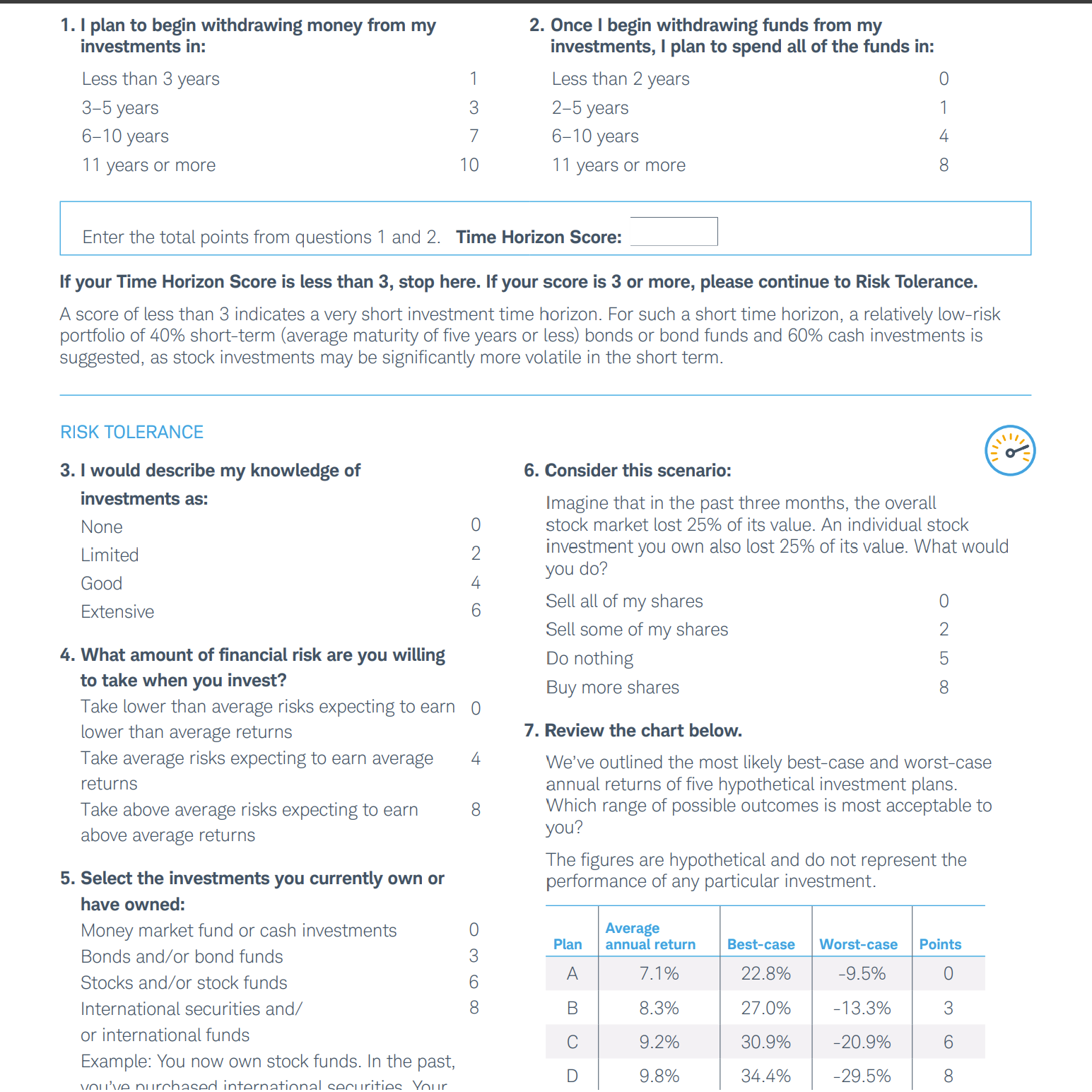
Screenshot of Schwab’s Investor Profile Questionnaire
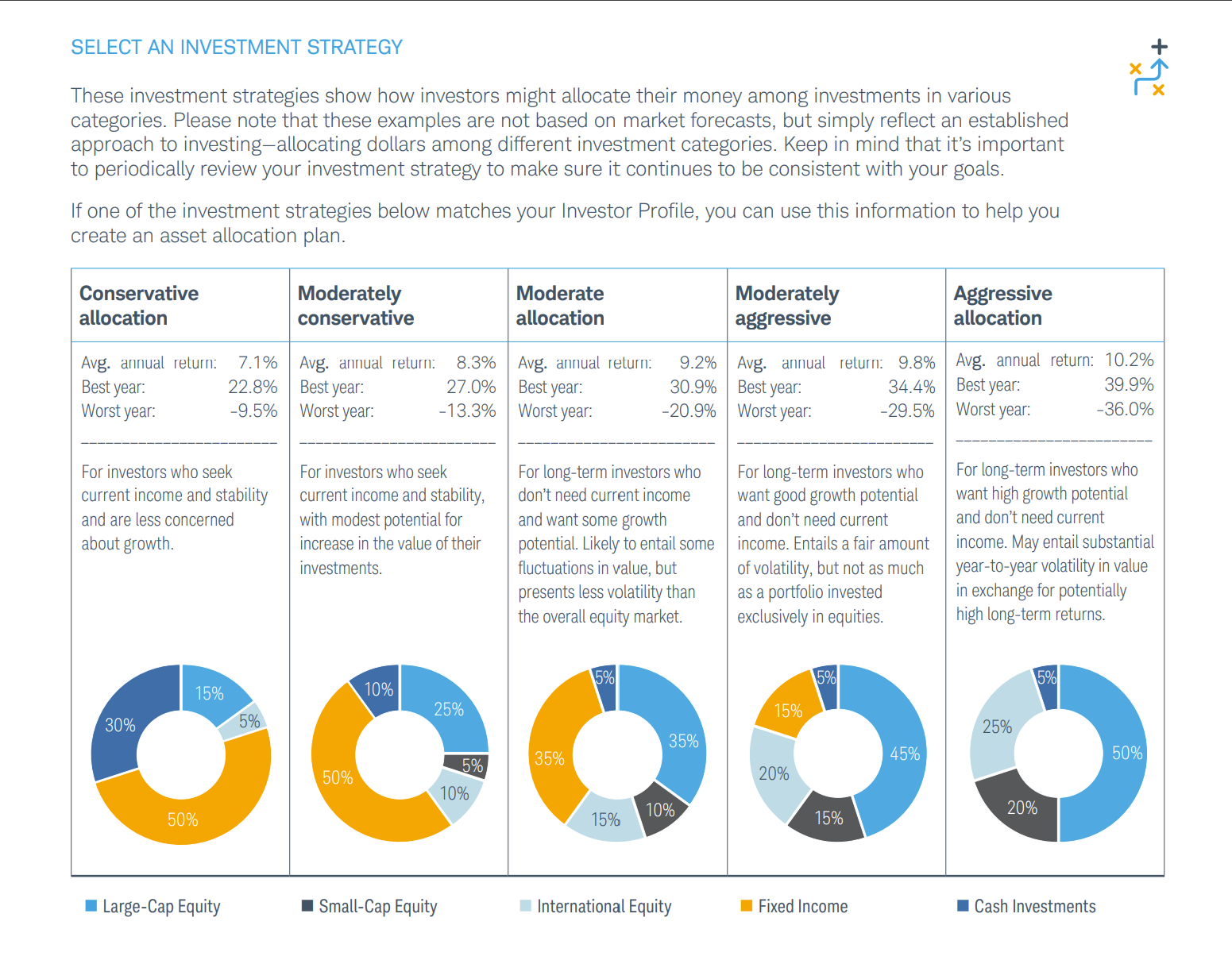
Screenshot of Schwab’s Investor Profile Questionnaire
Step 4: Choose your simple portfolio (your asset allocation/portfolio mix)
Putting it together: Building Your Portfolio
Your portfolio is built on asset allocation, the split between stocks, bonds, and cash. That split drives most of your risk and return. Diversification within each category protects you from any single company or sector sinking your plan.
Common rules of thumb to consider when deciding your asset mix
Approach | Typical mix | Who uses it |
100% stocks | 100/0 | Young accumulators with high tolerance and a long runway |
Classic FIRE accumulation | 80/20 to 90/10 | Most FIRE investors are more than 10 years from FI |
Approaching FI | 70/30 to 60/40 | Within 5 to 10 years of FI, building a bond buffer for sequence risk |
“Age in bonds” | Your age as % bonds | Jack Bogle’s conservative starting point, often adjusted to age minus 10 or 20 |
Your portfolio should be based on your risk profile learned from the risk tests above. Then, take those, and the investor education material from reputable sources, as well as a trusted and competent investment advisor, and decide on the portfolio mix that fits your situation
Here’s how three of the largest investment firms model it:
Vanguard: Allocation recommendations by age (Target Retirement glide path)
Age | Stocks | Bonds |
25 | 90% | 10% |
65 (retirement) | 50% | 50% |
72 and beyond | 30% | 70% |
Source: Vanguard. Vanguard’s glide path starts with a 90% equity allocation at age 25, gradually decreases to 50% equity at age 65, and ultimately lands at 30% equity around age 72.
Fidelity: target asset mixes by investor profile
Profile | Stocks (US + international) | Bonds | Short-term/cash |
Aggressive Growth | 85% (60% + 25%) | 15% | 0% |
Growth | 70% (49% + 21%) | 25% | 5% |
Growth with Income | 60% (42% + 18%) | 35% | 5% |
Balanced | 50% (35% + 15%) | 40% | 10% |
Moderate | 40% (28% + 12%) | 45% | 15% |
Moderate with Income | 30% (21% + 9%) | 50% | 20% |
Conservative | 20% (14% + 6%) | 50% | 30% |
Source: Fidelity. The stock totals are the sum of Fidelity’s domestic and international equity figures.
Schwab: sample allocations by risk profile and time frame
Profile | Time frame | Stocks | Bonds | Cash |
Aggressive | 15 or more years | 95% | 0% | 5% |
Moderate | 7 to 10 years | 60% | 35% | 5% |
Conservative | 3 to 5 years | 20% | 50% | 30% |
Sources: Schwab allocation by age and Schwab time frames. The allocations are Schwab’s samples: 95% stocks, 5% cash; 60% stocks, 35% bonds, 5% cash; 20% stocks, 50% bonds, 30% cash. The time frames are tied to Schwab’s risk profile table, which runs from 3–5 years for conservative to 15 or more years for aggressive.
The three firms generally agree on a pattern: About 85 to 95% stocks with a long horizon and aggressive risk profile, about 60% in the middle, and 20 to 50% stocks near or in retirement in a more conservative phase.
Other Portfolio Approaches to Consider
The three-fund portfolio. The Bogleheads standard: one US total-market fund, one total international fund, one total bond fund. A common FIRE accumulation version is 60% US stocks, 20% international stocks, 20% bonds (e.g., VTI / VXUS / BND).
The one-fund portfolio. A single target-date or all-world fund. You give up control of the mix in exchange for never having to rebalance. For a new investor who will otherwise do nothing, this is a great option. VT (Vanguard Total World Stock ETF), Vanguard Target Retirement 2050 (VFIFX) and LifeStrategy Growth (VASGX) are common examples with Vanguard, though many of the large, respected firms offer equally good alternatives.
The US-only vs. international debate. JL Collins historically only held US stocks (but recently JL Collins has begun investing in the “Total World ETF” VT, for the same reasons I dabble internationally), arguing that many US companies already earn a large share of their revenue abroad. The Bogleheads hold 20% to 40% international to avoid betting everything on one country. Both camps agree on what matters most: targeting low-cost, broad funds, and staying the course is the objective to keep in sight. My own FIRE holdings lean toward US equities as the growth engine, invested from wherever I happen to live, as that is the core of the Geoarbitrage Squared approach I lean on. While I do track and invest in other markets with a separate investor policy statement based on my observations living abroad, my core FIRE engine is built on the US markets.
How can and should real estate contribute to FIRE?
Real estate is one of the most hotly debated points in the FIRE community. The debate splits three ways: Index funds only, direct real estate ownership for rental income as valuable, or REITs (publicly traded real estate companies, already inside a total-market fund at about 2 to 3% of the US market).
The case against directly owning real estate. Rental real estate concentrates a large share of your net worth in one asset, in one city, possibly financed with debt. Houses and condos are illiquid and take months or years to sell; they come with the headaches of tenants and repairs, the unpredictable losses of vacancies, and the costs of maintenance, management, and real estate taxes. Many real estate investments earn less than the stock market would deliver while demanding far more of your time, energy, and concern. This is the logic behind rentvesting and Geoarbitrage Squared: buying the stock market equities that pay for renting the real estate you want to live in and while receiving an additional surplus of cash each month.
The case for owning real estate. A paid-off home is an opportunity for Expense Lock-in. In this case, your highest cost (housing) stops rising with inflation, and the elimination of the monthly expense lowers your FIRE number, permanently. There is also the emotional value of owning your own home, and the opportunity to leave that asset for future generations.
My case. I generally caution those who intend to buy property. Owning property in the US creates problems (tax, maintenance, and the pull to stay put in the US), and owning property outside of the US comes with its own problems (ownership restrictions for foreigners, currency risk, and thin resale markets). But I do own real estate abroad, which does two things for me:
- It can be a near-zero-cost emergency and fallback base that lets me live for less than $1,000 (and likely more like $600) per month. That option lowers my FIRE number to between $180,000 and $300,000 at 4%, while still living extremely comfortably.
- It generates income that actually covers my ExpatFIRE expenses on its own, without touching my equities, allowing my liquid ETF portfolio to continue growing untouched.
But with the average rental property in Latin America or Southeast Asia earning 4% to 6% gross rent, my property case is an anomaly achieved by a lot of sweat equity on an efficient build, location selection, and lots of risk that I’m being compensated for with the current rents.
The point: Whether real estate investment and ownership fit well into your FIRE investment or simple investment approach is very much a case-by-case situation. It depends on the location of the property, where you live, the maintenance and management structure and cost, the rental returns you’ll receive versus the stock market returns, and the sentimental or intangible benefits and strategy options that come with it. If you can’t explain why a specific property beats a total-market index fund after every cost, buy the index fund.
Step 5: Pick low-cost index funds and ETFs to build your target portfolio
Understanding what Exchange Traded Funds (ETFs) are: the heart of the FIRE investing philosophy
Though we already reviewed asset classes (e.g., stocks, bonds, commodities), let’s quickly dive into ETFs in particular, so you can understand the core tool of the FIRE approach to simple investing.
What an ETF is: A chance to own a small piece of a lot of companies, in a single stock
An ETF (exchange-traded fund) is an easy approach to purchasing a “bucket” of stocks or bonds that targets the performance and characteristics of a specific market, industry, or theme, such as the US Market, Aerospace, or “global cybersecurity,” but via a single “stock.” An index fund is a similar bucket (sold in slivers) built to copy a market index, such as the NASDAQ, the S&P500, or the Korean KOSPI.
ETFs can mimic the entire US stock market, automating a way for you to own a sliver of the entire market (or a sliver of each business in the market, depending on how you look at it). Additionally, you own that market as it evolves, as the ETF automatically updates ownership of the companies it holds according to how the market or index changes, instead of letting a mutual fund manager pick which businesses you own within that market.
FIRE investors commonly use index ETFs.
ETFs trade all day like a stock and move between brokers easily.
Why ETFs are great for self-guided investors
- Diversification. One ETF can hold thousands of companies, with the Vanguard Total World Stock ETF a good example, holding over 9,800 companies. This large holding in a “sliver of ownership” gives diversification across a large market that makes index funds have a “self-cleaning” nature: you absorb the profits from firms overperforming, which makes up for the firms that go bankrupt, and the result is a more stable average return. You never need to know which company wins or pick the winner, because you own all of them, so inherently you always own the winner in that market.
- Cost. The biggest total-market funds charge 0.03% a year, which is $3 on every $10,000 invested. On the other hand, managed mutual funds charge a .87% expense ratio on average, which would be $87 by comparison.
- Access. ETFs are easily and quickly purchased through common brokers (Schwab, Fidelity, Interactive Brokers, Robinhood, etc.) just like stocks, with no trading commissions and fractional shares allowed.
- Tax efficiency. Index funds rarely sell holdings inside the fund, so they throw off few taxable capital gains in a regular brokerage account, decreasing tax headaches before your FIRE withdrawals.
Why ETF index funds win against fund managers and picking stocks: The evidence
The 2025 SPIVA scorecard found that 79% of all active managed (managed with active decisions by a human) large-cap US equity funds underperformed the S&P 500 (which can be owned through an ETF), the fourth-worst year in the scorecard’s 25-year history (S&P Dow Jones Indices). Over five years, 89% of the actively managed funds underperformed the S&P Dow Jones Indices.
Few managed funds actually ever beat the market, and the ones that do rarely repeat, especially once you include their management fees and the tax drag of their trading. Owning the ETF that automatically tracks the index (S&P, NASDAQ) means historically the ETF would beat most professionals by simply not playing their game, and get that with a lower expense ratio and less friction.
Why FIRE followers commonly opt for ETFs
FIRE investors need three things from their portfolio: growth that outruns inflation for 40+ years, costs low enough not to eat that growth, and simplicity they can stick with through crashes. Broad index ETFs deliver all three. That is why JL Collins built The Simple Path to Wealth on one total-market fund, and why the Bogleheads forum built its most famous portfolio from three.
The FIRE fund menu: ETFs and index funds commonly recommended in FIRE forums
These are the funds that come up again and again on Bogleheads, r/financialindependence, ChooseFI, and in Collins’ and Mr. Money Mustache’s writing. Funds in the same row are near-substitutes.
These ETFs are listed as illustrative and educational examples only, not recommendations. Expense ratios are as of 2026; confirm on the issuer’s site before buying.
US broad market ETF options
Fund | Ticker | Type | Expense ratio | Notes |
Vanguard Total Stock Market | VTI / VTSAX | ETF / mutual fund | 0.03% / 0.04% | The FIRE classic; ~3,500 stocks |
iShares Core S&P Total US Stock Market | ITOT | ETF | 0.03% | Near-identical to VTI |
Schwab US Broad Market | SCHB | ETF | 0.03% | Schwab’s version |
Schwab Total Stock Market Index | SWTSX | Mutual fund | 0.03% | No minimum at Schwab |
Fidelity Total Market Index | FSKAX | Mutual fund | 0.015% | Fidelity’s standard total-market fund |
Fidelity ZERO Total Market Index | FZROX | Mutual fund | 0.00% | Free, but can’t be moved to another broker |
Vanguard S&P 500 | VOO / VFIAX | ETF / mutual fund | 0.03% / 0.04% | 500 largest US companies (~80% of the US market) |
iShares Core S&P 500 | IVV | ETF | 0.03% | S&P 500 alternative |
Fidelity 500 Index | FXAIX | Mutual fund | 0.015% | S&P 500 at Fidelity |
Schwab S&P 500 Index | SWPPX | Mutual fund | 0.02% | S&P 500 at Schwab |
International Broad Market ETFs
Fund | Ticker | Type | Expense ratio | Notes |
Vanguard Total International Stock | VXUS / VTIAX | ETF / mutual fund | 0.05% / verify | Developed markets + emerging markets, ~8,000 stocks |
iShares Core MSCI Total International Stock | IXUS | ETF | 0.07% | VXUS alternative (the world minus the US market) |
Fidelity Total International Index | FTIHX | Mutual fund | 0.06% | Fidelity’s total international |
Fidelity ZERO International Index | FZILX | Mutual fund | 0.00% | Fidelity-only |
Vanguard FTSE Developed Markets | VEA | ETF | 0.03% | Developed markets only |
Vanguard FTSE Emerging Markets | VWO | ETF | 0.07% | Emerging markets only |
iShares Core MSCI EAFE / Emerging Markets | IEFA / IEMG | ETF | verify | iShares developed/emerging pair |
Schwab International Equity | SCHF | ETF | verify | Schwab developed markets |
US Bond Market ETFs
Fund | Ticker | Type | Expense ratio | Notes |
Vanguard Total Bond Market | BND / VBTLX | ETF / mutual fund | 0.03% / 0.04% | The standard Bogleheads bond fund |
iShares Core US Aggregate Bond | AGG | ETF | 0.03% | BND alternative |
Schwab US Aggregate Bond | SCHZ | ETF | verify | Schwab’s version |
Fidelity US Bond Index | FXNAX | Mutual fund | 0.025% | Fidelity’s version |
Vanguard Total International Bond | BNDX | ETF | verify | Currency-hedged foreign bonds, sometimes a 4th fund |
Vanguard Short-Term Inflation-Protected Securities | VTIP | ETF | verify | TIPS: bonds indexed to inflation, popular near retirement |
All-in-one fund options (one fund & done)
Fund | Ticker | What it holds |
Vanguard Total World Stock | VT | Aims to represent every market on earth, both US and international, in one ETF. Tracks the Financial Times Stock Exchange Global All Cap Index |
Vanguard Target Retirement 20XX | e.g., VFIFX (2050) | A full three-fund mix that shifts to more bonds as the target year approaches |
Vanguard LifeStrategy Growth | VASGX | A fixed 80/20 global mix |
iShares Core Growth Allocation | AOR | A fixed ~60/40 global mix |
Assets and Habits to Avoid when Buying for Your Portfolio
The FIRE approach wins as much by what it buys as it does by what it skips.
- Stock picking. If 79% of professional managers with research teams can’t beat the stock market index in a year, picking individual stocks from your phone is a bet against even worse odds. Owning one company means owning its bankruptcy risk and performance risk; owning the market means one bankruptcy is a rounding error in the 9,799 other companies you hold.
- Trading on leverage. A 3x leveraged ETF delivers three times the index’s move for one day, then resets. Over weeks and months, that daily reset compounds against you: if the index drops 10% (from $100 to $90) and then rises 10% (from $90 to $99), it ends down 1%, but a 3x fund drops 30% (from $100 to $70) and rises 30% (from $70 to $91) to end down 9%. The math is confusing and brutal. In choppy markets, the fund bleeds value even while the index goes nowhere, and a sharp bear market can wipe out most of the balance before any recovery. If you had not been in the leveraged ETF, you could simply hold and wait for recovery with nothing lost but time. The SEC warns that most of these funds are built for holding periods of a single day (Investor.gov). Their expense ratios, often near 1%, add to the drag, but the daily reset is what makes them extremely risky for buy-and-hold investors.
- Crypto speculation. Unlike stocks, which own businesses that deliver a product or service and create a profit (paid as dividends or reinvested), crypto has no underlying earnings or income stream to value the price against. The purchase of crypto is justified solely by the hope that someone will pay a higher price later, which is speculation by definition. Buy assets based on provable value, not hope.
- Sector bets. Any move that is speculative is a risk, including speculating on events within sectors. Financials, aerospace and defense, consumer discretionary, tech: each has had decade-long stretches of brutal underperformance. A total-market fund already owns every sector at its market weight.
- High-fee advisors. The beauty of index fund ETFs and this simple approach to investing is that it gains you percentage points of return just by avoiding paying someone else to manage a fund or manage your money. The next section (on costs to beware of) gives numbers for why money managers are generally unnecessary, and more often than not, a risk to your wallet with better, easier alternatives.
Costs to be aware of on your investing journey
Every dollar spent on fees is a dollar that never compounds. Watch for three kinds of hidden costs:
- Fees per trade when buying ETFs, stocks, and bonds. Most major US brokers now charge $0 commissions on ETF trades. If yours charges fees on trades, switch.
- Expense ratios on ETFs, but more so on mutual funds. Index ETFs charge 0.00 to 0.07%. Actively managed mutual funds often charge 0.5 to 1%, plus sales loads of up to 5.75% at some brokers. Check the expense ratio before you buy anything.
- Financial advisor fees. The standard assets-under-management (AUM) fee is about 1% a year, every year, on your entire balance, regardless of how they perform…or don’t.
Fund managers and AUM advisors, as well as trading costs when charged, can tilt toward 1% off the top of your assets. But is 1% really that significant and worth worrying about?
Here is what that 1% does. Invest $20,000 a year for 30 years at a 7% return. In a 0.03% index fund, you end with about $2.01 million. Pay 1% on top, and you end with about $1.67 million. That 1% fee costs $343,000, roughly 17% of your final wealth, and the equivalent of more than half of the $600,000 you contributed. (Assumptions: 7% annual return, fees deducted annually.)
This drag is central to the case for the FIRE approach to investing. It also makes the case for fee-only financial planners (paid a flat or hourly fee, with the simple investing approach) over AUM advisors. Pay for advice when you need it. Don’t rent out a percentage of your future for it.
Step 6: Choose a broker and open a brokerage account to cheaply and easily buy your target ETFs
Aim for a brokerage and account with an easily understood interface and an account that charges no fees per trade, offers fractional shares of ETFs, and supports automatic recurring investments.
I personally have used and have been satisfied with Robinhood and Schwab for easy-to-use brokerage accounts, with Robinhood being easier for newbies, and Schwab (with the Thinkorswim platform) being better for trading and advanced research. Other commonly recommended platforms include Fidelity (the zero-fee index funds and a strong all-around app), Vanguard (the home of index investing), and Interactive Brokers (the widest global access and available to Non-US Residents). For retirement accounts, Vanguard is another trusted option.
Non-US residents may not have access to Schwab or Robinhood, and may need Schwab International or Interactive Brokers instead. Many US brokers also restrict or close accounts for Americans who move abroad, so check the policy before you go.
Account types and the order to fund them
Where you hold your funds matters almost as much as which funds you hold, due to taxes. Tax-advantaged accounts let your money compound without a tax bill every year, if you get the tax benefits.
The commonly recommended FIRE investment order for US workers is as follows (assuming the tax benefits and other benefits intended for each stage are achieved):
- 401(k) up to the employer match. A 50% or 100% match is an instant return no investment can touch. Never leave this opportunity on the table.
- HSA (Health Savings Account), if you have a high-deductible health plan. It is triple tax-advantaged. You get a deduction going in, tax-free growth, and tax-free payout for medical costs. Many FIRE investors pay medical bills out of pocket and let the HSA compound as a stealth retirement account.
- Roth IRA (or traditional IRA). Roth contributions are taxed now and grow tax-free forever. For early retirees, Roth contributions (not earnings) can be withdrawn at any time without tax or penalty, which makes the Roth a flexible bridge.
- Max out the 401(k). Back to the workplace plan, up to the annual limit.
- Taxable brokerage account. No limits, no age restrictions, and the account that funds the years before 59 1/2. If the money is already taxed or is tax-exempt without going through an HSA, IRA, Roth IRA, or 401k (for example, via FEIE), this may be the better option.
Account | 2026 contribution limit | Catch-up (age 50+) |
401(k), 403(b), 457, TSP | $24,500 | +$8,000 (+$11,250 at ages 60 to 63) |
Traditional + Roth IRA (combined) | $7,500 | +$1,100 |
HSA, self-only | $4,400 | +$1,000 (age 55+) |
HSA, family | $8,750 | +$1,000 (age 55+) |
Taxable brokerage | No limit | n/a |
Source: IRS 2026 limits, compiled by TaxSlayer. Roth IRA eligibility phases out at higher incomes.
The Expat Angle: Taxes to consider
If you live abroad, or plan to, you need to be aware of three taxes that can create headaches:
- Taking the foreign earned income exclusion can wipe out IRA eligibility. IRA contributions require taxable compensation. If you exclude all your foreign earnings with the FEIE (up to $132,900 per person for 2026, per the IRS), you may have nothing left to contribute against. Claiming the foreign tax credit instead, or excluding only part of your income, can preserve it. On the other hand, earning FEIE tax-exempt income potentially makes it smart to fund your taxable brokerage account (with untaxed income) first, and consider the possibility/approach for 0% taxed capital gains later.
- US citizens abroad who buy foreign-domiciled ETFs will run into PFIC tax rules. A European or Asian fund (including the popular Irish UCITS ETFs) is a Passive Foreign Investment Company for US tax purposes, taxed at punitive rates with heavy annual paperwork. US persons anywhere in the world should consider holding US-domiciled funds like the ones in the menu above, unless it otherwise fits your plan.
- Non-US persons holding US assets face US estate tax exposure. US-situs assets, including US-listed ETFs, above $60,000 can be hit by US estate tax at death for non-residents. This is why many non-Americans use Irish-domiciled funds instead.
Step 7: Invest your money, then automate the process
Getting an initial sum or a large sum of money into the market
Once you have your target portfolio planned, the ETFs you want planned, and a brokerage account, it’s time to get in the market and buy that portfolio…and start investing.
You have two options to invest your cash:
- Lump sum investing: Invest all of your money today.
- Dollar-cost averaging (DCA): Invest separate, set dollar amounts at set intervals (weekly, monthly, etc.) until all of your planned cash is in the market, matching your target portfolio mix.
The data favors the lump sum approach.
Vanguard compared the DCA investing approach against lump-sum investing across markets from 1976 to 2022 and found lump-sum investing beat cost averaging about two-thirds of the time, with the margin widening the higher your stock allocation (Vanguard). Markets rise more often than they fall, so money waiting on the sidelines usually misses gains.
However, for nervous investors delaying out of fear (like I was when I started), dollar-cost averaging is far better than nothing. DCA only wins in the worst markets, and it still beat holding cash in Vanguard’s research. If a lump sum keeps you up at night, spread it over 3 to 6 months and set it on autopilot. More on this in Investing a Windfall.
Note that your regular monthly contributions already apply dollar-cost averaging. The choice between dollar cost averaging and lump sum only applies to the pot of money you have now that needs to be invested, or if you’re lucky enough to receive a windfall later.
Why saving automatically and routinely matters
- It removes timing from the decision. Automate a transfer and purchase the day after payday. You will never again wonder whether this is a good month to buy.
- It buys more shares when prices are low. A fixed $1,000 a month buys more shares in a crash and fewer at a peak, without you lifting a finger.
- It builds the habit that survives bad years. People who invest by schedule keep investing through bear markets. People who invest by feel stop at the bottom.
Step 8: Stay the course: Rebalance, keep taxes low, and leave it alone
Rebalancing
Rebalancing is the option of resetting your portfolio to maintain your asset allocation (e.g., 80% stocks / 20% bonds, 70% stocks / 30% bonds) in line with your risk profile and investment plan – the portfolio mix that you planned at the beginning. Once you have your target asset allocation, as the market moves, your mix drifts. After a great year for stocks, an 80/20 portfolio might be 87/13 and riskier than you chose. You could rebalance by selling a portion of stocks and buying bonds, or vice versa, to get back to your target allocation; however, this sale could trigger a taxable event and taxes, and the better option may be to simply direct new assets (new monthly savings and investments) in a way to balance out your portfolio and put it back in line with your target mix.
To rebalance by steering new contributions, if stocks are overweight, direct the next few months of contributions to bonds instead. This gets you back on target without selling, which avoids taxable gains on sales. Rebalancing inside a 401(k) or IRA (selling and buying within the account, without any withdrawals) triggers no tax at all, so do any selling there first.
Whichever option you pick, write it into your personal Investment Policy Statement and stick to it.
- Calendar rule: set a recurring date to check, once a year (your birthday or January 1 works).
- Band rule: rebalance only when an asset drifts past a set band, for example, 5 percentage points from target.
Asset location and tax efficiency
Asset allocation is what you own. Asset location is which account you hold it in. Put the right funds in the right accounts, and you keep more of the same return.
- Bonds in tax-deferred accounts (401(k), traditional IRA). Bond interest is taxed as ordinary income every year, so shelter it.
- Highest-growth stocks in the Roth. Tax-free growth is worth the most on the assets that grow the most.
- Total-market and international stock ETFs in taxable accounts. They are tax-efficient, mostly paying qualified dividends taxed at low rates. International funds held in taxable accounts also let you claim the foreign tax credit on taxes withheld abroad.
Essential Tactics to Learn: Tax-loss harvesting and tax-gain harvesting
- Tax-loss harvesting: In a down market, you can sell a fund in your taxable account at a loss and immediately buy a similar but not “substantially identical” fund (e.g., sell VTI, buy ITOT or SCHB). By doing this, you stay invested, and the realized loss offsets capital gains plus up to $3,000 of ordinary income a year, with the rest carried forward. Avoid buying the same fund within 30 days before or after (the wash-sale rule).
- Tax-gain harvesting: In low-income years (less than $49,450), you can sell winners and buy them right back to reset your cost basis higher, paying 0% tax on the gain, if you’re below the annual threshold for earnings & gains. For 2026, long-term gains are taxed at 0% for taxable income up to $49,450 for single filers or $ 98,900 for married filers filing jointly (Kiplinger). Early retirees living on modest withdrawals or Expat FIRE retirees often sit in this bracket for years.
Also, see how to pay zero taxes in retirement.
Essential knowledge: Invest it and leave it
Time in the market beats timing the market
The way to win in investing is not by trading, it is just by putting your money in the right place, soon, and leaving it there.
J.P. Morgan found that missing the 10 best days of the market over the past 20 years would have reduced a portfolio’s annualized return by almost 50%, and missing the best 40 days would have turned the return negative (J.P. Morgan 2025 Guide to Retirement, via 401k Specialist). Seven of the 10 best days for the S&P 500 occurred within two weeks of the 10 worst days (J.P. Morgan 2024 Guide to Retirement, via 401k Specialist).
A problem that exacerbates this is that the best days in the stock market often arrive in the middle of the panic, when selling feels safest but buying and holding are counterintuitively the smartest moves. Timing those specific “winner” days is nearly impossible for most retail investors (like us), and professional fund managers and traders do no better. The only reliable way to catch the best days in the stock market is to be invested during all of them.
Leave your invested stocks alone, and when the market dips and your stocks’ prices dip with it, understand that the market will come back, along with your portfolio value.
The market cycles between bear markets (losing value, with low stock prices and stacked losses) and bull markets.
Yes, some single companies will lose value they’ll never get back, and some companies will inevitably even die off. However, in the 100+ years of Wall Street, the entire US stock market, which the 4% rule is based on, has always come back (though after 1929 it took decades in price terms, but market activity regulations and consumer protections were restructured to avoid such a catastrophe happening again). The 2020 crash took the S&P 500 down about a third of its value in just five weeks; it took six months to recover back to its previous high, but it did recover.
The end performance of the entire market in all scenarios above, ultimately bouncing back, highlights why diversification, owning a little piece of every company in the US instead of “betting” on one big one, is the strategy that wins, and why staying in the game through all of it, unmoved, matters.
Only sell to rebalance back to your target portfolio, for tax-loss or gains harvesting, or to fund your life once you reach FI. Otherwise, invest your money, then leave it alone.
Know how deep the losses can get, before they happen, so you can be mentally and emotionally prepared to ride out the roller coaster.
The three-fund portfolio’s maximum drawdown was 47.74%, bottoming on March 9, 2009, and recovery took 539 trading sessions, a little over two years (PortfoliosLab). A $500,000 portfolio would have shown about $260,000 at the bottom.
Understand this possibility exists: that an extremely rough two years is possible, and be mentally prepared to ride out that storm and buy more when that dip happens. The investors who were mentally prepared and then jumped on the offensive, who kept buying through 2009, bought the cheapest stocks of the next decade.
The best tool for staying the course through the storm is a written plan made while you are calm. Your Investment Policy Statement records your target allocation, your rebalancing rule, and what you will do when the market drops 20%, 30%, or 50%. When the headlines scream, you follow the document, not your nerves.
Step 9: Plan your path from investing into FIRE
Once you’ve taken on the initiative, effort, and diligence of understanding investing, taking the leap to grow your wealth, and continued investing while time does its part, with enough patience, you land at the end goal.
Financial independence, with the opportunity to retire early, if you wish.
This freedom, and these options, are the ultimate goal of the FIRE movement. But, in order to properly convert your investment plan into a plan that leads to FI, it is essential to understand where the end goal of “financial independence” is for you specifically, and how to withdraw the money once you reach that point.
To help you plan your path to FIRE, we’ll first dive into what the 4% rule actually is, and how we use that to find your finish line, your FIRE number, also known as the dollar amount that buys your financial freedom.
The 4% rule: the driving logic behind the FIRE investment philosophy
The notorious “4% rule” is the driving idea behind FIRE number calculations and figuring out how much you need to be financially independent, according to the FIRE philosophy.
So, what is the 4% rule?
The 4% rule says you can withdraw 4% of your portfolio in your first year of retirement, raise that dollar amount with inflation every year after, and historically not run out of money for at least 30 years. It is why your FIRE number is 25 times your spending: 1 divided by 4% is 25.
Where the 4% rule comes from: William Bengen’s 1994 study and the 1998 Trinity University study
In 1994, Financial planner William Bengen tested every 30-year retirement in US market history using a portfolio of 50% US large-company stocks and 50% intermediate-term US Treasury bonds. The highest withdrawal rate that survived every period, including retiring into the Great Depression and the inflation of the 1970s, was about 4.15%, which he rounded to 4% and called the “SAFEMAX”.
In 1998, three Trinity University professors (Cooley, Hubbard, and Walz) ran the same kind of test across many stock/bond mixes. Portfolios between 50% and 75% stocks, withdrawing 4% adjusted for inflation, survived roughly 95% or more of historical 30-year periods.
Practically, the average FIRE follower can recreate the tested portfolio with broad market US stock exposure, such as through ETFs (such as VTI, ITOT, or SCHB, listed as examples only, not recommendations) and broad market US bonds (such as BND, AGG, or FXNAX, listed as examples only, not recommendations), in a portfolio mix of somewhere between 50/50 and 75/25.
The 2025 and 2026 updates to Bengen’s 4% rule
- Bengen raised his 4% number to 4.7%. In 2025, Bengen’s book, A Richer Retirement, increased the baseline safe withdrawal rate for a 30-year retirement from 4% to 4.7%, after adding more asset classes to the test portfolio (WTOP). He frames 4.7% as the worst-case floor, not the typical outcome.
- Morningstar went the other way. In Morningstar’s December 2025 State of Retirement Income report, the firm set 3.9% as the highest safe starting withdrawal rate for new retirees in 2026, using forward-looking return forecasts (24/7 Wall St.).
In reality, 4% sits in the middle of the serious estimates, which is exactly why it remains the default for most of the FIRE community.
The catch for FIRE and early retirees: 30 years is not 50, and the original 4% wasn’t calculated for FIRE
The original 4% rule was built on 30-year retirements. Most aspiring FIRE followers are looking at much longer periods for retirement if they successfully retire early.
Retire at 40, and your money may need to last 50 or 60 years. Karsten Jeske’s (“Big ERN”) Safe Withdrawal Rate Series, which tests horizons up to 60 years, found that a withdrawal rate of 3.5% or below with roughly 75% or more in stocks produced strong success rates over 60 years (Early Retirement Now). Because of that data, many FIRE-focused financial planners use 3.25 to 3.5% (a FIRE number of 29 to 31 times spending) to plan for very early retirement.
You can still use 4% if you build in flexibility via things such as a willingness to cut spending 10% in a bad year, starting some part-time work or Barista FIRE income, or considering a move to a cheaper country leveraging geoarbitrage for a down year. Flexibility is worth more than a few fractions of a percent. As such, stress-test your plan with the safe withdrawal rate calculator, and think about contingencies in down markets, potentially via ExpatFIRE.
Sequence-of-returns risk and the bond tent option
The biggest threat to a new retiree is not a bad average return; it is bad returns early in retirement. A 30% crash in your first two years of retirement, while you are also withdrawing, can permanently shrink the portfolio, even if the next 20 years are great. The same crash in year 20 will barely matter.
One option for countering sequence of returns risk is doing a soft entry into FIRE, keeping the door open for income and employment in the first couple of years of early retirement, or semiretirement, whether that’s via an old employer, via freelancing, or via consulting.
However, the bond tent is the standard, primary defense. In the bond tent approach, you raise your bond allocation (within your portfolio mix) in the five or so years before and after your FIRE date (for example, from 20% to 30 to 40%), so you plan to spend from bonds instead of selling stocks in a crash. This works because while stock prices will crash, and selling stocks at a low price is not what you want to do, bond prices will stay more stable and closer to their value in good times by nature, even during a bear market. Then, after you are out of the early danger zone of FIRE retirement, let bonds drift back down as a portion of your portfolio over your first decade of retirement as the danger zone passes. Some FIRE retirees keep two to three years of expenses in bonds or cash for the same reason, so they can always draw from a less volatile and more predictable pool of assets.
Finally catching FIRE: Getting to your money before age 59 1/2
Retirement accounts charge a 10% penalty on most withdrawals before age 59 1/2. While traditional retirees never notice this problem, because they rarely have the option to retire before that age, early retirees have to plan around it. There are five well-worn options for accessing your retirement funds early for that FIRE escape:
- Plan for a taxable bridge account. Your regular brokerage account has no age limits. Many FIRE investors fund the first 5 to 15 years of retirement from taxable savings while the retirement accounts keep compounding.
- Roth IRA contributions. The amount you contributed (not the growth/gains) comes out any time, tax and penalty free. Ten years of $7,500 contributions is $75,000 of accessible money.
- The Roth conversion ladder. Each year in early retirement, convert a slice of your traditional 401(k) or IRA to a Roth, paying tax at your new, low-income tax rate. Each converted amount can be withdrawn penalty-free five years later. Build five years of taxable or Roth-contribution money to cover the gap, and the ladder feeds you from year six on. (Source: IRS Publication 590-B)
- 72(t) withdrawals (SEPP). “Substantially equal periodic payments” let you take an IRS-calculated amount from an IRA each year with no penalty, but you must continue for five years or until 59 1/2, whichever is longer. Rigid, but useful for large IRAs. (Source: IRS | Substantially Equal Periodic Payments explainer)
- The Rule of 55. Leave your job in or after the year you turn 55, and you can withdraw from that employer’s 401(k) without penalty. It doesn’t apply to IRAs, so don’t roll that 401(k) over until you’re past 59 1/2.
Bonus Option: Plan your taxable brokerage account around the 0% capital gains bracket
If you’ll be leveraging geoarbitrage and living on less than $49,450 per adult, there is an opportunity to cash in your stocks from your Schwab, Vanguard, Interactive Brokers account, or any other normally taxable brokerage, tax-free up to that limit. Plan correctly: that first $49,450 of capital gains could be tax-free, regardless of your age or location (but note state taxes may still apply, depending on your US state of residence) (Source: IRS Topic no. 409, Capital Gains and Losses).
Consider how you allocate beyond your annual tax-advantaged limits to your taxable account, which is immediately accessible. Long-term capital gains are taxed at 0% up to $49,450 of taxable income for single filers and $98,900 for married couples filing jointly (2026). Add the 2026 standard deduction ($16,100 single, $32,200 married) and a married couple living only on long-term gains can realize about $131,000 a year at a 0% federal rate (Kiplinger; US Tax Tools). Qualified dividends, interest, Roth conversions, and any other passive or part-time earnings count against this limit, so the order you draw from each account is its own planning project.
The practical takeaway for accumulators: don’t put every spare dollar into accounts you can’t touch until 59 1/2. A healthy taxable account is the bridge that makes the early in early retirement possible.
Rolling it up: how to invest according to the FIRE philosophy, step by step
- Step 0. Understand the basics of investing, why it is important, and the basic tools the FIRE approach to simple investing uses
- Step 1: Get your foundation in place: Assess your financial position and your risk profile
- Step 2: Set your savings rate and how much you’ll invest each month
- Step 3: Know your investor risk profile by assessing your risk tolerance and your risk capacity
- Step 4: Choose your simple portfolio (your asset allocation/portfolio mix)
- Step 5: Pick low-cost index funds and ETFs to build your target portfolio
- Step 6: Choose a broker and open a brokerage account to cheaply and easily buy your target ETFs
- Step 7: Invest your money, then automate the process
- Step 8: Stay the course: Rebalance, keep taxes low, and leave it alone
- Step 9: Plan your path from investing into FIRE
What next
- Find your FIRE number, the number that, with the 4% rule, will finance your financial independence and early retirement: FIRE number calculator.
- Read the full guide to what financial independence is and how to achieve it.
- Understand which type of FIRE is for you: traditional FIRE, LeanFIRE, ExpatFIRE, and more in Which Path to FIRE Is Right for You?
- Understand how geoarbitrage can supercharge your saving and investing: Geoarbitrage Squared.
- Consider more investor education with these books, starting with JL Collins’ The Simple Path to Wealth and Taylor Larimore’s The Bogleheads’ Guide to the Three-Fund Portfolio.
- Consider downloading our Investor Policy Statement template to create your own financial plan.
FAQs
How much money do I need to start investing?
You can start with as little as $1 to $10. Many brokerages have no account minimums and offer fractional shares, so you can buy part of a stock or ETF with any amount. The more important thing is when, starting investing early, ideally now, not how much you start with.
Is investing better than saving?
Both investing and saving are good and serve different purposes. Liquid stores of cash, such as savings accounts, are best to prepare for emergencies and goals within three years. Investing, such as in stocks and bonds, is better for long-term goals because it offers higher growth potential over time and the time horizon can withstand the volatility.
What is the safest way to invest for beginners?
A diversified, broad market, low-cost index fund or target-date fund is one of the most reliable starting points for any beginning investor. This approach is simple, easy, and spreads your money across hundreds or thousands of companies, which reduces the impact of any single loss while making the process frictionless.
Should I pay off debt or invest first?
High-interest debt, such as credit cards, should be paid off before investing beyond your employer match. Low-interest debt, like many mortgages, can usually be paid on schedule while you invest. The deciding factor is whether the debt’s interest rate is higher than the after-tax returns of your portfolio, with any debt with an interest rate above that being a higher priority.
Can I lose all my money investing?
It is always possible to lose money with individual stocks or speculative assets, such as crypto. However, a broadly diversified index fund, such as VTI, would require nearly every major company in the US to fail at once, which would essentially mean the US economy, and the US as we know it, cease to exist. This scenario of total loss is extremely unlikely.
How often should I check my investments?
You should invest monthly, then once annually (at most quarterly or semi-annually), you should assess the asset mix in your portfolio against your target portfolio mix to consider rebalancing through allocation of new investments. Annually, consider whether the assets, the targeted risk profile, and your goals and requirements align. Avoid checking daily, as it tends to encourage emotional decisions.
What’s the difference between a Roth IRA and a traditional IRA?
A traditional IRA allows a certain deposit each year that is untaxed, and lowers your taxes today by making that contribution “tax-deducti”, and in return you pay taxes on the entire withdrawal in retirement. A Roth IRA uses after-tax money contributed today, and qualified withdrawals in retirement are then tax-free.
Sources
- S&P Dow Jones Indices: SPIVA U.S. Year-End 2025
- S&P Dow Jones Indices: SPIVA by the numbers
- Vanguard: Cost averaging vs. lump-sum research
- Vanguard: 2025 expense ratio reductions
- J.P. Morgan 2025 Guide to Retirement, via 401k Specialist
- J.P. Morgan 2024 Guide to Retirement, via 401k Specialist
- WTOP: Bengen’s 4.7% update
- 24/7 Wall St.: Morningstar’s 3.9% for 2026
- Early Retirement Now: Safe Withdrawal Rate Series, Part 2
- IRS: Figuring the foreign earned income exclusion
- TaxSlayer: 2026 contribution limits
- Kiplinger: 2026 capital gains thresholds
- US Tax Tools: 2026 capital gains rates
- SEC Investor.gov: Leveraged investing strategies
- US Inflation Calculator: September 2026 CPI and annual rates
- University of Missouri: Investment Risk Tolerance Assessment
- PortfoliosLab: Bogleheads three-fund portfolio
- Fund expense ratios: Financewonk index fund comparison, My Money Blog, Walnut
.
.
ABOUT THE AUTHOR
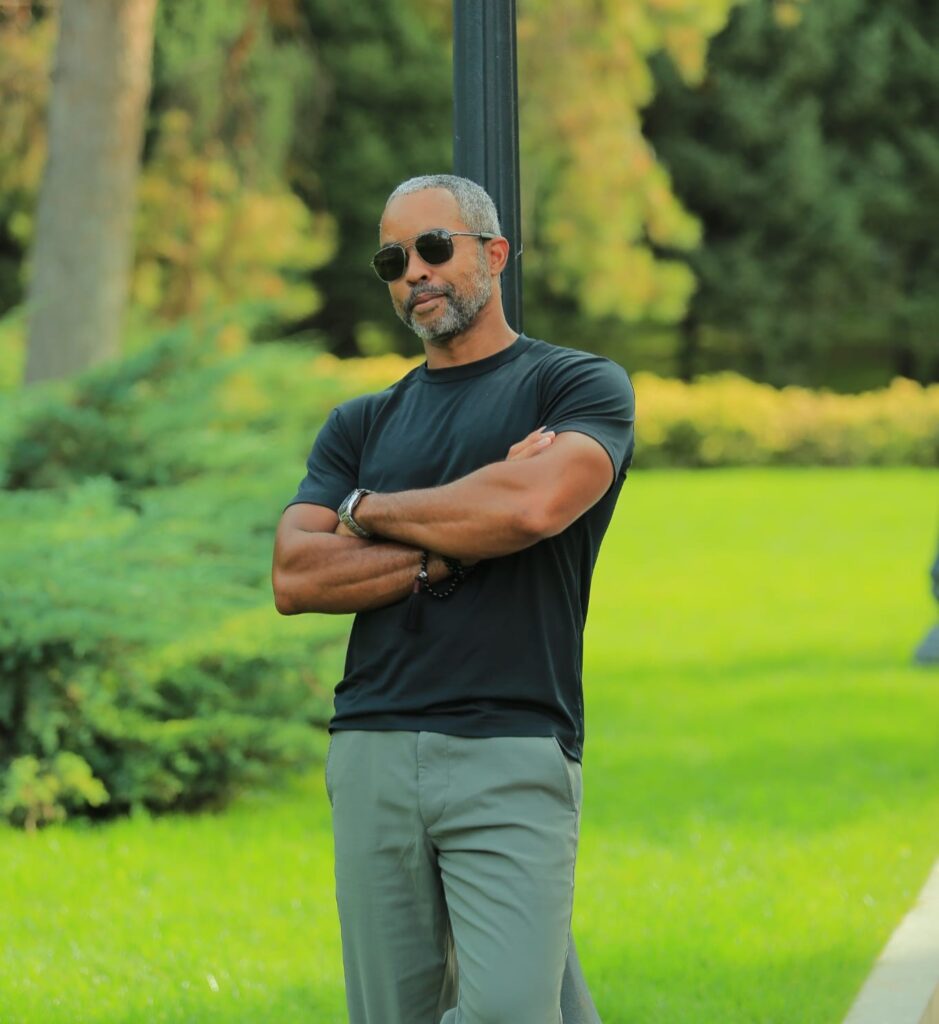
Carlos Grider launched A Brother Abroad in 2017 after a “one-year abroad” experiment turned into a long-term life strategy. After 65+ countries and a decade abroad, he now writes about FIRE, personal finance, geo-arbitrage, and the real-world logistics of living abroad—visas, costs, and tradeoffs—so readers can make smarter global moves with fewer surprises. Carlos is a former Big 4 management consultant and DoD cultural advisor with an MBA (UT Austin) and Boston University’s Certificate in Financial Planning. He’s the author of Digital Nomad Nation: Rise of the Borderless Generation and is currently writing The Sovereign Expat.