
Most nomads and expats estimate the price of a new life in a new country with cost of living databases. Numbeo, Expatistan, and Nomads.com (formerly Nomadlist) are some of the most commonly used, and I appreciate them as they’ve helped me plan my life for the last 10 years, estimating prices for meals, rent, and transportation before ever setting foot in a country.
Table of Contents
The weakness in these oft-used tools among nomads is who supplied the prices used to calculate the cost of living (COL), and the kind of budget they live within: the retiree with an ample budget, the backpacker on a shoestring budget living in hostels and cooking their own meals, the nomad with a monthly allocation for coworking and wellness. Though each traveler’s entry is honest, the databases return the average of all of their entries. None of those travel styles, and their monthly budgets, perfectly line up with your lifestyle, or your budget, so the average cost of living delivered by these tools will absolutely be inaccurate in predicting your spending. Your salary and budget sit either above or below the national average in your home country, and your spending does too.
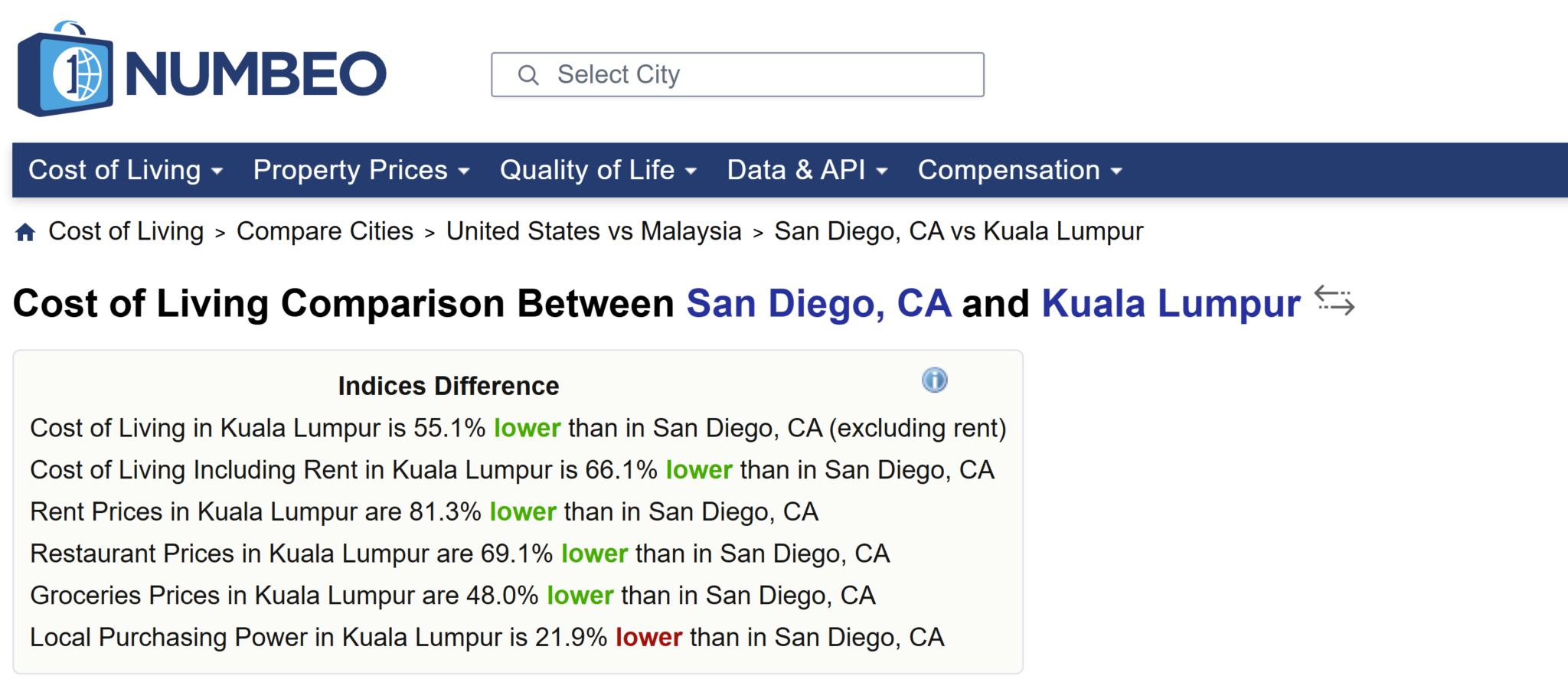
These tools are directionally correct – Rome is more expensive than Da Nang, and Phnom Penh is cheaper than San Diego – and relatively correct – Kuala Lumpur is definitely less than half the cost of living of San Diego.
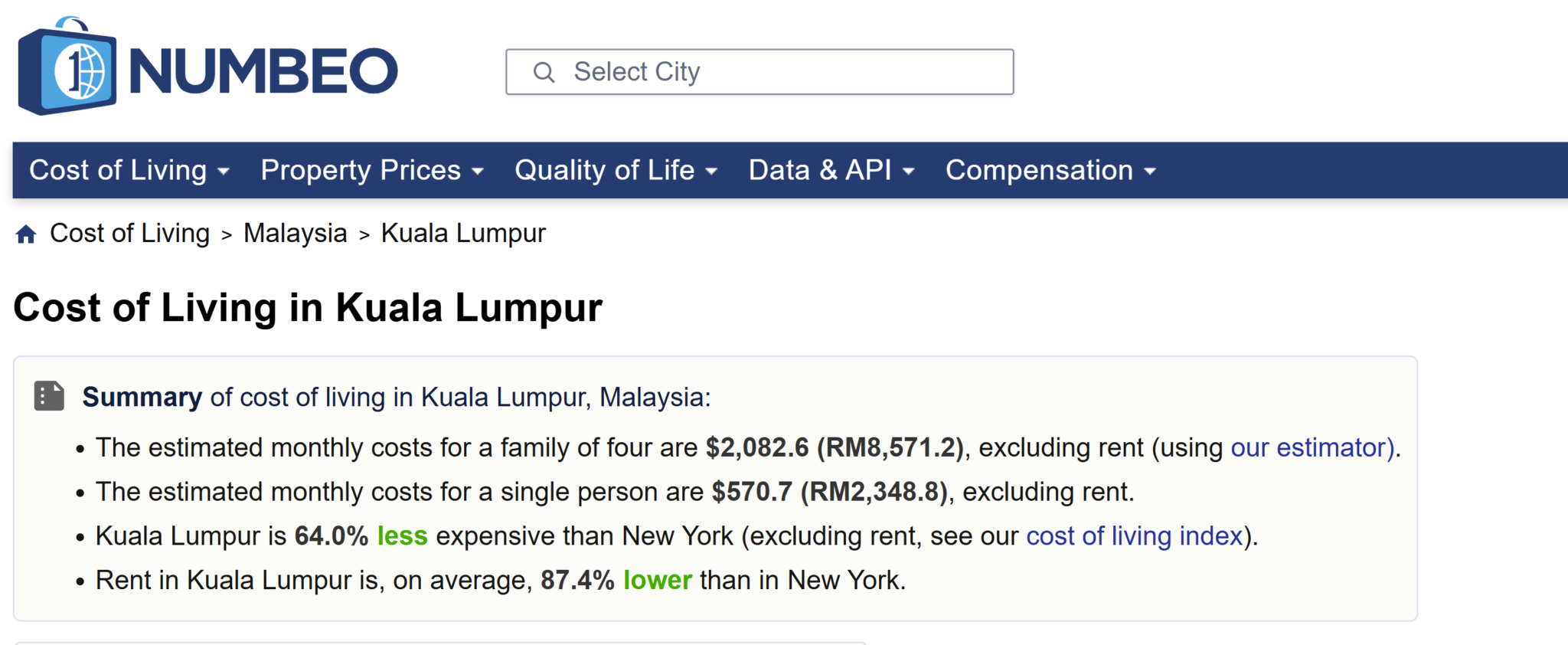
And this valuable information holds even if I know my cost of living in Kuala Lumpur as a single person is more than the estimated $1,250 a month ($570 basic COL + $680 rent in city center).

This error, with the “average” cost of living available being far above or below your actual spending costs, is the most common in Expat FIRE planning, where you plan for and target your FIRE number based on an estimated COL in a place you have not lived yet. A 30% underestimate on monthly spending is a 30% undershot on the portfolio you need. And overestimating by 30% means staying 30% longer than you needed to.
So, the key to better planning your moves, your budget, and your COL is to use the accurate parts of this data (relative costs) to estimate the less accurate costs (specific city COL) to get your estimated monthly budget and cost of living in any city in the world, based on a budget or monthly spending habit you already know.
The specific fix is to stop treating the database number as your likely budget and use it as an input to estimate a more accurate number. Instead, use that data to calculate the ratio between the cost of living of two locations from the same database, then apply that ratio to the one cost of living you know for certain: your own.
This ratio is a “geoarbitrage multiple,” helping you estimate and calculate how much purchasing power you gain, or lose, moving between two locations, and how that affects your numbers.
What a geoarbitrage multiple is
A geoarbitrage multiple is the ratio between the cost of living in two places, pulled from the same database (e.g., Expatistan, Numbeo, Nomad.com, etc.). In using this practically, one of the places should be where you know your real spending and monthly cost of living. The other should be where you want an estimated cost of living tailored to you.
The database does not need to match your lifestyle. It needs to price the same basket of goods, like rent, eating, transportation, and incidentals, in both places, so whatever it gets wrong about you, it gets wrong in both, and the error mostly cancels out.
Your estimated spend abroad = Your Monthly Spending at Home x (Database Cost of Living for City Abroad / Database cost of living for home city)
For example, take Expatistan’s numbers for the US and Thailand.
Expatistan lists the US at $3,610 a month and Thailand at $1,138.
Divide the US figure by Thailand’s ($3,3610/$1,138), and you get 3.17, so the US costs 3.17 times what Thailand costs.
Flip the calculation, and we understand that Thailand costs 31.5% of the US ($1,138 / $3,610 = 0.315).
Now apply it to a real budget.
My US spending was $5,500 a month. Multiply that $5,500 monthly budget by 0.315, and my likely Thailand spending is $1,734. Expatistan’s own Thailand number is $1,138, so the database undershoots my life by $596 a month. That doesn’t make Expatistan wrong. It means the average cost of living is the average, and the estimate wasn’t tailored to me yet.
Keep in mind that two caveats apply. (1) The estimated cost of living, based on the geoarbitrage multiple, describes your spending as a person “settled” into their new home, once you have a longer lease, a familiar neighborhood, and a routine. And (2) both numbers, the cost of living for your home city and target city, must come from the same site. A Numbeo figure divided by an Expatistan figure compares two different baskets and tells you nothing. Comparing Numbeo to Numbeo and Expatistan to Expatistan compares apples to apples.
Compare and analyze city to city when you can
Country averages, like the US to Thailand comparison above, hide the nuanced financial aspects of the city you will live in. On Numbeo, Dallas costs $3,126 a month, and Bangkok costs $1,431. Divide Dallas by Bangkok, and you get 2.18, so Dallas costs 2.18 times Bangkok. Flip it, and Bangkok costs 45.8% of Dallas.
My $5,500 Dallas budget times 0.458 is $2,518 in Bangkok.
Run the same $5,500 through Numbeo’s country figures instead (US $2,847, Thailand $1,095), and the answer for what my estimated Bangkok COL drops to is $2,115. The $403 gap is due to the city-level data. Bangkok runs 31% above the Thai average, and Dallas runs 10% above the US average, so the city pair fits a Dallas-to-Bangkok move far better. Moving to a Thai city cheaper than Bangkok requires pulling that city’s number instead.
Multiples around the world
Now that you understand the power of geoarbitrage multiples for estimating your COL globally and exploring more accurate opportunities around the world, let’s explore your options.
This table gives you a starting multiple for 21 popular expat destinations, measured against the US. If you have a known monthly COL for somewhere in the US, multiply that known monthly spending number by a country’s “share of US cost” in the last column to get an estimated COL tailored to you. Data comes from Numbeo, pulled November 10, 2026, for a single person renting a one-bedroom apartment in the city center. Each total adds Numbeo’s monthly cost excluding rent to its one-bedroom rent.
Country | Cost excl. rent (USD/mo) | 1BR rent, city center (USD/mo) | Total (USD/mo) | Multiple (US ÷ country) | Share of US cost |
United States | $1,180 | $1,667 | $2,847 | 1.00 | 100% |
Indonesia | $410 | $295 | $705 | 4.04 | 24.8% |
Vietnam | $445 | $425 | $870 | 3.27 | 30.6% |
Morocco | $481 | $390 | $871 | 3.27 | 30.6% |
Sri Lanka | $479 | $427 | $906 | 3.14 | 31.8% |
Mexico | $678 | $242 | $920 | 3.09 | 32.3% |
Ecuador | $510 | $417 | $927 | 3.07 | 32.6% |
Malaysia | $527 | $450 | $977 | 2.91 | 34.3% |
Peru | $527 | $511 | $1,038 | 2.74 | 36.5% |
Thailand | $600 | $495 | $1,095 | 2.60 | 38.5% |
Romania | $639 | $500 | $1,139 | 2.50 | 40.0% |
Georgia | $614 | $528 | $1,142 | 2.49 | 40.1% |
South Africa | $680 | $484 | $1,164 | 2.45 | 40.9% |
Taiwan | $760 | $507 | $1,267 | 2.25 | 44.5% |
Montenegro | $691 | $641 | $1,332 | 2.14 | 46.8% |
Colombia | $721 | $710 | $1,431 | 1.99 | 50.3% |
Japan | $838 | $594 | $1,432 | 1.99 | 50.3% |
Poland | $786 | $720 | $1,506 | 1.89 | 52.9% |
Italy | $1,002 | $817 | $1,819 | 1.57 | 63.9% |
Portugal | $760 | $1,066 | $1,826 | 1.56 | 64.1% |
Spain | $803 | $1,047 | $1,850 | 1.54 | 65.0% |
Australia | $1,115 | $1,592 | $2,707 | 1.05 | 95.1% |
A $5,500 US budget times Thailand’s 38.5% is $2,115. The same budget lands near $2,765 in Colombia or Japan and $3,570 in Spain. Indonesia, Vietnam, and Morocco cut a US budget by 70% to 75%. Portugal, Spain, and Italy cut it by roughly 35%. Australia cuts it by 5%, which is not geoarbitrage at all.
If you are not from the US, use the geoarbitrage multiple calculation to estimate your COL in the US (using data for your home country and the US), then use that US COL against the geoarbitrage multiples above by multiplying by the “Share of US cost”.
Be sure to clean your baseline monthly COL first, removing expenses that don’t scale
The geoarbitrage multiple works on the kind of spending that fluctuates based on local prices. Some of your monthly spending, and some of my $5,500, does not. These three adjustments will make for a more accurate estimate.
- Remove debt payments. Cost of living databases never account for loans, so a payment inside your baseline would shrink along with your groceries, which isn’t the case. Say $600 of your $5,500 is a student loan. Apply the multiplier to $4,900, then add the $600 back at full value. That gives $2,145 in Thailand, not $1,734.
- Pull out flights home. A ticket costs the same regardless of your home country. Average what you expect to spend on trips back each month and add it at full value.
- Price housing separately if you own your home now, and your living (rental) situation changes. If you own a paid-off home in the US, your baseline holds no rent, and the multiple misses the rent you will have to pay in your new home. Apply the multiple to everything except housing, then price housing from local listings.
Leave health insurance in the baseline. Local and expat coverage in Asia and Latin America costs less than US and Europe coverage, so it scales with everything else. Streaming and software subscriptions cost the same worldwide, but the difference is too small to worry about adjusting for.
Build the baseline from after-tax spending, not gross income. The multiple compares what you spend, and taxes change what you need to earn to fund that spending.
Expect a higher number when you initially move to a location
The geoarbitrage multiple gives you your “settled” number. Your first months living in a new city or country will inherently run higher.
Add 15% to 30% for a short-term situation: hotel markups, Airbnb fees, and tourist-zone prices.
With the Thailand example, that turns $1,734 into a range of $1,994 to $2,254. Note that the range is my own directional estimate, not a published figure.
Don’t worry because that “new kid on the block” premium fades over time, leading your COL to drop. A month-to-month rental gets cheaper when it becomes an annual lease. Eating out gets cheaper when you learn where locals eat, and tourist pricing stops following you.
Taxes change what you must earn, not what you spend, so be aware of the effects before planning a move.
The geoarbitrage multiple tells you what life costs in a new place.
Your tax residence decides how much you must earn to pay for it.
The geoarbitrage multiple doesn’t account for tax, but note that a country’s tax situation can enhance or degrade the geoarbitrage power of a location.
For example, a US citizen who spends the year in Thailand without becoming a Thai tax resident owes Thailand nothing on foreign income. Thailand taxes foreign-sourced income only for residents, meaning people who spend 180 days or more in a calendar year, and only when that income is brought into the country (Thai Revenue Department). The US still taxes citizens on worldwide income, and the Foreign Earned Income Exclusion lowers that bill for earned income only (IRS). The bottom line is, fewer taxes owed to the US and taxes legally avoided in Thailand make more of your income available to spend.
France sits at the other end. A person domiciled in France is taxable on all income, “whether it is French or foreign source” (Service-Public). France sets domicile by where your home or main place of stay is, where you work, and where your economic interests sit (PwC), so a visa type does not decide it. Once you qualify, the 30% bracket starts at €29,580 of taxable income for a single filer on 2025 earnings (Service-Public), and it even applies to income you earned while you were outside France.
Two expats with the same $2,000 monthly spending can need very different paychecks. Gross income needed equals monthly spending divided by one minus your effective tax rate: $2,000 at a 0% rate needs $2,000, and at a 20% rate it needs $2,500. Run the multiple on after-tax spending first, then price the tax bill for each destination separately. Our expat taxes guide covers how each country treats foreign income.
Applying the Geoarbitrage Multiple to your FIRE number
The geoarbitrage multiple for Thailand turns a $1,650,000 FIRE number into roughly $520,000 to $635,000 in Thailand. Your FIRE number is annual spending times 25, a common rule of thumb for a 4% withdrawal rate, so the multiple carries straight through. $5,500 a month is $66,000 a year, and $66,000 times 25 is $1,650,000. Multiply by Expatistan’s 0.315, and you land near $520,000. Multiply by Numbeo’s 0.385, and you land near $635,000.
Moving the same life to Thailand cuts the portfolio you need by $1.0 million to $1.1 million. That gap is the case for Expat FIRE in two lines of arithmetic.
Plan on the higher figure. Add your debt payments and flights home back at full value before you multiply by 25. Then keep a cushion for three costs the multiple cannot see: baht and dollar swings, healthcare in later life, and visa rules that change. Our FIRE number calculator handles the full build.
Run it yourself in seven steps.
Pick one database (Numbeo, Expatistan, and Nomads.com are my favorites) and use it for every number below.
Pull the total for the city you live in now and for your destination city from your database of choice. Use country figures only when you have no city.
Divide the destination COL by your current city COL (from your database of choice). That is your share, and one divided by the share is your multiple.
Build your baseline from after-tax monthly spending. Take out debt payments and flights home.
Multiply the baseline by the share, then add the debt payments and flights back at full value.
Add 15% to 30% for your first months.
Repeat on a second database and plan on the higher result.
Our expat cost of living calculator and geoarbitrage FIRE calculator pair with these steps. For the wider strategy behind these numbers, start with our geoarbitrage guide.
Sources:
- Numbeo: Cost of Living, United States, Thailand, Dallas and Bangkok, accessed November 2026
- Expatistan cost of living
- Thai Revenue Department: How foreigners living in Thailand pay tax
- IRS: Foreign Earned Income Exclusion
- Service-Public: Income tax, who is taxable
- Service-Public: Income tax brackets on 2025 income
- PwC Worldwide Tax Summaries: France, residence

.

.
ABOUT THE AUTHOR
Carlos Grider launched A Brother Abroad in 2017 after a “one-year abroad” experiment turned into a long-term life strategy. After 65+ countries and a decade abroad, he now writes about FIRE, personal finance, geo-arbitrage, and the real-world logistics of living abroad—visas, costs, and tradeoffs—so readers can make smarter global moves with fewer surprises. Carlos is a former Big 4 management consultant and DoD cultural advisor with an MBA (UT Austin) and Boston University’s Certificate in Financial Planning. He’s the author of Digital Nomad Nation: Rise of the Borderless Generation and is currently writing The Sovereign Expat.