

For the average person who wants to achieve financial independence, that desire for early retirement is also for comfort. For many, the prospect of never having to work again is only a worthwhile opportunity if it comes with a lifestyle worth living, and without compromise. This is the prospect of Fat FIRE.
The Fat Financial Independence and Retire Early approach is all about retiring with a fat bank account, translating to a high passive income in retirement. This ample income means no expense needs to be spared for your financial freedom. But with such a benefit comes sacrifice, up front. Fat FIRE’s bigger numbers on the back end of FIRE require more savings up front.
For high earners and the adventurous willing to explore business ownership and alternative investment opportunities, the biggest hurdle isn’t achieving an income that can fuel a Fat FIRE plan – it’s becoming aware of how unquestioned consumption and social signaling in the circles of high earners can decay the prospects of wealth early. However, knowing about the possibility of Fat FIRE, and the potential benefit (of financial freedom) that becomes available with conscious consumption, is the perfect first step to switching from a high-earning consumer to a Fat FI retiree. In the ideas and roadmap that follow, we’ll cover this and more.

In this complete guide to Fat FIRE, we’ll break down how to use the Financial Independence and Retire Early approach to convert a high-earning opportunity into a lifetime of comfort and financial freedom.
Fat FIRE at a Glance
The Idea:
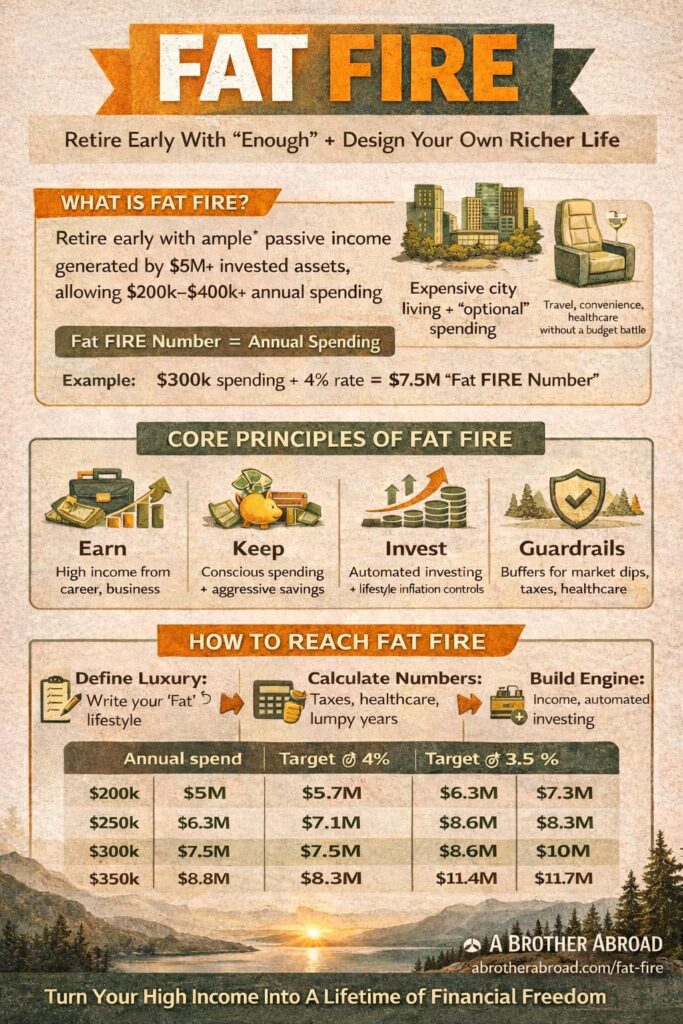
Fat FIRE is Financial Independence with a high-comfort lifestyle and ample margin – where your portfolio supports higher annual spending than other FIRE approaches (often $100k–$500k+ per year) without the need to work.
The FIRE Equation:
Fat FIRE Number = Annual Spending ÷ Withdrawal Rate
Withdrawal rates are typically 4%, 3.5%, or 3%, depending on how conservative you want to be, with 4% being the most commonly applied in FIRE planning.
A Quick Example:
If you want to spend $300,000/year, a 4% assumption implies that $7.5M in invested assets is what you need. Your “Fat FIRE number”.
At 3.5%, it’s ~$8.57M—same lifestyle, with a bit more margin for multi-generational wealth and long retirements.
Quick Fat FIRE Numbers Based on Spending
Annual spending | Target @ 4% |
|---|---|
$200,000 | $5.0M |
$300,000 | $7.5M |
$400,000 | $10.0M |
$500,000 | $12.5M |
The Approach: Use our Fat FIRE calculator to run your numbers here.
Fat FIRE roadmap:
- Define your “Fat” lifestyle in writing (housing, travel, healthcare, convenience, giving).
- Calculate the annual spending of that lifestyle, including taxes, insurance, big-ticket items, and buffers.
- Choose a withdrawal-rate range (4% / 3.5% / 3%) and stress-test it.
- Compute your Fat FIRE number.
- Build your accumulation engine: High income + savings + controlled lifestyle inflation + automated investing.
- Test-drive the lifestyle.
- Check in annually.

Table of Contents
What is Fat FIRE
At its core, Fat FIRE is still just FIRE:
The goal of Fat FIRE is to retire early with sufficient passive income-generating invested wealth to afford a more luxurious lifestyle than the other FIRE approaches, and thus with less emphasis on frugality as the key to achieving FIRE.
Fat FIRE is underpinned by achieving a high income through a specific profession or business ownership, combined with conscious consumption to avoid lifestyle creep and social signaling.
You save and invest enough that your portfolio can reliably cover your expenses.
The difference is the expense level – and what that spending level represents.
The target income in retirement, and the FIRE number it dictates, vary from person to person, but FIRE followers generally agree that FIRE numbers falling between the $2.5 million and $10+ million range, thus paying incomes in retirement of $100,000 to $400,000+, assuming a 4% withdrawal rate, fall into the “Fat FIRE” category. These numbers are less about making the owner part of a “special club” and more about being above a financial threshold that makes them difficult to achieve without a high-earning profession (e.g., doctor, lawyer, business executive) or business ownership.
Fat FIRE usually also implies one or more of these realities:
- You want to live in an expensive city by choice, not by accident. San Francisco, Los Angeles, Miami, and London are on the table comfortably with Fat FIRE.
- You want to travel often, comfortably, and without turning every trip into a budgeting contest. This means trips to Europe, not just Southeast Asia, and booked fluidly last-minute, instead of budget flight chasing months in advance.
- You want convenience: Outsourcing, frictionless life admin, fewer “DIY everything” weeks. Fat FIRE affords the money to pay specialists to do what they specialize in throughout your life.
- You want margin for healthcare, family obligations, and aging – without flinching. This means home country (U.S.) medical costs are covered, without falling back on medical tourism.
- You want optionality: the ability to say yes (or no) without negotiation with your bank account.
And a key precision point:
Fat FIRE is about invested assets that fund your spending – not your total net worth.
Net worth can include home equity, a business you can’t easily sell, or assets that look impressive but don’t reliably produce spendable cash. Invested assets pay passive income that gives you financial independence and gives the opportunity of early retirement.
The Key to Fat FIRE: High income alone doesn’t create wealth; intentionality does
The most common mistake people make with Fat FIRE is thinking that achieving it is primarily “a high-income problem.”
It’s not.
The primary hurdle to achieving Fat FIRE is a behavior and system problem.
High income gives you access to wealth. It doesn’t guarantee you’ll keep it.
And here is the brutal truth: High earners are not automatically good at keeping money – especially when their spending is socially rewarded.
You don’t even need to take my word for it. A 2025 Goldman Sachs Asset Management retirement survey found 40% of working respondents making $500,001+ said they primarily live paycheck to paycheck (Goldman Sachs Asset Management). This implies that the average Lean FI retiree potentially has a higher net worth and more freedom than many individuals making half a million USD per year.
Not all high earners are wealthy, and many “high earner behaviors” run counter to FIRE.
During my early time as a management consultant at a Big 4, one day our team was headed out to eat while we were on a local engagement. The Partner on the engagement, for whatever reason, decided he wanted to hitch a ride with me, in my car — at that time, a well-kept 10-year-old Toyota 4Runner V8, that I’d taken on hundreds of climbing, snowboarding, and trekking adventures. For your average “dirt bag” rock climber, the only more reliable vehicle you could opt for would be a Toyota Land Cruiser. However, for a partner at a consulting firm, “this” would not do.
“When you get promoted, an Audi or a Mercedes is a standard. Absolutely do not get a BMW 3 series — that’s strictly for associates. But, plan to upgrade. You are buying a different car soon, right?”
The Partner, who likely earned between $750,000 and $1 million a year, couldn’t hide his disgust when I explained that I loved this car, had no intention of replacing it, and I’m not a “two-car guy.” The rest of that ride was an awkward bit of silence as my “boss” couldn’t hide his contempt at the idea of my satisfaction with my trusty adventure mobile being “good enough.”
Yes, my compensation (about ~$175,000 that year) was enough to buy another car outright, and very possible considering I had no debt and expenses that rarely peaked above $4,000 a month. But that wasn’t the point. According to my financial ethos, there was no reason to replace a perfectly good (and kind of awesome) car. My impending financial independence was more valuable. According to his, my partner’s, and the majority of my firm’s opinion, simply keeping up appearances and dressing the part alone was reason enough to spend $50,000 in debt.
Here is when I realized that high earners aren’t always (and rarely are) wealthy, and FI takes intention and conscious consumption, no matter who you are.
40% of high earners live paycheck to paycheck, and it’s why “FI” is still out of reach for them
After that conversation — which made me realize that I needed to keep my financial guard up and that high earners aren’t necessarily financially savvy — the director on my new engagement overshared in a very telling way.
His wife wanted to decorate the entryway to their house and needed a budget of $25,000, and he had resorted to telling her to put it on the credit card so she wouldn’t have to wait any longer.
I’ll put this into context — directors at this firm commonly earned between $250,000 and $300,000+ each year, and he was in a situation where this chunk of money ($25k) needed to be put on a credit card because… he just didn’t have it.
I’ll take this a step further and say, considering savings rate is one of the most important factors in FIRE, though income wise my Director was likely ahead of me, by having insufficient saving (or discretionary income) for something like that, he was very likely further behind in terms of FI – despite being the textbook version of a high earner with ample years to save.
The point: High earners have the same hurdles to FI that the average saver does, and a handful of self-imposed ones that are more crippling — but there is significantly more upside to make the effort worthwhile.
What Fat FIRE buys: The lifestyle reality
Fat FIRE isn’t about winning consumption. It’s about choosing optionality in your FIRE and life design – and removing the small, constant frictions that make a “comfortable” life feel tight.
At the Fat FIRE level, you’re typically buying:
- Housing flexibility: You can choose the city (or neighborhood) you actually want—because your plan can handle the rent/mortgage reality of higher-cost places, not just the “cheap-but-fine” ones.
- Travel cadence without tradeoffs: Not “one big trip a year if nothing goes wrong,” but a rhythm of travel that doesn’t require a guilt hangover or a spreadsheet apology.
- Convenience and outsourcing: You can pay to protect your time—cleaning, repairs, meal shortcuts, logistics – because the plan has margin for life to be… life.
- Healthcare margin: You’re not pretending healthcare is a line item. You can absorb premiums, out-of-pocket years, and aging costs without the plan feeling like it’s one diagnosis away from collapse.
- Generosity and legacy: you can give, help family, fund experiences, or build a legacy without needing to “steal from future you” every time you do something meaningful.
That’s the difference between “I can retire” and “I can retire well.” Fat FIRE is the version of FIRE where the goal isn’t just freedom from work—it’s freedom from constant constraint.
Fat FIRE Net Worth: $2.5 million to $10 mil
This is the cleanest way to translate a Fat FIRE lifestyle into an actual number.
Pick the annual spending level that matches the life you want, then see the portfolio target under different withdrawal-rate assumptions.
Portfolio target = Annual spending ÷ Withdrawal rate
(4% = spending × 25)
Fat FIRE Number Portfolio targets based on Annual Spend
|
Annual spending |
Target @ 4% |
Target @ 3.5% |
Target @ 3% |
|---|---|---|---|
|
$200,000 |
$5,000,000 |
$5,714,286 |
$6,666,667 |
|
$300,000 |
$7,500,000 |
$8,571,429 |
$10,000,000 |
|
$400,000 |
$10,000,000 |
$11,428,571 |
$13,333,333 |
|
$500,000 |
$12,500,000 |
$14,285,714 |
$16,666,667 |
Important reality check: these are “clean math” targets. Your real plan should account for taxes, healthcare, and lumpy spending (home upgrades, family support, big travel years), which aren’t accounted for here. Fat FIRE isn’t fragile when you plan properly, but it does require buffers.
How Fat FIRE Works: High Income + Intentional Consumption + Investing + Time
Fat FIRE has a simple recipe. Not easy. Simple.
Ingredient 1: A real spending target.
You can’t build Fat FIRE on a blurry number. You need an annual spend target that reflects the life you actually want.
Ingredient 2: An accumulation engine that can support it.
For most people, Fat FIRE requires one of these:
- High income
- Business ownership
- Real estate done well
- A hybrid of the above
Ingredient 3: A durable investment approach.
Fat FIRE is usually a decades-long compounding project. It does not reward constant cleverness. It rewards durability through cycling markets.
Ingredient 4: Tax awareness.
At higher incomes and higher portfolio sizes, taxes stop being a footnote. You don’t need gimmicks – you need competence.
Ingredient 5: Guardrails.
Because the biggest risk in Fat FIRE isn’t the math – it’s the lifestyle drift.
Fat FIRE works when you treat it like an operating system:
Earn → Keep → Invest → Review → Adjust → Repeat
FIRE Math Translated for Fat FIRE
At the core, FIRE math is just a translation layer between the life you want to live and the pile of invested assets required to fund it.
The most common shorthand is the 4% rule, which comes from research often referred to as the Trinity Study. The simplified takeaway looks like this:
- If you withdraw ~4% of a diversified portfolio per year (adjusting over time), you’re using a rule-of-thumb that historically often survived a 30-year retirement in U.S. market history.
- The “mental math” version is the classic: 25× annual expenses is your target portfolio, the amount you need to be financially independent, and your “FIRE Number”. (Because 1 ÷ 0.04 = 25.)
So, if your spending target is $300,000/year, FIRE math says:
$300,000 × 25 = $7.5M required for your FAT FIRE retirement.
But Fat FIRE has a different vibe than “standard FIRE”: your spending is higher, your lifestyle is usually less flexible, and you may be planning for longer retirements (or legacy goals). That’s why many Fat FIRE plans use more conservative withdrawal rates as a starting point:
- 3.5% = about 29× annual spending (1 ÷ 0.035 ≈ 28.6)
- 3% = about 33× annual spending (1 ÷ 0.03 ≈ 33.3)
Those aren’t “better” withdrawal rates, they’re simply offering more margin:
- Margin for long retirements (30+ years),
- Margin for lumpy spending (housing, healthcare, family), which is a commonly reported reason that the FIRE approach breaks
- Margin for bad early market years,
- Margin for “I’d like to leave something behind.”
One important framing point: none of these are guarantees. They’re rules of thumb and commonly accepted practices within the FIRE community. More importantly for you, these are planning assumptions that you should assess, test, and transform into the financial plan that fits your situation. The prudent approach is to run the math at 4% / 3.5% / 3%, and then build guardrails to ensure your financial foundation won’t be fragile in down years.
Fat FIRE Number Math
Fat FIRE math is the same equation as any FIRE math, just with bigger inputs and fewer excuses to be sloppy.
Here’s the clean equation:
Fat FIRE Number = Annual Spending ÷ Withdrawal Rate
But the real work is defining Annual Spending as accurately as possible or with as much margin for error as possible.
In Fat FIRE, “expenses” aren’t just groceries + rent. Your plan needs to cover the life you actually want to live, including the surprises and one-off expenses that show up in real life:
- Taxes, which can be more meaningful at Fat FIRE withdrawal levels than leaner FIRE withdrawal levels
- Healthcare premiums, out-of-pocket expenses, and aging, especially if you use your Fat FIRE comfort to live in a higher cost-of-living city or country
- Lumpy spending as big travel years, home upgrades, family help, and car replacement cycles happen
- Convenience costs, such as outsourcing, services, and time-leverage, are taken advantage of
- Buffers, because Fat FIRE should not be one bad year away from panic
That’s why Fat FIRE planning often works best when you think in two layers:
- Base lifestyle spending, which occurs in your normal year
- Fat FIRE margin to account for taxes, healthcare, lumpy spending years, and a “life happens” buffer
Remember in your planning, Fat FIRE math is about your invested, income-producing assets that fund spending. Fat FIRE math is not about your total net worth.
Net worth can include home equity, a business you can’t easily sell, or assets that look impressive but don’t reliably produce spendable cash. The number that matters here is the one that can actually produce a cash flow you can live on.
A simple “math workflow” that stays honest:
- Write down your Fat lifestyle target (in dollars per year).
- Add a real buffer for taxes/healthcare/lumpy years.
- Choose a withdrawal-rate range (4% / 3.5% / 3%).
- Run the equation.
- Treat the result like a range, not a verdict—and stress-test it.
That’s the Fat FIRE math: simple, but not simplistic.
Fat FIRE Calculator
This is where you stop arguing with hypotheticals and put your numbers on the table.
Use our Fat FIRE calculator to run your plan under multiple assumptions:
- Plug in your target annual spending (and don’t forget taxes + healthcare + buffers)
- Run it at 4%, then again at 3.5%, then again at 3%
- Compare the outputs as a tradeoff: speed vs margin vs legacy goals
- Then use the result to set your accumulation plan (income engine + savings system + investing + guardrails)
If you want the simplest way to use the tool:
Run the calculator three times (4% / 3.5% / 3%).
If the “3% number” feels insane, that doesn’t mean Fat FIRE is impossible—it means you either:
- tighten the lifestyle target,
- widen the timeline,
- build a bigger income engine (often via ownership),
- Or design a plan with smarter guardrails, so you don’t need to live at maximum conservatism forever.
Fat FIRE isn’t about picking a single magical number.
It’s about building a plan that still works when life stops cooperating.
Why Fat FIRE: The Benefits
Fat FIRE’s real value isn’t the luxury. It’s the opportunity, the margin, and the reduced friction it creates.
At higher levels of wealth, three things happen:
- Your mistakes get less expensive: You can change course without detonating your whole plan.
- Your life becomes less fragile: Healthcare surprises, family obligations, and inflation don’t automatically become existential threats.
- More doors open: Not because you “deserve” them—because capital does that. Better housing options, better location flexibility, better time leverage, and yes—more access to certain investment opportunities and advisors (if you want them).
The point of Fat FIRE is not to turn money into status. It’s to turn money into time, freedom, and resilience.
Who Fat FIRE is for: High earners and the ambitious
Fat FIRE tends to fit a few archetypes:
- People who want financial independence without shrinking their life into austerity
- People with high earning power who can resist lifestyle inflation
- Business owners and equity holders who can convert ownership into investable assets
- Families who want margin (kids, healthcare, aging parents, geographic choices)
- People who value convenience and time leverage enough to pay for it
Fat FIRE is usually a poor fit if:
- You’re chasing it purely as a consumption license
- You don’t have a plan for how your spending stays intentional when income rises
- You hate your current path but have no alternative engine (Fat FIRE rarely rewards “I’ll just grind and hope”)
- Your idea of “Fat” is infinite (the plan breaks when the finish line moves faster than the portfolio)
The risks and downsides of Fat FIRE
Fat FIRE has two phases of risk: getting there and staying there.
Accumulation risks (getting there)
- Burnout + golden handcuffs: The pay gets addictive, the lifestyle follows, and suddenly the plan owns you.
- Lifestyle inflation: The silent killer—because it feels “earned” and looks normal in your peer group.
- Concentration risk: One company stock, one business, one real estate market.
- Tax drag: high income can get taxed aggressively; ignoring this is leaving money on the table.
- Time cost: The pursuit can quietly consume the life you’re trying to build.
Post-FI risks (staying there)
- Sequence-of-returns risk: Early bad market years matter more than later ones.
- Spending creep: “We’re rich now” becomes a permanent budget expansion.
- Complexity: Bigger portfolios often come with more accounts, more tax decisions, more moving pieces.
- Health + longevity uncertainty: Long retirements amplify uncertainty.
- Protection planning: Insurance, estate planning, liability—boring, but crucial.
Fat FIRE is sustainable when you build two habits:
- Flexibility: Room for spending to be adjusted in bad years
- Regular reviews: Annual check-ins so you catch drift early
Fat FIRE vs. Other Types of FIRE | in numbers, lifestyle, and suitability
Fat FIRE is the “high discretionary + high margin” end of the FIRE spectrum.
A quick positioning, just to anchor it:
- Lean FIRE: Essentials-first, tight spending, requires strong systems (especially healthcare).
- Coast FIRE: Front-load investing, then stop needing to save aggressively while compounding does the work.
- Barista FIRE: Partial portfolio + part-time income (work becomes a dial).
- Expat FIRE / Nomad FIRE: Location strategy as a lever (geoarbitrage can lower the FI number).
- Chubby FIRE: Comfort + margin, but not “full luxury flexibility.”
- Fat FIRE: Higher discretionary spending + convenience + location flexibility + margin for surprises.
Fat FIRE isn’t “better.” It’s just a different target—one that demands a different engine.
How to Fat FIRE: A Roadmap
Fat FIRE is execution-heavy. To keep it clean, I like the criteria → archetypes → examples approach.
Fat FIRE engine components
A Fat FIRE path tends to have four traits:
- High income density: Strong earnings relative to time
- High savings capacity: Income minus lifestyle stays meaningful
- Scalable compounding: Investments that can grow without heroics
- Durability: You can keep doing it without breaking yourself
Three archetypal paths
1) High earner path (W-2 / professional):
The core move is boring and powerful: keep lifestyle controlled while income rises, automate investing, avoid concentration risk, and don’t let “I deserve it” eat your earnings. Paths in medical, tech, engineering, finance, and legal fields are best.
2) Business/ownership path:
This is where Fat FIRE becomes more achievable for some people – because a viable, boring, small business can scale faster than a salary. But it also carries a higher failure risk and more volatility. With the “great wealth transfer” on the horizon, there are ample possibilities to buy a high-potential, boring business that delivers an essential service to society that is resistant to economic cycles and innovation. The world will always need roofing companies, HVAC repair, mechanics, garbage pickup, and more. Codie Sanchez’s book, Main Street Millionaire, has a great model and example businesses for this path.
3) Hybrid path:
High earning years + ownership (or real estate) + disciplined investing. Many “quietly wealthy” Fat FIRE outcomes look like this: not one miracle, but stacking advantages.
A practical Fat FIRE sequence
- Define your Fat FIRE lifestyle target (spend, location, cadence, convenience).
- Choose a withdrawal-rate range (4% / 3.5% / 3%).
- Calculate your target portfolio (and separate it from total net worth).
- Build your engine: income strategy + savings system + investing plan.
- Add tax competence (not tricks): understand your levers and your drag.
- Review annually: spending drift, portfolio allocation, risk, and timeline.
And if you want the shortest, most honest version:
Fat FIRE isn’t “earn a lot.”
It’s earn a lot, keep a lot, invest well, and don’t let the lifestyle outgrow the plan.
Fat FIRE FAQ
What is Fat FIRE?
Fat FIRE is financial independence designed to fund a higher discretionary lifestyle—more flexibility, convenience, and margin than traditional FIRE.
How much do you need for Fat FIRE?
Enough investable assets to fund your annual spending at your chosen withdrawal rate: spending ÷ (0.04, 0.035, or 0.03). A $250k/year lifestyle implies roughly $6.25M–$8.33M depending on assumptions.
Is Fat FIRE a net worth number?
Not really. Net worth can include illiquid assets. The useful number is investable assets that support spending.
Is 4% safe for Fat FIRE?
It’s a planning baseline, not a guarantee. Many Fat FIRE people use 3.5% or 3% for more margin—especially for long retirements or when they value legacy and stability.
What’s the difference between Chubby FIRE and Fat FIRE?
Chubby FIRE is comfort + margin. Fat FIRE is higher discretionary + more convenience + more location flexibility + bigger buffers.
Can you Fat FIRE faster by moving abroad (Expat FIRE)?
Potentially. Location can reduce the spending target, which reduces the portfolio required. But it also adds complexity (currency, taxes, residency). This is where Expat FIRE can “bolt on” depending on your goals. (link to Expat FIRE guide)
What’s the biggest mistake people make in pursuing Fat FIRE?
Assuming high income equals wealth. It doesn’t. Without intentionality, the lifestyle expands to meet the paycheck—sometimes even at very high incomes. (Goldman Sachs Asset Management)
Do I need a financial advisor for Fat FIRE?
Not always—but complexity rises with income, taxes, and portfolio size. A fee-only planner can be worth it if it prevents one big mistake or helps you build durable guardrails.
Other Helpful Resources
ABA Calculators
- FIRE Calculator
- Lean FIRE Calculator
- Coast Calculator
- Barista Calculator
- Nomad FIRE Calculator
- Expat FIRE Calculator
.

.
ABOUT THE AUTHOR
Carlos Grider launched A Brother Abroad in 2017 after a “one-year abroad” experiment turned into a long-term life strategy. After 65+ countries and a decade abroad, he now writes about FIRE, personal finance, geo-arbitrage, and the real-world logistics of living abroad—visas, costs, and tradeoffs—so readers can make smarter global moves with fewer surprises. Carlos is a former Big 4 management consultant and DoD cultural advisor with an MBA (UT Austin) and Boston University’s Certificate in Financial Planning. He’s the author of Digital Nomad Nation: Rise of the Borderless Generation and is currently writing The Sovereign Expat.