

with lower cost living and higher quality lives…
Picture Andre. A young American man from California. At 35 years old, he knew himself well. He knew his love for wine and a delicious steak. He knew that time outside, whether walking between tall pines on hiking trails, or between ancient buildings and centuries old architecture, recharged him. He dreamed of a corner apartment overlooking cobblestone streets and a walk away from a café perfect for a reflective coffee before work, and reading or a sketchbook on the weekends, a stark contrast to the freeways, car culture, and housing tract McMansions of Californian, and generally American, suburbia.

He also knew that Los Angeles and the “meager” salary of $70,000 (which was gargantuan by global standards) would never deliver that alternate life he envisioned, with old world accents and a life beyond satisfying contained in a single neighborhood.
So, he left.
Like many Americans tapping out of the rat race to trade up, Andre took stock of his investments, negotiated a remote job, and flew to Porto – the place he visited long before on a whim that made him realize that the life he dreamed of could in fact be reality.
In Porto, he found that apartment. On a cobblestone street, with live music steps away every night, and countless paths to walk between nearly ancient buildings, over to grassy hills, and into fishing villages and wineries stores and tasting rooms further out. To boot, he had healthcare, half the cost of living, and a pass to live in Portugal until he grew tired of his personal paradise, or became a Portuguese citizen.

This is the kind of alternative that many Americans are opting for, with a life abroad that delivers the once advertised American dream, delivered more efficiently in an international package.

Contents
- The New American Plan B: Finding peace and comfort in a permanent vacation abroad
- The Trend: Americans are increasingly moving abroad to find a better life, for cheaper
- Why the American Dream Is Suddenly Possible…Abroad
- Why residencies beat the alternatives, and your options for making the dream abroad a reality
- What This Looks Like in Real Life: Who are the Americans actually going abroad?
- The Money & Tax Piece: Amplifying your salary, and building in tax benefits through essential prep and moving abroad
- The Other Side of the Adventure: Drawbacks & Realities to be aware of
- If your curiosity is piqued: How to make it happen for you
- The Bottom Line
The New American Plan B: Finding peace and comfort in a permanent vacation abroad
More Americans are quietly leaving the US rat race behind. But, they’re leaving not as backpackers or lottery winners. They’re not wealthy global citizens buying golden passports. Instead, these working class heroes are building new lives dilgently, using residencies instead of second passports, to live in cheaper, calmer countries, designing more enriching lives via geoarbitrage.
In 2025, the median US salary is just over $62,000 before taxes, according to the Bureau of Labor Statistics. Though this income is barely enough to afford the average cost of living in desirable spots like cosmopolitan New York, coastal California, and vacation-worthy Florida and Colorado, it can buy the seemingly out of reach lifestyle, with better food, more vacation time, and ultimately more freedom, for those who strategically adventure abroad long term. And increasingly, it does.
Data Sources: https://www.bls.gov/news.release/pdf/wkyeng.pdf; July 2025; https://www.numbeo.com/
By comparison, the US cost of living before taxes is nearly double the cost of living for a comfortable family of four living in most of the top 10 expat destinations. This massive cost of living difference means living abroad carries significant inherent cost cutting power and tax discounts to boot.

The kicker…scan the list of the most popular locations for Americans pursuing residencies and you realize every option offers beaches, nature, or a cosmopolitan lifestyle against backdrops of deep culture, amazing cuisine, and walkable cities. So in reality, most expats are trading their old home for a “forever vacation” meets Blue Zone lifestyle.
Before the logistics and the data, there’s a more fundamental question most people spend years stuck on — whether this is actually possible for someone in their specific situation. That piece: Why Moving Abroad Is More Possible Than You Think →
The Trend: Americans are increasingly moving abroad to find a better life, for cheaper
With over 4.4 million US citizens reported as living abroad as of 2022, according to the Federal Voter Assistance Program, it’s clear that more Americans are exercising Plan B by living abroad.
There’s proof that this is a growing trend, and Americans aren’t just “moving abroad,” they’re specifically choosing high-value, high-quality of life, relatively low-cost locations long term.
In the decade up to 2022, Southeast Asia, Australia, New Zealand, and the Pacific Islands saw some of the highest increases in American expats moving in for sunny weather and cheaper living far away from the global geopolitical chaos. Southeast Asia saw 40% more Americans moving to its more welcoming countries, while Australia, New Zealand, and the “nearby” islands welcomed 50% more Americans aiming to stay long term.
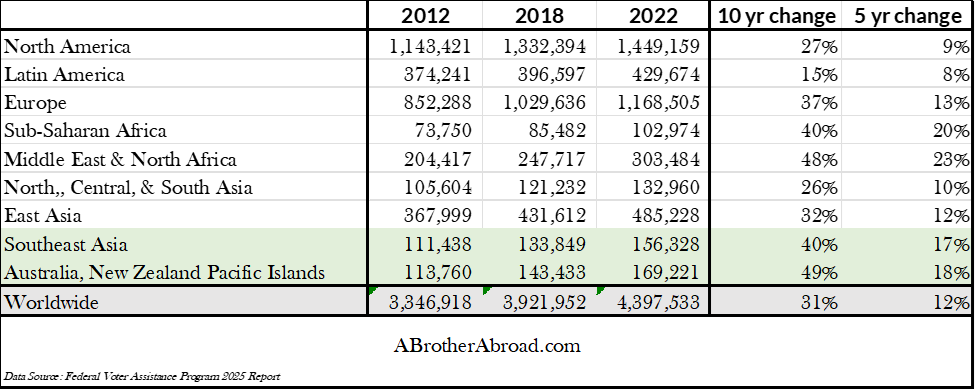
Even during the preceding 5 years, despite COVID-19 movement restrictions, more and more Americans made their way abroad. If so many braved the lockdowns, travel restrictions, and extra paperwork for an international move during one of the worst times ever to travel, then it’s clear – this trend is here to stay.
Europe and East Asia, most notably China and Japan, are routinely hosting more and more Americans (~30% more).
All the while, Latin America remains a well-kept secret.
Central America, South America, and the Caribbean Islands offer proximity, low cost of living, and a vibrant welcome without the tourist hordes of Southeast Asia, as its countries routinely top the global lists of best places to live, while “only” boasting a relatively low 15% more American expats in the preceding decade.
As the US and many of its allies become less stable, financially, socially, and in quality of life, more and more Americans will take up the offer of temporary and permanent residencies in other countries.
But this raises the question, where exactly are Americans going? You may also be asking, where are the best places to go now?
Current hotspots, such as Panama, Portugal, and Mexico, are just the visible tip of the expat exodus iceberg, but beware of backlash.
Mexico City, Lisbon, Tulum, and Barcelona are making headlines for the right and the wrong reasons, but they’re just the visible tip of the expat destination opportunity iceberg. While these cities each do offer a vibrant, culture-rich backdrop with warmth, their proximity to Americans (and Europeans) making hasty exits to cheaper places with better weather has overwhelmed not only real estate markets but the lives of locals in an unwelcome way.
Digital nomads driving up short-term rental prices in Lisbon, pseudo-island expats in Barcelona and Malaga, and a “spiritual materialism” and Instagram-powered hustle & growth scene in Tulum have rinsed out the memories of low prices and authenticity from these once go-to spots. But in this insight lies a lesson, an opportunity, and a guidepost.
While the news headlines soak up the attention and the traffic, residencies and bohemian “wanderer villages” are sprouting around the world.
Follow the trail of adventurous expat bread crumbs and you’ll find promising “up and coming” destinations and welcoming hubs tucked in Vietnam, Paraguay, Cambodia, and Albania.
Vietnam’s “Miami of Southeast Asia” ($1,503 COL per month), Albania’s alternative European Alps and Riviera ($2,646 COL per month), Paraguay’s uber-cheap nouveau tax haven ($1,729 COL per month), and Cambodia’s emerging SEA hideaway ($2.062 COL per month) are the most popular under-the-radar destinations inviting expats, but the options are endless.
Even today, the best options, that luckily avoided the viral “best places to live” articles, are still the cheapest, lack the crowds, and deliver on a way of living that expired long ago in the US. And in the right places, you have good reason to believe they will deliver on their promise – of being cheap, healthy, and happiness inducing – in the long term as long as they continue to stay out of the spotlight.
This menu of destinations with varying prices, nature, and culture is diverse enough to fit any combination of personality, life state, and budget, and it all adds up to one thing…
For the first time, a middle-class American with a laptop, modest savings, or a “tiny” pension can realistically design a life abroad.
If you’re past “should I” and into “how do I actually do this,” the practical starting point is working through the full pre-departure checklist — what to handle, in what order, and with what lead time before you leave: The Complete Moving Abroad Checklist →
Why the American Dream Is Suddenly Possible…Abroad
…and why the new long-term residency options are key to achieving it.
Over the last 20–25 years, three things changed quietly in the background: the internet got fast and cheap, remote work went from fringe to normal, and more people started to question whether the default “work and die at home” script made sense. Put together, those shifts created something new – the ability for a regular American to earn an income from anywhere, then actually go somewhere better.
COVID didn’t create the possibility of working from anywhere, but it forced everyone to test it at scale. Almost overnight, millions of Americans were working from kitchen tables, Airbnbs, and guest rooms instead of offices. Companies learned the work still got done, while workers learned they didn’t need to be tethered to one zip code to earn an income.
As the pandemic proved that high-salaried employees could work from anywhere, governments in locales around the world realized they could simply lure the new remote working employees (instead of the whole company), with the opportunity, to live in, enjoy, and visit destinations that were previously only possible during vacations.
Mexico. Spain. Thailand. New Zealand. All on the menu, with no time limit.
With this cascade of changes, the American Dream suddenly became possible abroad, because the potential for remote income, residencies, and viability of low-cost-but-high-quality destinations all matured at the same time.
Remote work went mainstream, and online business ownership became accessible.
By 2022, remote work wasn’t a temporary blip anymore. It had become a permanent part of the global economy, as more than 35,000,000 digital nomads worked and traveled around the world, and even more worked remotely from their home countries. 2024 Surveys of US salaries** showed that even after the “remote discount,” remote roles still average in the mid-$75,000 a year.
For a mid-career American working on a laptop from home in a major US city, that $75k salary is barely life support. But, that same job holds the potential of achieving much more in arguably more comfortable destinations like Portugal, Thailand, Colombia, or Mexico.
At the same time, the cost of starting and running an online business plummeted, making business ownership and solopreneurship possible for anyone with ambition. In 2025, Flippa, a marketplace for online businesses, reported a 40% increase in online businesses sold for over $100,000, showing the possibility owning a fully remote business is more real than ever.
Marketing, payments, and delivery all evolved to be completely automated, outsourced, and online business friendly empowering single-person, boot-strapped, location-independent businesses. This newly common and cheap capability empowered a wave of freelancers, solo founders, and small teams in serving clients everywhere from New York to London while living in Da Nang or Lisbon.
The Residency Boom: Governments began laying out the red carpet for financially stable, long-term guests
Governments quickly took notice as the opportunity for location independence trickled across the broader workforces around the world. Before the pandemic, “globalization” generally meant companies from “wealthier countries” hired cheaper labor abroad via outsourcing. After COVID, a new globalization opportunity came into focus. What if governments offered up not just their workforce, but their home and community to share? What if governments invited the workers instead of the corporations? If they could convince a financially stable American, Canadian, or European to live in their country, that new guest would bring their salary, their spending, their skills, and often their family – without the political baggage of big multinationals.
That realization, that mobile, financially self-sufficient visitors were a valuable new option, is what quietly kicked off the residency boom.
First came the digital nomad visas as flashy one or two-year programs designed to attract remote workers. While these experiments had their flaws, they were a perfect test of the waters.
But then, a more serious, refined, and strategic wave of long-stay residencies followed. Retirement visas, “independent means” visas, remote-worker and freelancer visas, and simple savings-based permits sprouted as invitations in countries around the world.
Most of these new visas and residency options focused on exactly what governments now want – guests who can prove a financial self-sufficiency via a steady income, a pension, or modest savings. In exchange, these welcoming countries offer something incredibly valuable: one to five years of legal stay, often renewable, and sometimes a future path to permanent residency or even citizenship.
The Push Factor: The US isn’t making it easy to (want to) stay…
Even if you earn around the national median in 2025 of roughly $62,000, a significant chunk of that paycheck disappears into rent, health insurance premiums, daycare, car payments, and debt. Plus, that’s after paying taxes in a place that doesn’t even guarantee a basic living.
After fighting daily for that slim living, most Americans only get two or three weeks of vacation a year to recover from the rat race, and many are made to feel guilty for even attempting to use that hard-earned time off to enjoy the life they’ve created…or recover from it.
Add in the constant background noise of polarizing political megaphones, culture wars, and a 24-hour news cycle built on outrage, and it’s no surprise that more people started to ask, “Is this really it?”
“Is this all there is?”
“Is this what I’m sacrificing my life for?”
For a growing number of hardworking Americans, the problem isn’t that they hate the US; it’s that they can’t find a clear path to a calm, affordable, healthy life while living inside the US.
The Pull Factor: Awareness of what life is like abroad becomes alluring when seen in the perspective of what the US rat race offers in comparison
Once you take off the blinders and ignore the suggestions of what you “should” do, you can start looking beyond US borders. After considering what life is like abroad, it’s hard to unsee how much more quality, time, and life your money can buy elsewhere.
In many of the destinations Americans are choosing, such as Lisbon, Chiang Mai, Medellín, and Da Nang, a normal neighborhood comes with things that feel like luxuries back home: walkable streets, fresh food at local markets, cafés where you can linger all afternoon, safe parks for kids with no school shootings, quick access to nature, and a culture that doesn’t treat taking an afternoon off as weakness or failure.
For a lot of people, this combination adds up to the closest thing possible to a “forever vacation” with a sprinkling of real-life responsibilities pleasantly layered on top. Of course, you still work, you still pay bills, and you still deal with bureaucracy. However, the backdrop to normal life becomes calmer and more humane. A baseline day feels more like a life you choose on purpose. In reality, the hardest part is simply deciding to choose it.
The Lower Cost of living abroad adds up to room, and time, to breathe, saving, and the ambiance of a real life.
What makes this idea more of a potential reality than a daydream is the math. If you’re earning a remote US salary making $70,000 a year, that income will barely keep you afloat in the major cities of New York, Chicago, Austin, and Los Angeles. Rent, commuting, insurance, and food will eat most of your earnings before you can even think about saving, much less a vacation, retirement, or investing. Take that same income to a country where a comfortable life for one or two adults costs $1,500–$3,000 a month, and the equation flips. You can live comfortably, even luxuriously, while successfully saving more, or working less and reclaiming your time along the way.
Even if you’re not working remotely and perhaps in, or near, the position of a retiree, a pensioner, or a small-scale investor planning on “FIRE” much later, the same logic applies. Pensions, Social Security, and investment income can deliver the same freedom and subsequent residency and geoarbitrage opportunities. The monthly check that might feel tight in the US stretches surprisingly far in countries where housing, transport, and healthcare simply cost less.
The lower cost of living abroad doesn’t just make life cheaper. It buys margin, space in your budget and calendar to think, rest, and enjoy the place you moved for in the first place.
Knowing why it’s possible still leaves one practical question. How are people making this happen in a legal, stable way?
The answer: long-term visas and residencies
Why residencies beat the alternatives, and your options for making the dream abroad a reality
If you want to build a real life abroad and not just hop between Airbnbs, then you need more than a tourist stamp giving you 90 days before you have to leave again.
Short stays and trendy digital nomad visas are perfect for testing places, but they’re fragile foundations for a long-term life.
At the other extreme, second passports and golden visas that were once assumed to be the holy grail of living are now expensive, slow to get, and increasingly under political fire.
The real solution for most Americans aiming to live abroad sits in the middle, as modern long-term residencies.
Digital Nomad Visas and Short Stay Tourist Visas: Great for exploration, but a fragile option with no long-term path
Tourist visas and pure “digital nomad” living are perfect for exploring destinations for brief periods to see how they fit your tastes and what you want in life. And they serve a wonderful purpose. From experience, I recommend against opting for a residency of a year or longer without spending at least a few weeks “trying on” the destination that will potentially be your prospective new home. Nomad visas and tourist stays are perfect for a solid trial run.
A 30 to 90-day stay lets you feel a city’s rhythm, test a few neighborhoods, and see how your work fits the time zone. But legally, these visas are sandcastles. Tourist stamps are designed to end. In most countries, on a nomad visa, it is extremely difficult to sign a long lease, open a bank account, or enroll kids in school, and on a tourist visa, you usually can’t. Even worse, you’re always one disgruntled border agent away from being told “time to go.”
The new wave of digital nomad visas fixed some of that, powered by insightful countries that thought through the plight of digital nomads and the role they wanted them to play in their societies. But the “additional fix” gained with nomad visas is only temporary, and still doesn’t underpin a stable, long-term life in a single country. Many of these visas were built as one or two-year experiments during and after COVID. As predicted, they produced good headlines and a quick cash injection, but are intentionally finite. Visit the dead-end marketing pages for digital nomad visas on many immigration sites, and you’ll see the visa’s role was as permanent as the nomad’s allowed stay.
In most cases, these nomad visas don’t lead to permanent residency, they aren’t renewable beyond a single year total stay, and they keep you in a grey zone: allowed to stay, but not really encouraged, or allowed, to put down roots.
Ultimately, nomad visas are a great way to test a country, but they’re a shaky foundation for building a life.
However, nomad visas did pop the cork on the idea of welcoming location-independent foreigners. The idea and permission just needed better packaging and execution.
Golden passports/visas: Formerly the “gold standard,” now expensive, politically messy, and not worth the hassle for most people
At the other end of the spectrum sit golden visas and golden passports. These buzzy cross-border options are more flash than substance, the stuff of headlines and Instagram flexes.
For a while, these programs were viable options marketed as shortcuts to a Plan B passport if you could invest $500,000, $1,000,000, or more into local real estate or government bonds.
For the truly wealthy, these golden passports, the price tag, and the tax, financial, and mobility benefits they offer still make sense, sometimes. For most middle-class Americans, golden passports are neither realistic nor wise. And thanks to newer options, they’re not even necessary for a well-designed life abroad.
Even if you’re comfortable laying down such a significant amount of cash, golden visas and “citizenship for sale” schemes have become politically messy in the last five years, which has heavily reduced their potential value. Because these golden passports buy you not only access to that country but visa-free access to the EU, US, Mercosur countries, and special treatment in ASEAN states as well, these unions of countries have threatened to ban countries with “pay for passport” schemes unless they close said programs. As a result, in the past 10 years, Cyprus, Bulgaria, Moldova, Montenegro, and Malta have all unexpectedly shut down their Citizenship by Investment programs.
Ultimately, passports that can be paid for, instead of earned through residency, are being scrutinized, viewed as less valuable, and removed from visa-free entry programs.
The rules change often, and they tend to change in one direction: tighter, more expensive, more scrutiny. If your goal is simply to live somewhere calmer and cheaper for the next 3–10 years, you don’t need to buy a passport to get there.
Modern residencies: the perfect middle path
Modern long-term residencies sit comfortably between the two extremes. Instead of asking you to gamble six figures on a golden visa or live indefinitely on a tourist stamp topped up with border runs, governments ask for something much more human: proof that you can support yourself and won’t be a burden on the state.
In practice, that usually only means showing one of three things: a stable remote income, a pension, or modest savings and assets.
In return, you get exactly what most people actually want: one to five years of legal stay, often with the ability to renew as long as you still qualify. With the residency permit, you can open a local bank account, rent or buy a home, sign up for utilities, enroll kids in schools, and access local healthcare. In many countries, staying on a residency for long enough, often three to five years, and establishing roots opens a door to permanent residency or even citizenship if you want it. If you don’t want citizenship, you can simply enjoy your years in your new home and move on when it’s time for a new chapter.
The fact that new residency programs keep appearing, and that expats are actually getting approved through relatively smooth processes, highlights something encouraging: these programs aren’t afterthoughts. They’re being actively managed, refined, and respected.
Behind the scenes, governments are making their own quiet pivot in immigration policy. Instead of chasing transient freelancers who will leave as soon as a cheaper beach appears on Instagram, they are designing residency programs to attract financially self-sufficient people who actually want to live in, invest in, and contribute to their community.
The amazing news if you’re a remote worker, a retiree, or someone with modest savings, you are exactly the person many countries are now rolling out the welcome mat for.
Residencies deliver priceless flexibility: don’t get stuck in yesterday’s paradise.
One of the most undervalued advantages of modern residencies: flexibility.
Tourist trends and “it” destinations tend to have a half-life. A desirable, under-the-radar destination usually starts cheap. Then the blogs and TikToks go viral, sharing the “new hotspot.” Finally, within five to ten years, it’s crowded, prices spike, and the vibe shifts from bohemian secret to package tour, commercialized madness. Portugal, Bali, and Tulum felt like unmatched paradises between 2015–2020. By the mid-2020s, anyone who remembers the “before” can tell you those places aren’t what they were.
Luckily, new waves are already forming in Albania, the Balkans, Vietnam, Paraguay, and beyond.
If you lock yourself into a passport or a forever house in one of those hotspots, you’re tying your fate to that arc, from undervalued to overly discovered, to overvalued. Residencies offer a smarter middle road.
A typical temporary residency lets you stay one to three years at a time, with the option to renew if life still feels good there.
Many permanent residencies run for five years with minimal strings attached, usually a simple drop in to the country once a year and renew each five, ten, or fifteen years. That’s long enough to enjoy the golden era of a place, build friendships, maybe buy or rent a home, and truly live there, and still leave yourself the option to pivot when the crowds, bureaucracy, or politics catch up. And when “your crowd” senses its time to move, and does, you can pull up your tent stakes and follow…if you wish.
If you happen to be feeling crowded out in Malaga, Phuket, and Poblado, you could simply pack up and book a flight to Albania, Romania, or rural Italy.
The new strategy isn’t “marry a passport and hope for the best.” It’s “use residencies to buy yourself three- to five-year chapters in places that make sense now.”
That’s the mechanism. But what does this actually look like in real lives?
What This Looks Like in Real Life: Who are the Americans actually going abroad?
It’s easy to picture this life as something only backpackers in their twenties or retirees in their seventies have the time and resources to chase.
In reality, most of the Americans quietly using residencies to upgrade their lives don’t fit either stereotype. They’re mid-career professionals who got tired of burning out in big US cities. They’re early retirees and FIRE folks who ran the numbers and realized they could actually live abroad instead of scraping by at home. They’re families who want a calmer childhood for their kids. They’re people “between phases” who feel like the next chapter shouldn’t look like the last.
To make this less abstract, let’s look at a few very real patterns I see over and over. You might recognize pieces of yourself in one of them.
The Remote Professional in Europe
Sarah, 35, is a software developer from Denver. She earns around $75,000 a year working remotely for a US tech company, and though this is a perfectly respectable salary, she still felt like she was in survival mode in Denver once rent, health insurance, car payments, and everything else were paid. Even worse, Boulder and Austin, places where she lived before and preferred, living costs had skyrocketed even more. While the once hipster haven of Boulder and “keep Austin weird” backdrop both delivered more of the lifestyle and social circle she wants, both are farther beyond her budget than Denver.
After a year of working from home during COVID and a couple of month-long experiments in Mexico City and Lisbon, she decided to stop treating her idea of moving abroad as a fantasy. She gave up on her dream of moving back to Boulder or Austin and gave in to her dream of finding a more suitable lifestyle abroad.
Today, Sarah is based in Valencia, on a residency, specifically a three-year teleworker visa, that allows her, as a financially self-sufficient remote worker, to live in Spain long term. Her one-bedroom apartment near the old town costs $1050, about what she used to pay just for a room in a shared house in Denver, in a place nowhere near the city center. She doesn’t own a car anymore. Instead, she walks or bikes almost everywhere and hops a train when she wants to visit friends in Madrid or Barcelona. Her workday hasn’t changed much on paper: same laptop, same meetings. Though she is now 8 hours ahead of most of her team, her meetings are in the morning US time and afternoon her time, allowing her to work productively in the morning in peace and undisturbed, and end the day with team meetings, very rarely working after 8 pm.
The major difference for Sarah is the life woven in between those hours. Coffee breaks happen in sunny Plaza de la Reina, a short walk away, instead of rushed in a parking lot. Groceries come from the market down the street, fresh vegetables come from the weekend farmers’ stalls set up on the streets blocks away, and quality groceries with Iberian ham and delicious European cheeses cost ¼ what they did in Colorado. Even after upgrading her lifestyle, she’s saving more each month than she ever could in Denver.
If you’re a mid-career professional who likes your work but not the life that comes with it, you might see yourself in Sarah’s arc. The job didn’t change. The address did.
The “Pensionado” / FIRE Early Retiree in Latin America
Mark is 50 and spent nearly three decades as a firefighter in Ohio. Between his pension and a “modest” investment portfolio, possibilities for retirement in the US looked tight at best: a small apartment, constant cost-cutting, and a lot of worry about healthcare. More realistically, he would have to continue working. But, he didn’t want to work forever, but he also didn’t want his “golden years” to feel like a never-ending budget meeting and penny pinching.
After a few scouting trips, first to Mexico, then Guatemala, and continuing his way down Central America on vacations, he settled on Panama, like many other Americans discovering the secret of the luxurious Latam lifestyle in that region. There, he applied for a “pensionado residency,” designed for pensioners that make a minimum of $1000 per month. He qualified easily thanks to his guaranteed monthly pension.
Today, Mark and his partner rent a two-bedroom place near the coast in Panama City. Private health insurance costs less than his old US premium alone, and routine care is cheap enough to pay out of pocket. Their monthly expenses, including rent, utilities, food, and healthcare, come in around what just the mortgage and property taxes would have cost back home. They spend more time walking, swimming, and meeting friends on the malecón than worrying about the next medical bill. If all works out in a year, they have $100,000 in cash earmarked to buy a homeup the coast, and that will buy them a comfy coastal home or condo outright.
For people like Mark, with small pensions or “Expat FIRE” level investments, residencies don’t just make retirement abroad possible; they make it feel like an upgrade into the next phase of life.
The Flexpat Family in Asia
Jamal and Ana are in their early forties with two kids under ten. He works remotely in marketing for a US company, while she freelances part-time doing design work. Though they liked their life in Seattle, they felt like it was shrinking: long commutes, rushed evenings, weekends eaten by errands. When their oldest started asking why they were always “in a hurry,” they stopped to ask themselves why and answered with an experiment.
After a winter vacation test run in Chiang Mai, they applied for the 5-year “Destination Thailand Visas” that allow Jamal to work remotely while the kids attend the Panyaden International School. Their monthly rent for a three-bedroom house with a small yard and access to a pool is less than half their old mortgage. Their kids bike for fun on quiet streets. Healthcare is modern and affordable. A trip to enjoy the national parks of the hill country is shorter than their Seattle commute. On weekends, they take cheap flights to beaches, and every two months, they visit Japan, China, or Nepal. There are hard days, with language barriers, homesickness, and grandparents far away, but the overall pace of family life is slower and kinder than it was in Seattle, and time spent together is more often and richer.
If you’ve ever wondered whether “this kind of life” is possible with kids, families like theirs are proof that it can be. I’ve seen countless French, German, and Swiss nomad and expat families set up in Bali, Malaysia, Vietnam, Greece, Mexico, and beyond. As long as you’re intentional about where you land and how you structure it, your family can realize any collective dream you can muster.
One goal, to live better abroad, and infinite paths to reach it
These are just a few of the patterns. The details always change. The country, the visa acronym, and the job title shift, but the core story remains the same: people with ordinary incomes and ordinary responsibilities often do use residencies to trade in a life that felt tight and spartan for one that feels spacious and comfortable.
The question isn’t whether it’s possible anymore. It’s whether it makes financial and emotional sense for you.
To answer that, we need to look at the money and tax side of this choice in a bit more detail.
The Money & Tax Piece: Amplifying your salary, and building in tax benefits through essential prep and moving abroad
Here’s how the numbers and tax rules can work in your favor — in broad strokes — if you design this well.
At some point, every dreamy conversation about moving abroad runs into a hard question: “Can I actually afford this – and what happens with taxes?”
The good news is that, if you plan well, the money side of moving abroad often works more in your favor than staying put in the US. The trade isn’t just for cheaper rent and better food, it’s for a different tax landscape, plus the chance to align your income, your spending, and your life in a way that’s hard to pull off inside the US.
This section isn’t a full tax seminar, that’s what future Sovereign Expat guides will be for, but it will give you the big picture: how US taxes still apply when you live abroad, what your new country might expect, and why your income often stretches much further once you make the move.
Your US “Tax Shadow”: What follows you abroad, and how it benefits you
First, the part most Americans don’t want to hear: moving abroad doesn’t break up your relationship with the IRS. The US taxes its citizens and permanent residents on their worldwide income, no matter where they live. You still have to file a US return every year, even if you haven’t set foot in the States for a while.
However, the good news is that if you live abroad, Uncle Sam usually decides to take much less.
That’s why the other side of this coin is more encouraging.
US tax law includes tools that are specifically designed to keep you from paying full tax twice on the same income, and give you a “tax discount” on money earned while abroad.
One tool is the Foreign Earned Income Exclusion (FEIE)**. This exclusion lets you exclude a substantial chunk of earned income, well over six figures, if you genuinely live and work abroad.
Another valuable tool is the Foreign Tax Credit (FTC)**, which gives you a dollar-for-dollar credit for income taxes you legitimately pay to another country.
When used properly, those two tools, plus a decent plan**, can drastically reduce or even eliminate double taxation for many moderate earners living abroad.
Your new country’s rules: Tax residency and financial reality
On the other side of the equation is your new country. Almost every country in the world has its own idea of when you become a “tax resident.” This tax residency is often based on how many days you spend in that country and whether your life is centered there. Once you cross that line of “X number of days,” they can tax some or all of your income, just like the US does its residents.
In many countries, the “magic number” for tax residency is 183 days, roughly six months in a calendar year. Spend more than 183 days per single year in one place, and you’ll often be treated as a tax resident there. If you know you’ll be crossing that line, it’s worth talking with a local accountant or tax attorney so you understand what that means before you commit.
But don’t be discouraged. Many popular expat destinations are still much cheaper than the US, even after local taxes. Some countries, like Paraguay** and Thailand, barely touch foreign-sourced income or offer special regimes for new residents and retirees, such as Uruguay and Panama. Other countries tax worldwide income more aggressively, like Indonesia and Argentina.
The point isn’t to memorize every rule in every country. The point is to understand that your tax picture becomes a US plus host country puzzle, and that puzzle can be arranged in surprisingly favorable ways if you choose the right place and structure your income well.
How moving abroad actually amplifies your income.
If you’re working remotely, you’ve already seen the basic math in action earlier in this article.
Geoarbitrage as a remote worker
A remote US salary in the $60,000–$80,000 range can feel like survival mode in a major US city, once rent, insurance, commuting, and food are paid. Take that same income to a country where a comfortable life for one or two adults costs $1,500–$3,000 per month, and the equation flips. Your fixed costs drop, your daily life improves, and suddenly you have margin.
You finally have money left over to save, invest, or simply buy back time.
Layer the tax tools on top of that, and the picture can get even better. If most of your income is earned from work you do while living abroad, the Foreign Earned Income Exclusion may shelter a large portion of it from US income tax. If you’re paying reasonable income tax in your new home, the Foreign Tax Credit often wipes out much of what’s left. The result isn’t magic or “tax evasion.” It’s simply using the rules as written to stop overpaying for a life you don’t actually want.
Selecting your retirement destination strategically allows early retirement or supercharges your buying power in retirement.
If you’re retired, semi-retired, or building toward FIRE, the logic is similar. A portfolio that could only support a very lean lifestyle in the US often supports a genuinely comfortable one abroad. A simple version of the FIRE “4–4.5% rule” says that a $750,000–$1,000,000 portfolio can safely provide $30,000–$45,000 a year in today’s dollars without eating into the principal. In a high-cost US city, that’s tight. In many of the countries we’ve been talking about, that’s enough for a very decent life, or even a good one, especially if you’re willing to live like a local.
On top of that, long-term capital gains and qualified dividends are taxed more gently than regular income in the US, and the first chunk of those gains is often taxed at a very low rate or even 0%** under current rules. Combine that with a lower cost of living abroad, and it becomes realistic to live entirely on portfolio income, pensions, and Social Security in places where trying to do the same inside the US would feel like a constant squeeze.
The financial nuts & bolts: Building the financial engine that powers your life abroad
None of this happens by accident. The Americans who are actively using residencies to upgrade their lives abroad almost always do the same quiet work beforehand: they simplify, they build a cushion, and they build some kind of portable income or income-producing assets.
That “financial cleanup” means paying down high-interest debt, trimming a bloated lifestyle, saving six to twelve months of expenses, negotiating a remote role, building a small online business, buying a rental property back home that pays them while they sleep, or all of the above.
Ultimately, they build a financial engine that can power a cheaper, better life abroad without constant stress. The exact mix of salary, savings, and assets looks different for everyone, but the pattern is the same. In the next section, we’ll look honestly at the trade-offs and realities that come with that choice. Then, finally, we’ll walk through how you can start building your own version of this plan.
The Other Side of the Adventure: Drawbacks & Realities to be aware of
The life-improving and happiness-boosting potential of a strategic move abroad is real and amazing, but it’s not magic. You’re trading one set of problems for a different set, often better ones, but they’re still real. Ditching the “rose colored glasses” and going into the opportunity aware allows you to willingly trade a potentially unlivable situation for minor issues, managing for the luxuries of that new life
Culture & community shock: you’ll feel like a beginner again
No matter how many blogs you read, the first year abroad will smack you with some form of culture shock. The easy things at home, like ordering food, reading signs, and making small talk, suddenly take significantly more effort. In the beginning, it’s fun and novel. A few months in, constantly translating and guessing social norms can get exhausting. Even in places with big expat and nomad scenes, you may find yourself missing the effortless ease of “your people” who just get your jokes and references without explanation.
Loneliness is a significant risk.
With this, loneliness is a real risk if you don’t actively build community quickly. In the 2022 Global Digital Nomad Study, loneliness was reported as the #1 reason digital nomads returned to their home countries.
While you may think you can count on social media and DM’s from friends back home to suffice, nothing replaces true, balanced social contact and stability.
Friends back home are asleep when you’re awake. Old social routines and friendly hobbies vanish. If you arrive as a couple or a family, you may lean hard on each other at first and only later realize you need local friends, too. None of this is a reason not to go, but it is a reason to treat making local and expat friends, learning at least basic language, and joining communities (gyms, meetups, coworking spaces) as part of the job of moving abroad, not an optional extra.
Bureaucracy & uncertainty: the price of being legal
Living abroad on a real residency means you swap some of the invisible bureaucracy of life in the US (insurance networks, endless subscriptions, commuter hassles) for a more visible kind: visas, renewals, and paperwork in another language. You’ll have appointments at immigration offices partially in a foreign language, you’ll gather bank statements and certificates, and you’ll occasionally wonder if a missing stamp or typo will derail your plans. It’s not constant, but it does show up on the calendar every year or two.
On top of that, you can’t completely escape the tax and legal side of life in general. You’ll still file a US tax return every year, and once you spend enough time in a new country, you’ll probably become a tax resident there too. The mechanics, FEIE, foreign tax credits, and local tax rules** were the focus of the last section. Here’s the emotional reality: you need to accept a small amount of ongoing “adult homework” as the price of the freedom you’re buying. If you can treat this as a periodic project instead of a crisis, it becomes a manageable rhythm, not a reason to stay home.
Being a good guest: backlash is real, and you don’t want to be the problem
In some headline cities, such as Mexico City, Lisbon, and Tulum, waves of foreigners arriving with remote salaries and “I found paradise” Instagram reels have clashed with local realities.
Rents spike. Neighborhoods flip. Cafés start pricing in dollars. Locals who grew up there get pushed out, and frustration builds.
If you arrive without awareness, you can easily become part of that problem without meaning to.
The solution isn’t to feel guilty for wanting a better life. It’s to show up as a guest instead of a conqueror. Being a good guest might mean choosing neighborhoods that aren’t already at peak gentrification, supporting local businesses instead of recreating your American lifestyle, learning the language beyond ordering coffee, and listening when locals talk about what’s happening to their city.
Done well, you can be part of a positive exchange by bringing skills, spending, and curiosity, instead of just another “digital nomad” chasing what’s cheap and not honoring the unspoken social contracts, culture, and little sacred things of the place you are.
Long-term life stuff: kids, health, aging, and roots
Moving abroad for a year in your twenties is one thing. Building a life abroad in your thirties, forties, or beyond is another. If you have kids, or plan to, you’ll be thinking about schools, languages, and how growing up between cultures will shape them (mostly for the better, but not without complexity). You’ll navigate new healthcare systems, which are often cheaper and more humane than in the US, but still different from what you know. And in the background, aging parents and family back home don’t pause just because you changed time zones.
This is where long-term planning matters. You’ll want a sense of how you’ll handle big health events, what returning “home” would look like if you needed to, and how often you can realistically travel back for important family moments. You don’t need a 30-year blueprint before you go, but you do need to accept that every chapter abroad has an eventual ending, and that part of the game is knowing when to turn the page – or when to stay and fully commit.
If you can look these trade-offs in the eye and still feel pulled towards this life, you’re probably the kind of person who can handle it. Here’s how to start designing your version.
If your curiosity is piqued: How to make it happen for you
Fix the home base first
Before you think about visas and beaches, fix your foundation at home, financially and logistically. The Americans who actually make this work almost always do the same boring but powerful things first. They tame debt, cut bloat from their spending, and build a cash cushion. That “runway” translates to options: the option to say yes to a remote role, to take a sabbatical, or to weather a few months of transition without panicking.
Next, if you can, start shifting your income in a portable direction. That might mean negotiating remote work in your current role, slowly building a freelance practice on the side, or perhaps buying or setting up a small online business that can run from anywhere.
You don’t need everything perfect before you go, but the more savings you have and the more of your income that can follow you, the easier every step after this becomes.
Test before you leap
The next move isn’t to sell everything and disappear. It’s to run experiments. Use vacations, sabbaticals, or remote work stints as test drives in locations you’re curious about, to see if they are truly what you’re envisioning, and truly fit what you want.
Take one- to three-month trips to potential bases and treat them as “living rehearsals” instead of vacations: stay in normal neighborhoods, work from local cafés and coworking spaces, shop for groceries, take the bus, and even go to the dentist if you need to.
While you’re there, talk to people. Talk to everyone. Ask other expats and locals what it’s actually like to live there long term, not just pass through. Pay attention to the stuff that doesn’t make Instagram: noise, bureaucracy, weather in the off-season, school options, and healthcare. Your goal isn’t to find perfection; it’s to see your options for what they really are, dig deep, and uncover two or three places where real life feels better than your real life back home.
Choose a residency path that matches you.
Once you’ve found a place you could happily base yourself for two to three years, zoom out and look at it through the lens of residency. Instead of hunting for the “best visa in the world,” look for the best fit for you.
If you’re a remote worker, that best fit visa might be a digital worker or independent means visa. If you’re a retiree or pensioner, it might be a pensionado or rentista route. If you’re sitting on savings or home equity, it might be a savings-based residency that simply asks you to prove you can support yourself.
Narrow your potential list of residencies down to two or three realistic options by income type (remote worker vs. retiree vs. savings-based) and by region (Latin America vs. Europe vs. Asia). Read the official requirements, not just blogs. Make sure the minimum income, savings, and “time in country” expectations match your reality and your comfort level. When one option stands out as both appealing and achievable, that’s your working Plan A. Begin talking with the embassy, understanding the timeline, gathering the documents necessary, and filing the application.
Plan the move and your first year.
With a target country and residency path in mind, you can turn this from a daydream into a project. Sketch a simple timeline including when you’ll apply for the visa, how long the application will likely take, when you’d like to arrive, and how long you want the first chapter to last. Continue gathering the boring but essential paperwork early, such as passports, birth certificates, police checks, bank statements, pension letters, translations, and apostilles. It’s much easier to chase these documents down while you are still in the US and have time, a stable address, and access to your home bank.
At the same time, plan your first year abroad like a long, slow landing rather than a sprint. Where will you stay for the first three months? How will you meet people? What will you do if you hate your first neighborhood? Thinking through those “what ifs” now reduces the chance of panicking later. If you are traveling with a spouse, partner, or family, actively discussing these ideas and sharing thoughts, even without definitive “so whats,” will help you all plan together, multiply each other’s efforts, and make the adventure as enjoyable as possible for all of you.
If you want a detailed, step-by-step version of this phase, that’s exactly what my Moving Abroad Checklist walks through, from documents and money to packing and goodbyes.
Remember the overlooked perks – and stay flexible.
As you plan, it’s easy to get lost in paperwork and logistics and forget why you’re doing this in the first place. One of the subtle benefits of moving abroad is how much the default quality of daily life can improve. In many of the places Americans are moving, good healthcare is accessible and affordable. Food is fresh, local, and treated as something to enjoy, not inhale between meetings. Cities are walkable. Weekend trips to the mountains, beaches, or other countries become normal. Real estate, whether you rent in Asia or eventually buy in Latin America or the Balkans, stops feeling like a never-ending battle and starts feeling like an option.
On top of that, there’s the intangible upside: exposure and education for you and any kids who come along. Living in another culture forces you to update your assumptions about money, work, time, and what a “good life” looks like.
And keep in mind, if you treat residencies as three to five-year chapters instead of forever decisions, you also keep one more benefit: the ability to pivot when a place stops fitting you, and move towards a place that does.
The Bottom Line
The trend is real: more Americans are quietly using residencies, remote work, savings, and pensions to trade an expensive, exhausting life for a calmer, cheaper, better one abroad. The tools and programs that make this possible already exist, and they’re being refined, not rolled back. It’s not reserved for the ultra-wealthy or the ultra-brave. It’s available to regular, responsible adults who are willing to plan and take a few uncomfortable steps.
If this article lit up something in you, don’t let it fade. Start with your own situation at home, run a small experiment abroad, and see how it feels in your actual body and budget. If you want help, you can grab the Moving Abroad Checklist and join the newsletter – that’s where I share practical guides, residency breakdowns, and real stories from Americans who’ve already made the jump.
Guides to Achieving Financial Independence
- How to achieve Financial Independence & Retire Early
- Barista FIRE Guide: Semi-Financial Independence
- Expat FIRE Guide: Living abroad with geoarbitrage to retire early
- Nomad FIRE Guide: Achieving financial independence by traveling around the world
- Coast FIRE (Coming Soon)
FIRE Calculators
- FIRE Calculator | How much do you need to retire early?
- Expat FIRE Calculator
- Nomad FIRE Calculator
- Lean FIRE Calculator
- Coast FIRE Calculator
- Barista FIRE Calculator
What now?
- A Complete Guide to Moving to Another Country
- Join the ABA Newsletter for novel thoughts and ideas to get you abroad

.

.
ABOUT THE AUTHOR
Carlos Grider launched A Brother Abroad in 2017 after a “one-year abroad” experiment turned into a long-term life strategy. After 65+ countries and a decade abroad, he now writes about FIRE, personal finance, geo-arbitrage, and the real-world logistics of living abroad—visas, costs, and tradeoffs—so readers can make smarter global moves with fewer surprises. Carlos is a former Big 4 management consultant and DoD cultural advisor with an MBA (UT Austin) and Boston University’s Certificate in Financial Planning. He’s the author of Digital Nomad Nation: Rise of the Borderless Generation and is currently writing The Sovereign Expat.