
Many people fantasize about what life would be like if they could travel wherever they desired – financially secure enough to make such adventurous wanderings not just possible, but commonplace. In same moment, most people dismiss this “forever travel dream” as an impossibility.
But as I sit in a public park in Montevideo, Uruguay, scouting out a potential new summer destination before Japan, I assure you that this life of travel is very much possible. And it’s all thanks to something called Nomad FIRE.
Nomad FIRE is the “Financial Independence and Retire Early” movement approach to building financial independence, combined with a location-independent life abroad.
Beyond the standard FIRE approaches of the 4% rule, 25x, saving, investing, and ultinayely retiring warly, Nomad FIRE has unique additional “life systems” that make it possible and uniquely different from traditional FIRE. At the same time, this nomadic financial independence is more sustainable than simply traveling forever, emotionally, mentally, and financially.
In return for the additional efforts of the FI nomad, summers in Italy, winters in Panama, and a life designed in every step becomes possible.
In this guide, you’ll learn everything you need to know to start on the path of “Financial Independence and Retiring Early” with the goal of a financially independent nomadic life of slow travel.
Stop guessing. Stress test your plan for 50 years.
Build your FIRE number, then pressure test withdrawals across inflation and ugly sequences.
- PASS/FAIL + ruin year
- Inflation plus real return sequences
- One-time expense shocks
Includes the FIRE Number Builder, 50-year Stress Test, and the IPS rulebook.
By the end of this guide, you’ll know what Nomad FIRE really looks like, how to calculate your Nomad FIRE number, and how to decide whether this path (or just a useful experimental period abroad) is right for you.
This is part of the ABA FI and FIRE series and ABA FIRE Blog, designed to help nomads, expats, and FI followers go abroad. Be sure to check out our additional FI resources.
Disclaimer: This content is for educational and informational purposes only and is not individualized financial, tax, or legal advice. I don’t know your personal situation, and reading this does not create an advisor-client relationship. Consider consulting a qualified professional before making financial decisions, and invest based on your goals, time horizon, and risk tolerance.
Assumptions Notice: Examples and calculator outputs are hypothetical, based on user inputs and assumptions (e.g., returns, inflation), and actual results will vary.

Contents
- What is Nomad FIRE?
- Why Nomad FIRE: Geoarbitrage, a lightweight lifestyle, and a means to see the world
- Who Nomad FIRE is best for: Adventurers, open minds, and travel lovers
- The Math of Nomad FIRE: Calculating the cost of financial independence & forever travel
- The Nomad FIRE operating system: How FI nomadism works in real life
- Where to Nomad: How to choose destinations and your path
- How to make it happen: Roadmaps to Nomad FIRE
- Risks, realities, essential “Plan B’s,” and the exit ramps of Nomad FIRE
What is Nomad FIRE? : Using financial independence to slow travel the world
Nomad FIRE is when you’ve reached financial independence and choose to live around the world nomadically—moving every 1–6 months and using geoarbitrage to keep spending sustainable and quality of life high. Instead of retiring in one place, you rotate between lower-cost hubs and higher-cost “splurge” stops, using passive income from an investment portfolio (not a job) to fund long-term travel.
FIRE Nomads approach a life abroad is different than traditional FIRE, Expat FIRE, and Digital Nomads
While traditional FIRE followers generally retire early to one place, in their own country, and Expat FIRE followers move to and settle in a single country abroad for geoarbitrage, FIRE nomads move abroad, then continue traveling abroad between multiple countries, which adds a layer of financial, tax, logistical, and lifestyle planning unique to Nomad FIRE, as well as the luxury of a “forever travel” lifestyle.
While digital nomads do live a nomadic life abroad, they continue to work out of necessity, and generally do not have full financial independence. In contrast, FIRE nomads are fully financially independent and do not need to work.
Later, we will explore in depth how Nomad FIRE differs from other approaches to FIRE and to a life abroad.
For now, understand that the location independence and financial independence inherent to the Nomad FIRE lifestyle allow these nomads to optimize their lives via relocation, choosing new cities or countries based on the culture, cuisine, community, and opportunities they crave at that moment.
Nomad FIRE isn’t just about finding the cheapest places to live. It’s about building a travel rhythm—and a set of systems—that keeps your spending sustainable while you move through places you actually want to be.
Key Points of Nomad FIRE at a Glance
- Nomad FIRE is a slow travel lifestyle with no end date, underpinned by financial independence, paid for by passive income from a FIRE-friendly investment portfolio
- The slow travel (3 to 6 months per country) of Nomad FIRE beats fast travel and normal vacation travel in cost and sustainability
- Nomad FIRE lifestyles generally cost at least 1.25x to 1.5x the cost of living as an expat plus flights, but vary highly with pace, destination selection, and “level of experience traveling.”
- Financial buffers, planning buffers, and logistics matter more than in Nomad FIRE than in ExpatFIRE and traditional FIRE
- Most FIRE Nomads eventually choose a base country, transitioning to ExpatFIRE after 2 to 3 years.
- FIRE Nomads live a life of material minimalism (life in a suitcase) to enable mobility and “personal portability”
- Selecting nomad-friendly cities that inherently offer infrastructure, livability, walkability/public transport, and life essentials, allows nomads to live fulfilling yet still lightweight lives
A Story of Nomad FIRE: Achieving financial independence with just a flight…
Andrea is an open-minded and adventurous friend of mine. At 33 years old, this architect from Colorado had lived between Denver and Boulder as long as she could remember, and loved it, until recently. Life in Colorado hasn’t changed much, besides getting busier with higher rent prices, but she has changed. Andrea had potentially reached financial independence…if she chose the right location.
She spent all of her years since university working, saving, and pouring everything into a little house in Boulder that she risked buying right out of school. Like a normal FIRE follower, she kept life simple, revolving around the simple, and cheap, pleasures easily accessible in Boulder – nature, camping, friends, and sports. She kept her life simple through the promotions, drove the same car, and dodged the rent hikes as she owned her home (now an advantage, though buying fresh out of school was the scariest thing she’d done). Now, just over a decade later, she’d reached a significant pot of assets (including the equity in her house) for her age…along with an intense need for a vacation. As enjoyable as her Boulder, Colorado, life was, the last 10 years without a real vacation were wearing on her. That was the last time she’d been to Thailand and Southeast Asia, on a backpacking trip 10 years ago, just before starting at the architectural firm she’d worked at since then.
It was time for a vacation.
However, as Andrea researched the cost of flights and travel, reminiscing about street food and skewers in Thailand, and Lawson “Konbini” meals at midnight in Japan, she started thinking – what if she simply took a year off? A late gap year.
Like any good traveler, the wanderlust and research bug kicked in immediately. She prioritized destinations. She scribbled bucket lists of items and places to visit. Then she started making the budget for this potential year abroad.
That is when it hit her.
Life in Colorado, as much as she loved it, was so much more expensive than the price to be in the places she would love to be right now. Japan was ½ the price of life in Boulder. Thailand was 1/3 the price of living in Boulder. The Mexican coast was ½ the price of Boulder. Maybe there was an opportunity beyond just a vacation.
Andrea’s assets weren’t nearly enough for a comfortable early retirement in the US. She had at least 10 more years of work to hit a comfortable “FIRE number” anywhere in the US. But with potential rental income, or equity from selling her home, and the savings and investments from the last 10 years of practicing FIRE, the $2,000 a month it would pay, she could definitely afford to live in one of the destinations on her list.
But where?
There were so many destinations to choose from. Thailand (again), Japan (again), El Salvador, Kenya, Sri Lanka, Greece…
How could she choose?
Then it hit her. Why not choose them all? Why not try everywhere she wanted to visit, to test them all? If a move abroad suddenly made her financially independent (because her FIRE income could go much further abroad than in the US), then the opportunity was right in front of her to move everywhere. Then, after that year wandering abroad, she could check in with herself and decide where to settle abroad permanently and financially independently, after the urge to see everywhere and wander was out of her system. Or perhaps continue slow traveling and exploring?
In either case, with the assets she had and a “FIRE” approach, the world was open to her, and it offered financial independence if she went.
Andrea decided…
It was time for a forever vacation.
She would use her newfound financial independence, contingent on her taking a “permanent vacation abroad”, to travel the world and figure out everything else later.
Andrea chose Nomad FIRE.
Why Nomad FIRE: Geoarbitrage, benefits of a lightweight lifestyle, and a means to see the world
Ultimately, Nomad FIRE adds up to a forever vacation and a life designed for health, comfort, luxury, or happiness (you get to choose which), cheaper than life at home, but this is only possible because of a few inherent benefits of the Nomad FIRE life.
Why Nomad FIRE is appealing
Lower costs, lower FIRE number, higher quality of life.
Geoarbitrage, or geographical arbitrage, is the practice of earning (or saving) in a high-paying location and spending those earnings or savings in a lower-cost location, giving more buying power to those same dollars or euros. This practice allows one to simply move locations to buy a more luxurious or comfortable life with the same amount of money.
A real-world example could be renting an apartment in Austin, Texas, where a city center apartment is $2,686 according to Expatistan, while a comparable apartment in Da Nang, Vietnam, a modern and beautiful beachside promenade and thriving expat scene, is only $688. In this case, you can use the same money to pay for either an apartment for 1 month in Austin, Texas, or use the same money to pay for nearly 4 months in a centrally located apartment in Da Nang, Vietnam.
Ability to adjust location as needs and preferences change
Tied closely to improving life via geoarbitrage in nomadism is the opportunity to change your life by changing location. Whether you crave warmer weather, a beach one month and a mountain the next, the flavors of Asian cuisine, or high-quality, low-cost dental service, as a nomad, you can achieve that change to your life, or access to anything you can imagine, with a simple flight.
Variety of places, cultures, and climates through a life of continuous travel.
The clear opportunity in Nomad FIRE is travel. Whereas some people backpack around the world, attempting to cram 100 countries into a single year, FIRE nomads can move place to place, not just living there, but simultaneously experiencing it as a tourist or traveler, and soaking it up as only a slow traveler, or expat, might.
Nomadism and continuous travel give you the chance to see and experience the world however you choose.
The hidden trade: FIRE nomads buy travel and locational freedom with the friction of life on the move
While the modern nomadism seems dreamy, all things in a life of travel come with tradeoffs. In this case, in exchange for time, mobility, and priceless opportunities, the FIRE nomad pays a unique price: friction.
A life of constant movement translates to constantly moving pieces, systems, and constantly planning. From getting visas, to booking flights, to screening hotel rooms and short-term apartments for bed bugs, and fulfilling nomad life, and the movement it requires, add processes and tasks that do take time, energy, and focus. When not tackled fully, headaches occur. Missed flights, subpar Airbnbs from booking too late, and refusal of entry at the border due to an improper visa. These things happen if the “systems” in a nomad’s life aren’t attended to. Paying attention to and tackling these tasks are the financial, mental, and emotional taxes and essential friction of the nomad lifestyle.
So, before embarking on the Nomad FIRE path, assess whether the “dividend of experience” alone is worth the hassle of a continuous life of travel.
The differences: Nomad FIRE, ExpatFIRE, Digital Nomadism, and More

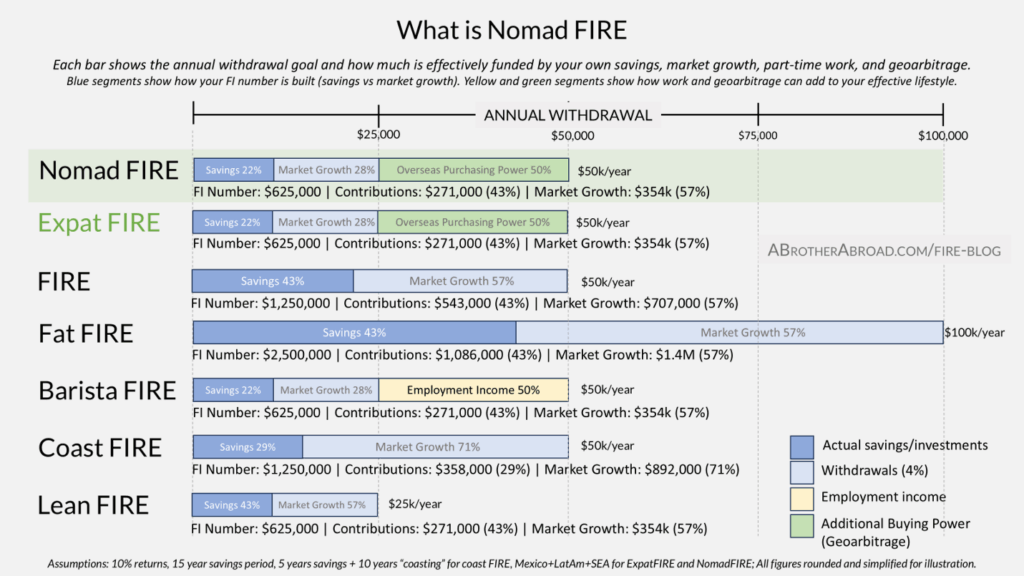
ExpatFIRE vs. Nomad FIRE: FIRE Expats settle in one place abroad, FIRE nomads continuously travel abroad. Many FIRE nomads transition to Expat FIRE as they increasingly desire to settle.
Digital Nomadism vs. Nomad FIRE: Digital nomads are (often) not financially independent and must continue to work, but do work remotely to travel abroad. FIRE nomads are FI and do not need to work, but may choose so for passion, for purpose, or to strengthen their financial situation.
Traditional FIRE vs. Nomad FIRE: Traditional FIRE followers generally reach financial independence with enough assets to retire early in a single place in their home country. FIRE nomads not only move abroad but also travel continuously, often staying 1 to 6 months in each location. While some FIRE nomads’ assets (their FI number) might not be enough to retire early in their home country, due to geoarbitrage, it is sufficient to be financially independent in the locations abroad that they choose.
Barista FIRE is an approach to FI in which a person reaches partial financial independence, receiving passive income that covers part of their living expenses, and takes part-time employment to cover the remainder of their expense. A FIRE nomad that covers 50% of their expenses with withdrawals, and works remotely to cover the remaining 50% of their expenses would be a FIRE Nomad and a Barista FIRE follower, living as a digital nomad.
LeanFIRE is the approach to fire in which followers target a more lean withdrawal, generally $25,000 per year or less, and FIRE in their home country in a single location. While $25,000 per year, or ~$2,000 per month, is lean in the US, $2,000 per month is sufficient for a normal expat existence for a single person in 2/3 of the cities around the world I review in my research into where expats reported COL in 2026. (Source: 2025 A Brother Abroad Global Cost of Living Analysis)
The Difference between “Nomad” vs. “Expat”: A single home vs. a location-independent lifestyle, and the planning requirements that each situation creates
When you stay long enough in a single country, often when approaching the 6 months mark, tax obligations start to kick in, bank accounts begin to feel necessary, and residency planning feels like the logical and necessary next step. Though these things don’t necessarily add weight to your bag, they absolutely make the lifestyle feel less “lightweight.” This threshold, of time and logistical requirements, makes up the line between a nomad and an expat, highlighting the point at which the logistics required to comfortably stay/live in a country change.
The Expat lifestyle, within ExpatFIRE, is another extraordinary way to live, but it requires and different kind of planning and intentionality, geared towards legally and efficiently staying in one place abroad, instead of moving from place to place. Being aware of this difference, and the underlying requirements, allows you, as a nomad, to maintain a lightweight lifestyle empowered by simplicity and, when the time comes, intentionally choosing a country you’ve tested and screened to grow roots in, become an “Expat” (aka legal immigrant) and transition onto the path of ExpatFIRE.
Who Nomad FIRE is best for: Adventurers, open minds, and travel lovers
While Nomad FI does have an upside that’s nearly impossible for the average person to craft any other way, understand that a successful and fulfilling nomadic lifestyle takes minimalism, intention, research & planning, and an adventurous spirit. While these traits can be cultivated, the best fit is for those people who inherently have these traits – to enjoy the tradeoffs of the journey without spoiling the adventure.
Nomad FIRE is best for:
- Those who are flexible, uncertainty-tolerant, systems-minded people who enjoy movement.
- Those who have a strong desire to see the world
- Those who don’t mind handling the small but important “logistics” of life, which become more frequent with a life on the move
- Experienced travelers who relate to the FIRE mindset and lifestyle requirements
With this said, Nomad FIRE is not for everyone.
Who should reconsider other FIRE options instead of Nomad FIRE
- Those needing specific in-place medical care
- Those who hate bureaucracy/logistics
- Those who have heavy local family obligations
- Those who simply want to live cheaper by moving abroad, but do not want the logistics and planning responsibilities of constant moves (consider ExpatFIRE instead)
- Those who don’t love travel
- If you are not the type that loves to travel, are not open-minded towards other cultures, and are not flexible enough to deal with bureaucracy and hiccups, nomad FIRE is likely not the best option for you.
For those considering Nomad FIRE merely for the cheap lifestyle and quicker path to FI, Lean FIRE and ExpatFIRE deliver the same, or better, financial accessibility, with more stability and exponentially less friction, and should be considered instead.
However, if the adventure of long-term, continuous travel is something you would love to do, even if you had to pay for it, Nomad FIRE might be the avenue to adventure you’ve been looking for
The Math of Nomad FIRE: How to calculate the cost of financial independence & forever travel
“Nomad FIRE number” can be significantly lower than the “stay-in-US FIRE number” for the same person. While Nomad FIRE is inherently more expensive than ExpatFIRE, the possibility of being cheaper than home FIRE depends on your itinerary. While nomading in Vietnam, Bolivia, and Albania would likely be far cheaper than home, nomading in Singapore, London, and Hong Kong would likely break most budgets. In order to plan for a nomadic life and an itinerary that suits your FIRE budget possibilities, we would use your base monthly expenses at home, and three essential numbers for nomads.
The numbers behind nomad FIRE consist of three steps, and three numbers, that use your expenses in everyday life to estimate the amount of money you need to live a life of forever travel: Your FIRE Number, your Expat FIRE number, and finally your Nomad FIRE Number.
Traditional FIRE Math: Your FIRE Number
Annual Spending x 25 = FIRE
This is the amount of money you need to reach financial independence where you are now.
This math is underpinned by your chosen withdrawal rate, commonly 4%, but 3.5% and 3% can be used to calculate for longer retirements/FI periods and plans for multi-generational wealth.
This chosen withdrawal rate gives us the “25x rule”, for the 4% withdrawal rate, meaning that, according to the FIRE approach, 25x annual expenses is how much you will need for financial independence.
We take this home FIRE number and move on to calculate our “Expat FIRE number.”
If you do not want to do the math, use our FIRE calculator
Expat FIRE Math: Your Expat FIRE Number
Your “Expat FIRE number” is the amount of money you would need to be financially independent in a specific, different country from where you are now.
Your Expat FIRE number is calculated as:
Your FIRE number x the cost of living factor of your destination country = Expat FIRE Number
This is the amount of money you need for financial independence in your country of choice.
Example COL factors for popular expat destinations are given in this article, but Expatistan and Numbeo are great, up-to-date resources for finding the comparative COL factors between countries.
However, to find our nomad FIRE number, which consists of not one but several different countries that we live in for months at a time, we need to calculate our monthly costs of living in a different country.
How to find your estimated monthly cost of living in a different country:
(Your monthly or annual spend) X (destination cost of living factor) = Your estimated Expat monthly spend
This is your estimated monthly expense in your destination country
Now we can use this number to find your monthly costs as a nomad, your annual costs as a nomad, and your Nomad FIRE number.
If you do not want to do the math, use our Expat FIRE calculator
Nomad FIRE Math
Now that you know how to find your monthly expat experiences for a specific destination, we will use this and your planned 12-month itinerary as a nomad to find the cost of a nomadic year. And we will use the cost of a nomadic year to find your Nomad FIRE number. This same process is repeated in our Nomad FIRE Calculator.
Calculate the cost of your nomad year: Start with monthly expenses by country.
Nomad Annual Spend = Σ (monthly expat cost by destination) + flights/transport + activities + buffer
Note that the “Expat Monthly Spend Per Country x 12” does not need to be the same 12 times, or all different countries. You just need to choose a country’s expense estimate for each of the 12 months.
For example:
(Thailand Monthly Expense)+ (Thailand Monthly Expense)+ (Thailand Monthly Expense)+ (Vietnam Monthly Expense) + (Vietnam Monthly Expense) +(Vietnam Monthly Expense) +
(Japan Monthly Expense) + (Japan Monthly Expense) + (Japan Monthly Expense) +
(Colombia Monthly Expense) + (Guatemala Monthly Expense) + (Mexico Monthly Expense)..
Then, add a buffer, additional cost, for nomading instead of a stable expat life, and your preferred travel style.
At this point, you have a very “lean” annual cost as a nomad.
But remember, “friction” creates a financial tax through all of the movement. Arriving in a new town, not knowing what is cheap or what is expensive, paying for a relatively more expensive Airbnb instead of a cheaper year-long lease, and lacking the local knowledge that divides locals from tourists will inherently make life more expensive. To account for this, multiply the annual spend by a “buffer”.
Increasing these “expat costs” by 25% (by multiplying the monthly expenses by 1.25) is, in my experience, the cheapest life gets as a nomad compared to an expat. If you live more than a “budget backpacker” lifestyle, 50% more is likely (so a 1.5 factor). And if you insist on either luxury or purchasing all of the things available in your home country even if they’re uncommon luxuries in your destination – think “steak in Bali,” renting a car in Europe instead of using public transport, or sticking to European wines while elsewhere – plan on a 75% to 100% 1.75x to 2x factor over living as an expat.
You now have a closer estimate of the in-country monthly expenses, accounting for the friction of nomad life and the luxuries you insist on.
Then, add flights and transportation:
(Flight) + (Thailand Monthly Expense) + (Thailand Monthly Expense) + (Thailand Monthly Expense) + (Flight) + (Vietnam Monthly Expense) + (Vietnam Monthly Expense) + (Vietnam Monthly Expense) + (Flight) + (Japan Monthly Expense) + (Japan Monthly Expense) + (Japan Monthly Expense) + (Flight) + (Colombia Monthly Expense) + (Flight) + (Guatemala Monthly Expense) + (Flight)+ (Mexico Monthly Expense)..
And be sure to add in other nomadic and travel expenses, such as a monthly local transport budget, a budget for tours and excursions, or a budget for any special activities you have.
Now, you have the cost of a nomadic year.
Convert your annual nomadic budget, using the 25x rule:
Nomad FIRE Number = Nomad Annual Spend × multiple (25x for 4%, 33 for 3% etc.)
Now, you have your “Nomad FIRE number”, which is the amount you need to be financially independent while living out your example itinerary.
If you do not want to do the math, use our Nomadt FIRE calculator
Note on the 25x rule and chosen withdrawal rate: For this step, the 25x rule applies if you choose a withdrawal rate of 4%. If you choose a withdrawal rate of 3%, you will use the ~33x rule. If you choose a withdrawal rate of 3.5% you will use the ~29x rule. If you choose any other withdrawal rate in retirement, not that the “multiple” to calculate that will be different.
The Nomad FIRE operating system: How FI nomadism works in real life
Building a portable life: Minimalism as a tool for financial independence
Minimalism & systems for nomadic living keep life portable, sustainable, and comfortable
While all types of FIRE require a form of minimalism, Nomad FIRE takes minimalism, embraces it (by aiming to own only what fits into a bag or two), and cultivates it to create maximum mobility and location independence.
Then, Nomad FIRE plugs the Nomad into locations that complement material minimalism by naturally delivering the conveniences and necessities – food, accommodation, community, wellness resources, and entertainment – in a way that is plug and play. In this, we create efficiency and mobility, and the opportunity to make travel and a smattering of destinations the abundant spice of life and a reward we receive for this minimalism, flexibility, and adventurousness in action – unique benefits beyond the simple “financial independence” and “retire early” movement.
Material minimalism and a lightweight lifestyle are “skills” and tools that empower the FI Nomad
Living the nomadic lifestyle sustainably and fulfilling requires material minimalism (life in a bag, or two), which then allows for the effortless mobility that allows one to switch homes every few months, with minimal headache, inconvenience, or loss. While this lightweight approach to life does seem simple, it does require the compromise of slimming the possessions in one’s backpack or duffle to only the essentials, and the planning to minimize belongings and responsibilities back home, placing items in storage, selling as much as possible, and canceling leases, so that nothing, at home or in your bag, slows down or prevents the next move on your journey.
However, this minimalism, which creates opportunities, does present a problem if not addressed in planning. Not having a car hampers life in highway and commute-centric places like the US, not having a kitchen becomes costly, eating out constantly in places like New York or Switzerland, and maintaining a healthy, active life becomes difficult in places lacking green spaces and walkability. Living with just a backpack limits how you live life to the opportunities – for food, entertainment, community, travel, and happiness – to what your chosen city makes accessible. Herein is where livable cities and nomad-friendly locations pair well with the nomad lifestyle, making minimalism not a hindrance, but a savings and mobility tool without a compromise in lifestyle.
Living in “highly livable citie” and “nomad enclave, that are either walkable or have easy transport, plenty of greenspaces and enjoyable shared public spaces, accessible healthy food, and actively connected community (locals and expats), allow for efficient living, without the car, the big house, and the many toys required to be happy, fulfilled, productive, and connected many places in the US.
We’ll review what makes a nomad-friendly city or a nomad enclave later, but take these as examples.
Medellin, Colombia, is a quintessential nomad-friendly city. This warm and welcoming city, filled with affordable cafes, restaurants, places to socialize, and public transportation options, makes it easy to arrive with just a backpack and eat, sleep, socialize, explore, and live easily and affordably. Within this shockingly livable city, the neighborhoods of Laurelles and El Poblado have become “nomad enclaves,” livable, self-contained neighborhoods wherein a nomad could arrive with just a backpack, check in, and live a rich daily without compromise because of all of the comforts and necessities easily available within just a few blocks’ walk, affordable enough not to break the bank.
This efficiency is achieved via combined lifestyle design and location selection, by “staying light” while also choosing “nomad-friendly” destinations, which naturally leads to a low-cost, high-satisfaction life that is akin to a permanent vacation (with a layer of permanent logistics and concerns that we’ll cover later) but still cheaper than life at home.
Slow travel: the lever that makes it affordable and cheaper over time
Slowing down and returning to known bases decreases costs over time
Longer stays make for cheaper stays
The longer you stay in any location, the cheaper it gets. Daily hotel rates get traded down for monthly Airbnb rentals, which get cheaper as short-term leases. As you venture out of the tourist area, local secret spot “mom & pop” restaurants find you, delivering healthier, home-cooked meals for a fair price. And as you settle, transportation costs drop, and daily life becomes the adventure – instead of overpriced tours.
No matter where you are in the world, slowing down your travels and planning to stay a bit longer makes your travels cheaper.
Cities get cheaper as you return, learning more about the city
Just as the knowledge you learn by staying in a location a few months longer makes the overall stay cheaper, returning to the same locations with accruing insight has financial savings and emotional benefits that keep nomadism sustainable.
Returning to a city you loved before, but learning more about budget-friendly neighborhoods, more affordable yet tasty restaurants, and where to buy that thing you’re missing from home means that every time you return, your stay will be simultaneously cheaper yet more satisfying – inching towards the knowledge, savings, and efficiency of an expat life in that place each time.
Additionally, the satisfaction of getting what you want (or need) when you need it has a recharging psychological and emotional effect that you will eventually need with months or years on the road. If you are ever depleted, lonely, homesick, or even sick and need to recover, return to a familiar base city or neighborhood, and you’ll find immense value that makes the nomadic life sustainable.
Your budget “buffer factor” naturally goes down the longer you travel, the more you slow down, and as you return to good nomad hubs that you are familiar with.
The buffer that we calculated into the math of nomadic budget, 1.25x, 1.5x, etc., goes down the slower you travel, the longer you stay on the road, and the more you return to good nomad hubs that you’re familiar with and aren’t touristy.
For reference, and from real-world experience, right now, after almost 10 years as an expat, and over a year spent in each of my 3 “go to” hubs, I stay for 2 to 3 months minimum, in the same neighborhood, and frequent the same restaurants, cafes, gyms, and grocery stores. Due to the familiarity and slower pace, my nomad budget in my hubs is ~1.15x of what my expat budget, settled, staying for 1 year or longer, would be. In contrast, my nomad budget in new cities still tends to be 1.5x what a comparable expat lifestyle, familiar with the area and settled in, would cost –based on cost of living research in the location and discussions with settled expats in these cities.
Nomad sustainability logistics essentials: visas, healthcare, banking (money & currency), taxes
Good visa, banking & money, travel insurance, health planning, and social/community planning & logistics make nomadic life more sustainable and enjoyable.
While the logistics of a nomad life are covered in our separate complete guide**, and understanding what it takes to go abroad is covered in our guide “how to move to another country”, it is worth considering the logistics required to live the nomad lifestyle as you start planning, and before deciding whether the nomad life is for you.
Here is an overview of the essentials and logistics to think about when planning a nomad FI life
Visa Planning for Nomad FIRE
Once you’ve received your passport, the next most important planning point as a solo traveler will be researching and planning for “visas.” Visas are essentially permission from a country to stay in that country for a period of time – generally 30 to 90 days for most tourist visas and waivers. For instance, US citizens are allowed to stay up to 90 days visa-free in Japan, and are allowed to stay up to 90 days total throughout all of the Schengen Zone countries in 180 days, and recently, China allowed stays of 30 days. But these are visa waivers.
For longer stays and multiple entries, up to a year, as of now, there are over 50 nomad visa options that allow you to stay up to a year or more (dependent on each country’s immigration policy)
If you decide that you want to make a single country a “base” for your travels, returning to it throughout the year, then there are more than a handful of great, long-stay residencies for nomads that offer multi-year stays as well as several specific visas for retirees. The two main draws of these long residency visas are that they offer long stays in places that are usually difficult to stay otherwise – such as Spain, Italy, Portugal, Japan, etc. – and that they can offer a path to permanent residency, citizenship, and a second passport in the EU and South America.
The rights of a resident (local bank accounts, easier access to health care, and apartment leases), assurance that you can go back repeatedly to your chosen place, and the stability that comes with it are worth good visa planning.
“Visa runs” are becoming less accepted, so plan accordingly.
In the earlier days of backpacking, in the 90s and early 00s, backpackers and nomads relied on shorter stay tourist visas, such as Thailand’s previous 30-day tourist visa waiver and Vietnam’s 30-day single entry visa, and simply flew back and forth between the two countries to reset their “visa clock.” However, in 2025, a wave of tightening immigration policy and enforcement has led countries in Asia and Latin America to begin refusing entry to frequent visitors who stay under the guise of being a tourist, on a tourist visa, but return frequently and do not return to their home country, unlike tourists. Though the trend of enforcement is meant to combat human trafficking, money laundering, and criminal organizations, it is preventing the age-old and loved practice of visa runs and crossing borders, light and carefree.
Know that long stays and specific visas can trigger tax liability in a second country
Warning: Having a base country and residency outside of the home country can be useful (storage unit, always a place to fly back to when burnout hits); however, residency likely triggers tax obligations, requires renewals, and address history.
The two most common triggers of tax residency, and the requirement to file taxes, are switching from a visitor visa to a resident visa (like the Indonesian KITAS or Indonesian Digital Nomad visa) or staying longer than a specific number of days in a single year (such as 183 in Bali/Indonesia, or longer than 11 months in Argentina). Researching these thresholds before staying longer than 6 months or applying for a resident visa allows you to avoid accidentally becoming a tax resident or being aware of how making a country you love a “base” location may affect your tax obligations.
What to do: Plan early, check the requirements, and know where to find up-to-date visa information
Nomads should plan for this by getting a proper visa and abiding by the entry requirements, such as cash in hand to cover their stay, proof of booked accommodation for their stay, and proof of an onward flight.
Tourist stays, Nomad Visas, and Residencies Lists and Resources
Use these resources to find the best visas to patch together for your nomading plan.
- Best Digital Nomad Visas
- Best Long Stay Residencies Around the World Database
- Best Residencies for Early Retirees and FI Expats & Nomads
- How to use a residency to gain an EU passport
My Preferred Approach: Nomadic with “roots.”
The routine that I have fallen into, enjoy, and find fulfilling yet sustainable is the “nomad with roots” approach, whenever I am in my nomad phase. During my wanderings, I always maintain one flexible residence option for ideally a year or more – Argentina, Thailand, Indonesia previously, Malaysia at one point – and get the paperwork, visa, and area familiarity to be able to always return to this place when burnout hits. Though keeping a visa for a place I don’t live continuously may seem wasteful to some, the comfort of, whenever loneliness, burnout, fatigue, or low productivity hit, being able to book a flight and AirBnB in a familiar neighborhood, and the following morning walk a few blocks to a breakfast and waffle café I’ve been frequenting for years does wonders for my spirits. Additionally, this approach allows me to keep a storage unit where off-season supplies (cold-weather jackets, camping supplies), kitchen extras, and documents can be stored, and always have a place I can plan to meet people on the road if they do want to meet.
Think of strategic visas not just as the right to visit, but the option to effortlessly take the parts of your life that aren’t nomadic and base them in a single place.
My preferred route: Eternal Spring
In addition to having “nomadic roots,” consider planning or being familiar with visas that add up to an itinerary that creates the “perfect year” for you.
For me:
- Sept to February: Thailand/Japan
- February to August: Southern Europe/Balkans (Italy, Montenegro, Albania)
Banking and Money, while nomadic abroad
Financial independence has no value if you can’t access your money conveniently and cheaply.
While credit cards tend to work globally and most places in the world have ATMs these days, it is still essential for nomads to have the banking mechanisms to access cash anywhere, be able to receive new credit or debit cards, and be able to verify “2 factor authentication.” Additionally, planning to avoid costly ATM fees and navigate different currencies saves headaches and money as well.
The full Nomad Logistics Guide** and Banking Abroad Guide** have full details.
- Bank Accounts: 2 checking accounts with debit cards and no transaction fees (I recommend Schwab checking)
- Credit Cards: 2 Credit Cards with no foreign transaction fees and good fraud prevention, while also not unnecessarily blocking your transactions abroad (I recommend Chase Sapphire)
- All Possible Cross-Border Financial Products: Wise, Revolut, PayPal – all with debit cards and verified home addresses
- Virtual Mailbox: Set up to receive mail, forward mail abroad at request, and scan important mail to view online
- Residential Address: Get permission to use the residential address of a family member or trusted and reliable friend, to list as your residential address with your bank while abroad – otherwise your bank will eventually cancel your
- SIM Card that receives texts globally and allows calls from home country: Important for “2FA” when accessing bank accounts and verifying transactions. (I recommend Google-FI)
- Permanent Email Address and Cloud Drive: This remains a permanent point of contact for you and a repository for travel plans and itineraries, and important documents (I recommend Gmail)
Travel insurance, Healthcare, and Aging on Nomad FIRE
Accidents are bound to happen abroad while traveling and wandering adventurously. I’ve witnessed people who aren’t accident-prone fall off motorbikes in Vietnam, get altitude sickness and require evacuation in the Himalayas, and require rabies vaccines after stray dog run-ins in Laos. Having the proper insurance can be the difference between quick, safe, effective care to continue on your journey and high-cost out-of-pocket expenses that end your travels.
For these reasons, I always recommend that nomads, at least, maintain a form of travel insurance covering their planned activities – high altitude trekking, SCUBA diving, surfing – and covering evacuations for medical, political, and disaster reasons.
While recommending specific healthcare or travel insurance, I always recommend maintaining coverage, ensuring the insurance covers your planned activities, and always doing what is required by the fine print – always wearing a helmet and staying sober on motorbikes, always surfing or swimming only where there is a lifeguard – to stay covered.
Consider your age and health, think through your existing conditions, consider your travels, and dig to find the right travel insurance or expat healthcare plan for you. While I currently have Safetywing and previously had World Nomads (and heard many adequate experiences about them), Cigna, IMG Global, and Allianz are generally regarded as higher-quality “expat healthcare” options to consider.
Medical and dental tourism: An amazing wellness hack for nomads
Unknown to many in the US, Canada, and Western Europe, many “destinations” around the world offer world-class healthcare, dental, wellness, and treatments that rival quality in the West – with impressive hospital and tourism infrastructure and doctors extensively trained and certified in the US, Europe, and Canada – at a fraction of US prices. For many checkups, labs, and treatments, one could fly to these locations, pay for comfortable accommodation and a vacation as well as the procedure, and still be cheaper than copays alone in the US. This is “medical tourism.”
As you live life on the road, do not disregard your health, and heavily consider medical tourism and wellness hubs. Thailand, Panama, Costa Rica, Malaysia, Turkey, and Southern Europe each specialize in health procedures, check-ups, dental and orthodontic surgery, cosmetic procedures, and more.
For awareness, visit the Medical Travel website of the Bumrungrad Hospital in Bangkok to learn about the possibilities of medical tourism.
Mental Health & Happiness: Community, loneliness, burnout, and long-term traveler fatigue
Though the travel life, and a forever vacation, is a dream treat for the right personality, it comes with a significant mental and emotional health potential downside – loneliness.
Wandering the world, traveling to countries that speak languages you don’t understand, meeting amazing friends who you spend days with and never see again, and having no true stability other than your backpack will, at times, leave you feeling emotionally isolated if not planned for correctly.
While we all have loved ones at home, we’ll stay connected via WhatsApp groups and social media. Without face time, the strength of many friendships and relationships can fade, and you will need to intentionally cultivate and maintain alternative connections with others to stay happy and healthy.
In the Global Digital Nomad Study conducted in 2022, loneliness was the #1 reason that otherwise self-sufficient nomads returned home.
Knowing that the potential for loneliness, and the need for connection and community, as well as the potential for long-term travel fatigue, and the need to intentionally recharge and return to the familiar, makes it easier to plan on these aspects as part of your journey – making your time on the road more enjoyable and fulfilling.
Maintaining Healthy Community & Relationships: Cultivate them as a nomad.
Good mental and emotional health in a nomadic life means avoiding “social starvation” and droughts of deeply connected contact over months and years, and the only way to do that is to preserve and adapt your current relationships to your nomadic lifestyle, and build a social life as a Nomad FIRE person.
Maintain ties with friends and family at home.
Understand from the start that most people would either love to live a life of travel or would like to vicariously live a life of travel with someone they love, and bringing your loved ones on your trip with you will be the tie that grows stronger along the way. At the same time, remember, it’s not all about you and your adventures, and regardless of your beautiful chaos, life is going on as normal for them at home, so be just as interested in their successes, their struggles, and their life.
Schedule calls, and consciously use WhatsApp or your favorite platform to stay continuously connected, and check in with a message, a voice call, or a video call the same way you would at home.
Also, don’t just leave contact to the virtual.
Plan to meet the ones you love at least once and ideally twice a year, either by visiting them or by bringing your family out to join your life in your travel circuit. From my observations of nomadic friends, one visit home per year, and one visit by the family abroad to the nomad as a loving guide (or vacation host) is the best use of the life for all involved.
Intentionally Join Communities & Build Nomad Life Friendly Relationships
The beauty of the increase of digital nomadism since 2018 is that wherever you go in the world these days, nomads are likely to find other nomads, like them. This means the potential to meet like-minded individuals with similar ideas, goals, aspirations, and paths in life. Connecting with the “others” like you, and maintaining contact, can be invaluable, healthy, inspirational, and eye-opening.
Though you will part ways, you’ll find that nomads tend to follow the same circuits and prefer the same hubs. So, nomad friendships never quite end; they just pause until paths cross again – accidentally or intentionally. In my years of nomading, I’ve crossed paths with hundreds of other nomads multiple times, to the point where we’d smile recognizing each other’s faces even without being introduced. As you’re on the road longer, these relationships grow more valuable with time.
To actively build friendships with other nomads, carve out time whenever you’re in a notoriously popular city for nomads to sleep, eat, and play where nomads go. Look for interest-based meetups and events, and just be friendly, open to connect, and open about wanting to reconnect later.
The best sources for connecting with other nomads are:
- Co-livings / co-working spaces.
- Local expat groups.
- Shared hobbies (jiu-jitsu, salsa, surfing, climbing, etc.)
Countering Long-term Travel Fatigue: Burnout, Boredom, and Decision Fatigue
As we reviewed before, the biggest risks in the nomad life are due to loneliness and burnout, also closely associated with long-term travel fatigue.
Both burnout and long-term travel fatigue can be traced back to traveling too quickly through too many places, without enough familiarity. Essentially, the emotional battery isn’t charged enough to keep the adventurer engine going.
This could happen due to FOMO and forcing yourself to expend more energy traveling in a way you don’t care about, or feeling like you have to travel, to epitomize the archetype of the modern nomad commonly shown on social media. The first step in overcoming both of these is recognizing – it’s your trip, and you can go, or not, and stay, or not, as you want to.
Next, for both of these issues, the best cure I’ve discovered is to slow down and return to the familiar.
Go back to the familiar and experience it again, more deeply, to recharge
Return circuits, or going back through circuits you’ve visited before to stay longer, and connect deeper with the place (study the food, learn the language, etc.) while being recharged by the familiar.
Schedule months to live, be, and do nothing, to balance the constant movement
“Still months,” wherein you play expat and simply live in the place, buying groceries, cooking dinner, watching Netflix, and doing as the locals do, is an excellent way to settle and recharge. I find this tactic works best in a place I’ve been to before and enjoyed.
Give yourself time to go “F*** it” and wander without an itinerary, skipping all decisions to fight decision fatigue.
Choose planning windows vs always-on logistics. By this, I mean sometimes skipping the detailed plans and just going with the flow. Decide to book accommodation and a flight, and that’s it – don’t research things to do, coffee shops, or best of lists. Instead, just wander around with headphones on, or even take an old school style Lonely Planet to reference every once in a while – or not. Intentionally plan for a place to sleep, and skip urgent decisions for everything else.
Where to Nomad: How to choose destinations and “stop-offs” on your path
While much of the nomad life is traveling circuits between bucket list sites, exploring the corners and destinations around the world you’ve always dreamed of, the foundational places in the nomad lifestyle will be the “nomad cities” and “nomad hubs” you visit, connect in, and return to as your home bases.
The destinations around the world you visit will satisfy your urge to wander and adventure.
The nomad hubs you grow to call home will recharge, refill, and fulfill you along the way.
What are Nomad Hubs, Nomad Friendly Cities, and Nomad Enclaves: Complementary and necessary bases in a minimalist, nomadic life
Nomad hubs and nomad-friendly cities are cities and neighborhoods around the world that either naturally or organically evolved to complement the minimalist lifestyle of the nomad, offering easy and comfortable options to sleep, work, play, and socialize for the wanderer living out of a backpack.
“Living” in nomad hubs creates cost efficiency and makes nomadic life sustainable, while maintaining “life portability.”
In reality, these nomad cities, or more appropriately called nomad-friendly cities, are walkable, safe cities and neighborhoods that offer plenty of places to work and eat, opportunities to socialize, connect, and enjoy community, and have comfortable short-term accommodation suitable for the nomad. Essentially, these nomad-friendly cities offer life’s necessities so easily that even a person with just a backpack can arrive and not just survive but thrive and enjoy a comfortable quality of life. Life in Japan epitomizes this “convenience for the minimalist” lifestyle, with affordable business hotels, “konbini” mini-marts that offer everything from socks to dinner and dessert, to bullet trains that make accessing the opposite corner of the country as simple as walking three blocks to the train station. Other good examples include Kuala Lumpur, Buenos Aires, and Tbilisi.
Nomad hubs are known nomad cities that nomads have then flocked to, which in turn nourishes an ecosystem that grows around the nomads. Chiang Mai, Thailand, Medellin, Colombia, and Da Nang are notorious for having accommodation, cafes, and meetups that perfectly accommodate the nomad crowd.
Lastly, nomad enclaves are specific neighborhoods that have grown around nomad culture and are places where both nomads and the nomad community thrive. The Laurelles and El Poblado neighborhoods of Medellin, the My An / An Thuong area of Da Nang, and Vake or Vera in Tbilisi are all blocks of apartments near cafes, restaurants, entertainment, and meetups. In nomad enclaves like these, a weary traveler could arrive and live life within a few blocks for still months while they make friends, connect, and recharge.
Knowing that these three types of nomad communities and nomad-friendly places exist allows you to not only plan to see the world, but also plan places to recover and enjoy, with people like you, between those travels.
What makes a good “Nomad Hub” or nomad-friendly city?
Nomad hubs and nomad-friendly cities are the key to a minimalist and lightweight yet comfortable and fulfilling life, but how can you identify one?
As you sit down, planning your path, and decide to plug in nomad hub spots, prioritize these criteria for a good nomad hub:
- Affordability (for the whole package)
- Walkability or being equipped with clean, cheap, accessible, enjoyable transportation (like Kuala Lumpur or Japan)
- Nomad community & spaces: Nomad-friendly cafes, coworking spaces, co-living spaces, and free events
- Food: Convenient, cheap access to good, healthy, tasty food
- Attractions nearby: Whether national parks, museums, or frequent cultural events, nomadic cities connect visitors to another world
- Engaging and Livable: Nomad hubs tend to be healthy, engaging, and enjoyable to live in
- Welcoming the community towards nomads
How to use the framework to choose nomad-friendly (not just cheap) cities
During your initial travels nomading, it is best to start with a known nomad hub or nomad-friendly city shared as viable by a trusted source. From the recommended cities for nomads, pick a destination that offers the climate, landscape, culture, and food you crave for a “connect and recharge” stay.
Here on A Brother Abroad, we keep a running list of the best cities for nomads in countries around the world, and that is a great place to start. Additionally, on our Digital Nomad Blog, we post the best cheap cities to live, destination guides, and guides for moving abroad to specific countries with recommended cities inside.
Beyond A Brother Abroad, Nomads.com (formerly Nomad List) is a great resource for discovering city destination ideas as nomad hubs.
As you plan from a budget standpoint, Expatistan and Numbeo are two of the best resources on the cost of living for specific cities, with COL numbers contributed by expats as they visit.
Lastly, Reddit is a more granular resource, even if polarized at times, as individual nomads offer up destination ideas, and follow on critiques and recommendations.
As you become more experienced nomading, take note which aspects of a good nomad city are most important to you – walkability, community, accessible attractions, cafes, etc. – and search for cities around the world that do that single thing extremely well, and screen out cities based on the criteria for a good nomad city.
For now, let’s save you some research and get you started with examples.
Where to start: The best cities and countries for nomad FIRE
This article on best nomad cities and hubs has an extensive and frequently updated list of the best cities for nomads, by region.
Alternatively, read this article on the lowest cost cities around the world, to find ideas to start with.
Shortlist of hubs by region (10–12 total)
This isn’t the end-all all be-all list or best of list nomads. It is a list of reliable cities to 1) potentially check out, 2) get you researching in the right direction, and 3) hopefully send you to the nomad hubs that are right for you, and is based on my research in the Global Digital Nomad study and conversations with 100s of nomads since then.
Asia’s Best Nomad Hubs
- Bangkok, Thailand
- Chiang Mai, Thailand
- Da Nang, Vietnam
- Pererenan, Bali or Kuta, Lombok
Latin America’s Best Nomad Hubs
- Medellin, Colombia
- Mexico City, Mexico
- Antigua, Guatemala
- El Zonte, El Salvador
- Florianopolis, Brazil
- Cusco, Peru
Europe’s Best Nomad Hubs
- Porto, Portugal
- Tbilisi, Georgia
- Tirana, Albania
Africa’s Best Nomad Hubs
- Accra, Ghana
- Cape Town, South Africa
- Nairobi, Kenya
- Essaouira and Taghazout, Morocco
- Tenerife and the Canary Islands
Sample “one-year NomadFIRE” routes
Sample one-year routes (3 routes: Lean / Balanced / Comfortable)
Lean Budget Nomad Itinerary for 1 Year
- Bangkok
- Chiang Mai
- Da Nang
- Phu Quoc
- Panang/Georgetown, Malaysia
- Tbilisi
- Bucharest
- Tbilisi + Sarande
- Egypt /Morocco
- Florianopolis
- Buenos Aires
- Medellin + Santa Marta
Balanced Budget Nomad Itinerary for 1 Year
- Mexico City, Mexico
- Antigua, Guatemala
- Lima, Peru
- Fukuoka, Japan
- Sapporo, Japan
- Da Nang, Vietnam
- Bangkok, Thailand
- Belgrade, Serbia
- Kotor, Montenegro
- Warsaw, Poland
Comfortable Budget Nomad Itinerary for 1 Year
- Portland, Oregon
- Quebec City/Montreal
- Tulum, Mexico
- Lima, Peru
- Kyoto, Japan
- Melbourne, Australia
- Dubai, U.A.E.
- Amsterdam, the Netherlands
- Zurich, Switzerland
- Tuscany, Italy
- Lisbon, Portugal
How to make it happen: Two roadmaps to Nomad FIRE, and a tester option
No matter which of the two paths you choose to make Nomad FIRE a reality for you, there are 4 essential steps to getting started.
- Learn about FIRE and tune your finances for FIRE
- Learn about the destinations around the world that you would love to live for 3 to 9 months
- Calculate the cost of your year abroad with Nomad FIRE
- Calculate the cost of the Nomad FIRE life for you, the monthly cost, and the Nomad FIRE number
Roadmap A: You’re already FI, choosing to embark on a Nomadic Life as early retirement
This approach is pure Nomad FIRE, aiming first to achieve FI and then transition to a life of slow travel around the world.
If you’re in this situation, and you’ve put in the work to already achieve FI, you’ve hit your classic FIRE number, and Nomad FIRE is “optional upside,” potentially delivering a better quality of life (depending on your itinerary) and absolutely satisfying the wanderlust.
In this case, you can choose to spend your FIRE period at home, or nomadically, perhaps with a portfolio now “overfunded” relative to your nomad budget.
The upside of achieving fire first is a lot of financial cushion, which becomes freedom to splurge while traveling. Additionally, if you have a comfortable job at home and you’re patient, this is the cleanest, most efficient path to Nomad FIRE – via traditional FI first.
The downside is that this ample comfort could potentially lead to complacency, and one extended stay in Zurich or London without tracking could put a dent in your FIRE number. Additionally, you will still need to manage the risks.
To take this approach, simply start on the FIRE path at home.
Start by reading these resources:
- What Is Financial Independence and How Can You Achieve It?
- A Complete Guide to the FIRE Movement
- How to become financially independent according to the 15 best personal finance books
Roadmap B: You’re still building FI and use NomadFIRE tactics as a bridge.
Barista FIRE+ Nomad FIRE Closest thing to “Digital Nomad FIRE” and allows nomadic remote workers to save more than working at home, thanks to geoarbitrage, while partly tasting the nomadic FI life.
Working remotely part-time while traveling, and using FIRE assets or passive income to cover the rest. In this scenario, withdrawals from the portfolio may cover 40–70% of your nomad budget.
Then, you cover the rest of your expenses with remote freelancing/consulting, online business income, or occasional short contracts.
This approach is a great option to financially support temporary long-term travel, such as sabbaticals or a simple year or two abroad before returning to work in one’s home country.
Additionally, this Barista FIRE + Nomad FIRE is an excellent way to buy time if building a (proven) income stream or business, or seriously testing side income options.
In this approach, the semi-FI nomad’s portfolio covers a chunk of the travel expenses by allowing for withdrawals (passive income) for that portion of travel expenses. Then, the nomad works part-time to pay for the rest.
In many ways, this can be safer than full FIRE at home, with the same number, as the nomad can make their money stretch further simply by choosing a destination, if their investment and withdrawal outlook changes.
If considering this path, use our Barista FIRE Calculator to see how the numbers will work for you.
Roadmap C: Partial Coast FIRE + Nomad FIRE: Front-Loaded Savings, Coasting+Nomading Abroad
When FIRE assets are too lean for FIRE at home, but significant enough to more than cover a slow travel life with a surplus, there is an opportunity to nomad on part of the withdrawal while allowing the untouched assets to grow.
Generally, assets invested well enough to receive the same returns as the market double every 7 to 10 years. This means that if a person decided to FI abroad, according to the FIRE methodology, and withdraw only half their save withdrawal rate (2%), essentially only touching half of their assets, in ~7 years, the untouched assets would double, reaching ~150% of the starting amount. So, a person with $1,000,000 that half Coast FIREs and half Nomad FIREs, taking only 2%, will have $1,500,000 after 7 to 10 years of nomading, and safe withdrawal goes from $40,000 per year to $60,000 per year.
The downside of this option is, it is not always sustainable to nomad for 7 to 10 years, unless you get creative. However, this nomad could transfer the partial Coast FIRE strategy into ExpatFIRE with potentially more success and a more sustainable life.
To Execute This Strategy, simply follow the standard FIRE strategy until you reach an amount where ~1/2 the withdrawal will cover a nomadic FIRE life. Then, continue with Nomad FIRE on your allotted budget (partial withdrawal) until you reach your final FIRE goal.
Test-driving NomadFIRE in 3–12 months (without blowing up your life)
Checklist:
- Clarify your lifestyle vision: Confirm if Nomad FIRE suits you or if another brand of FIRE is better
- Target lifestyle (lean vs comfortable).
- Create a shortlist of hubs/countries that suit your travel goals
- First region and 3–5 potential city hubs.
- Create Rough Nomad budget + Nomad FIRE number.
- Calculate the average monthly budget.
- Find your target Nomad FIRE number.
- Understand basic visa/tax/insurance, and sketch out the plan for your first year abroad
Useful Resource for Your Planning:
- FIRE calculator
- Nomad FIRE Calculator
- “What’s Your Number?” FI explainer
- Types of FIRE Guide **
- Long Term Visa & Residency Directory
- Relocation and Key Destination Guides
Risks, realities, essential “Plan B’s,” and the exit ramps of Nomad FIRE
Nomad FIRE is a high-freedom lifestyle, but it isn’t a completely carefree one. The whole point of planning for risks isn’t to be pessimistic; it’s to protect the upside. The more you travel, the more you’ll learn a simple truth: you don’t need a perfect plan, just a resilient one. That means recognizing what can go wrong and creating a handful of pre-built “exit ramps” you can take without panic when financial hiccups happen.
Financial Risks
Market crashes (and sequence-of-returns risk).
In a traditional FIRE setup, a bad market year hurts—but your life doesn’t necessarily change. In Nomad FIRE, a bad market year can collide with movement costs, visa timing, and “tourist pricing,” which makes the early years more fragile. A major drawdown early in your Nomad FIRE period can force you into withdrawals at the worst possible time.
Currency swings (spending and investing in different currencies).
If your portfolio is in USD but you’re spending in pesos, baht, euros, or dong, you’re effectively living in a multi-currency reality. Sometimes currency movement works in your favor. Sometimes it quietly inflates your budget by 10–20% without you changing anything. The risk isn’t just volatility—it’s getting complacent when a strong home currency makes you feel richer than you are.
Cost-of-living surprises (inflation, gentrification, and “new rules”).
Cities change fast. A neighborhood gets discovered. Rents jump. A destination that was famously “cheap” becomes merely “affordable.” On top of that, governments update policies: visa requirements change, proof-of-funds thresholds rise, tourist taxes show up, and suddenly your “easy plan” costs more money and more hassle. Nomad FIRE budgets need room for reality.
Non-financial Risks (Human Risks):
Health crises abroad.
Accidents happen. Illness happens. And “small” problems can become expensive or logistically painful when you’re far from your normal support systems. Nomad FIRE requires a higher baseline of health planning than most people expect—especially if you’re doing adventure travel.
Family crises back home.
This is one of the biggest emotional and logistical gut punches. A parent gets sick. A family emergency hits. You need to be on a plane tomorrow. If your Nomad FIRE plan doesn’t include “return home funding,” it’s not a plan—it’s a hope.
Political or visa shocks.
Rules change. Borders tighten. Requirements evolve. And sometimes a country simply becomes a place you should leave quickly. You don’t need to live in fear of this—but you do need to plan for it. Nomad FIRE works best when you can pivot quickly without blowing up your finances.
Loneliness, burnout, and community: the reason many nomads go home.
Nomad life can be incredible… and then suddenly hollow. You meet people fast, lose people fast, and if you aren’t intentional, you can go months without a deep connection. Add constant decisions, constant movement, and constant “lightweight living,” and you get a real phenomenon: long-term traveler fatigue. Burnout isn’t a character flaw—it’s often a pacing problem.
Aging, special needs, and the “this doesn’t scale forever” reality.
A lot of places aren’t designed for permanent mobility. As you age, or if you have ongoing medical needs, the cost of “always moving” rises. For many people, long-term Nomad FIRE naturally evolves into a stable base (ExpatFIRE) because it’s simply easier to do healthcare, community, and legal status well when you’re not always in transit.
Legal and health risks
“Perma-tourist” fragility.
Nomad FIRE is easiest when you’re moving on tourist permissions—but that also means you’re living on borrowed time everywhere. Over time, frequent entries, repeated stays, and unclear intent can create friction at borders. Even when you’re doing nothing wrong, you can still be questioned, delayed, or denied.
Residency triggers complexity.
Once you shift from “visiting” to “living,” things get heavier: renewals, paperwork, address history, tax considerations, local rules, and compliance. None of this is inherently bad—it’s just a different game. Many nomads resist it until they’re forced into it; the smart move is to decide intentionally when (and where) you want that transition.
Insurance gaps and healthcare access.
The biggest health risk isn’t “getting sick”—it’s assuming you’re covered when you aren’t, or finding out your plan doesn’t cover your activities, location, or evacuation needs. Nomad FIRE works best when your coverage matches your reality.
How to mitigate the biggest risks in Nomad FIRE
- Keep a larger emergency fund than a home-based FIRE plan: Specifically, a “get home fast” fund, because family emergencies don’t care about your itinerary.
- Use a more conservative withdrawal rate (often 3%–3.5% instead of 4%): Not because 4% is “wrong,” but because Nomad FIRE spending can be more variable, and the early years matter.
- Create a flexible spending band: Have a “normal” budget and a “tighten-the-belt” budget you can switch to immediately during market stress. This turns a crisis into a controlled adjustment.
- Alternate higher-cost and lower-cost destinations—on purpose—and save the surplus: Don’t just spend the geoarbitrage. Bank it. Treat expensive destinations as “planned splurges” you earn by spending time in cheaper hubs.
- Build a re-entry plan for work (even if you don’t plan to use it): This is your psychological safety net and your financial backstop:
- Maintain marketable skills (and proof you still have them): Keep a light network of contacts warm
- Have a realistic “how I’d reboot income” plan: Freelance, contract work, consulting, part-time remote – keep one or two strong fallback bases.
- A familiar hub you can return to: When you’re depleted, sick, burned out, or simply done moving for a while, this will be invaluable. This is also where you can store gear, reset routines, and recover.
- Treat healthcare planning as a core system, not an afterthought: Travel insurance/expat coverage that matches your activities, plus preventative care, plus the wisdom of routing through medical and wellness hubs when needed.
The buffer rule (cash + contingency months)
Nomad FIRE needs a buffer because movement creates friction—and friction creates surprise costs.
At minimum, I like to think in two layers of cash:
- Immediate cash for interruptions (flights home, last-minute lodging, urgent medical needs, replacing a stolen phone/laptop).
- Contingency months that let you pause, slow down, or shift to a cheaper hub without touching your portfolio at the worst time.
If you want a simple way to use this, your buffer should be large enough to absorb a “bad year” without forcing desperate decisions. When you’re home-based, you can often cut spending quietly. When you’re nomading, you sometimes need cash now (new apartment, new flight, new visa plan).
Sequence-of-returns risk matters more when your spending is variable
Sequence-of-returns risk is the classic FIRE danger: if the market drops early in retirement and you keep withdrawing, you can permanently damage the portfolio. Nomad FIRE amplifies this because spending often isn’t smooth.
Some months are cheap. Some months include flights, visa costs, deposits, gear replacement, and “arrival costs.” That variability is amazing when the market is up—and stressful when the market is down.
How to defend against it without turning Nomad FIRE into anxiety:
- Use a conservative withdrawal rate (or start conservative and relax later).
- Use spending guardrails: when the market is down, delay expensive destinations and shift into cheaper hubs.
- Keep your buffer so you don’t sell assets into a crash.
- Keep an exit ramp ready: slow down, return to a base, temporarily work, or shift into ExpatFIRE for stability.
The goal isn’t to eliminate risk. The goal is to make sure that when life happens—and it will—you have options that don’t end your travels or wreck your finances.
The natural transition: Slowing and growing from Nomad FIRE to ExpatFIRE
The life of travel that underpins Nomad FIRE is great, but many people eventually decide to slow down and settle, and that is ok. While some nomads eventually return home to reconnect with family and friends in their home area, others tend to find stability in their favorite place they found abroad, by transitioning to ExpatFIRE.
While this is far down the road, know that when the time comes to say goodbye to the nomadic life, you do not need to say goodbye to a life abroad. The lower cost, more stability, fewer moving logistics, and sustainability make the expat life a very logical next step.
FAQ
How much money do you need for Nomad FIRE?
You generally need 25 x your annual expenses in the nomadic life. To calculate this, you can learn how to use the formula here of “Nomad Annual Spend = Σ (monthly expat cost by destination) + flights/transport + activities + buffer” or you can use our Nomad FIRE Calculator to estimate your Nomad FI number.
Is Nomad FIRE cheaper than living at home?
Nomad FIRE can be cheaper than FIRE at home, but this heavily depends on the location selection of your itinerary, and the respective costs of living in each place, and the level of comfort you live in as a nomad. Whether or not Nomad FIRE is cheaper than FIRE at home will vary by person, lifestyle, and travel goals.
To see whether your Nomad FIRE life would be cheaper than at home, follow our guide to calculate your FI number, or use our FIRE calculator, and use our Nomad FIRE calculator to calculate your Nomad FI number and compare the two
What about taxes if I’m moving every few months?
As a US citizen, you will always be liable for taxes to the IRS in the US, so be sure to file every year. Additionally, you may become a tax resident in other countries based on how long you stay each year and which visa or residency you choose. To fully understand your tax liability, I highly recommend contact a US account (CPA) and separately contacting a tax consultant that specializes in places you will stay for an extended period or apply for long term residency.
For screening, PwC offers the most reliable information on country to country tax resident criteria, and can be readily found via Google.
Is Nomad FIRE safe long-term?
Yes, Nomad FIRE, and nomading, around the world can be safe, depending on the destinations you pick and whether you maintain proper travel or healthcare insurance. The US Department of State’s Travel Advisory website is the best resource for security, crime, and safety related travel advisories and country ratings.
The risks section of this guide lists the most common risks in nomadism, and nomad fire, and how to mitigate them.
FIRE Guides
- How to achieve Financial Independence & Retire Early
- Barista FIRE Guide
- Expat FIRE Guide
- Nomad FIRE Guide
- Coast FIRE (Coming Soon)
FIRE Calculators
- FIRE Calculator | How much do you need to retire early?
- Expat FIRE Calculator
- Nomad FIRE Calculator
- Lean FIRE Calculator
- Coast FIRE Calculator
- Barista FIRE Calculator

.

.
ABOUT THE AUTHOR
Carlos Grider launched A Brother Abroad in 2017 after a “one-year abroad” experiment turned into a long-term life strategy. After 65+ countries and a decade abroad, he now writes about FIRE, personal finance, geo-arbitrage, and the real-world logistics of living abroad—visas, costs, and tradeoffs—so readers can make smarter global moves with fewer surprises. Carlos is a former Big 4 management consultant and DoD cultural advisor with an MBA (UT Austin) and Boston University’s Certificate in Financial Planning. He’s the author of Digital Nomad Nation: Rise of the Borderless Generation and is currently writing The Sovereign Expat.